




This article originally appeared in The Skeptic, Volume 7, Issue 4, from 1993.
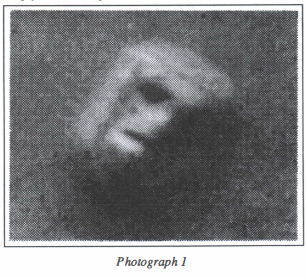
Among the 60,000 images returned by the 1976 Viking mission to Mars, several show what appears to be a gigantic, three-dimensional human face on the plains of the Cydonia Mensae region of Mars (see Photograph 1). The ‘face’ measures 2.5 x 2.0 kilometres, and about 400 metres high.
A minor literature has arisen, including reports of the application of sophisticated computer enhancement, which has confirmed the existence of the ‘face’, if not its nature. Investigators have also discovered a whole complex of objects which they believe are the ruins of an ancient ‘city.’ Furthermore, these ‘Monuments of Mars’ are said to resemble ancient ruins on Earth, such as the pyramids of Egypt and Central America, and mounds and rings such as Stonehenge. The geometry of the Martian ‘city’ has been ‘decoded’, revealing ‘correspondences’ with the geometry of ancient human monuments, the geological distribution of ‘upwellings’ of energy, and with the geometry of recent ‘crop circles’. The accumulation of such ‘meaningful correspondences’ is taken as evidence that the Monuments of Mars are the products of an alien intelligence, left as a message to us many thousands of years ago.
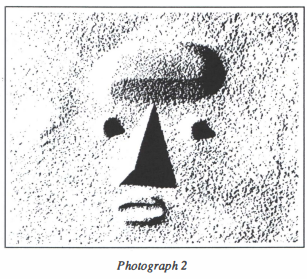
By chance, I happened across a photograph that strongly reminded me of the Martian face (Photograph 2). I applied the ‘look for correspondences’ method, and found quite a few parallels. This discovery may represent a major new development in the study of Martian monuments. Photograph 2 depicts a model for a grand landscape project designed by the famous sculptor Isamu Noguchi. The project is titled ‘Sculpture to be Seen from Mars’ or ‘Memorial to Man to be Visible from Mars.’ The sculpture was to be a huge earthwork, and the pyramidal nose was to be one mile long. The work was never constructed, the only record of it being the photograph of the model.
This grand vision was created in 1947 – before satellite images or missions to Mars were possible and thirty years before the Mariner mission discovered the ‘Face’ on Mars. Despite the separation in years and planets, these images are strikingly similar:
| Noguchi (1947) | NASA (1976) |
| Giant human face | Giant human face |
| Dramatic shadows | Dramatic shadows |
| On Earth to be seen from Mars | On Mars to be seen from Earth |
| Pyramid (forms the nose) | Pyramid(s) (nearby) conical mounds (the eyes) |
| Conical mound (nearby) purpose and meaning are obscure | Purpose and meaning are obscure (if deliberate) |
| Exists only in photograph | Exists only in photograph (so far) |
| Table 1. Significant (?) correspondences between the Noguchi face and the Mars ‘face’. | |
This many important correspondences simply cannot be coincidence! And the implications are positively staggering! Did Noguchi-sensei, through his sensitive artistic nature, somehow perceive echoes of the NASA discovery from the future? Or did visitors from space see this photograph in New York City in the 1940’s and like the idea so much that they went to Mars and executed the project? Did some unknown third force instruct and inspire both Noguchi and the Martians? Or is it the case that, at a particular stage in the evolution of consciousness, there is an inevitable drive to create interplanetary human portraiture? The mind simply reels at the possibilities.
Digging Deeper
The photograph of the Noguchi ‘Face’ can be seen in the Isamu Noguchi Garden Museum in New York City, which houses some of the fruit of Noguchi-san’s long artistic career. Born in 1904 in California, Noguchi lived and worked all over the world, including China, Japan, Paris, New York, and a war-time camp for Japanese-Americans. From the 1920s until his death in 1988, Noguchi created remarkable sculpture, drawings, theatrical sets, gardens and parks. His work often reflected the special influence of Japanese culture on a Nisei.
The ‘Face’ is one of many large scale works Noguchi dreamed of, including a massive, unrealized, ‘Monument to the Plough’ – a stepped pyramid on the prairie, one mile square at the base. The large earthwork ‘face’ also resembles a lifelong series of Noguchi ‘s designs for parks and playgrounds. These include the unrealized ‘Play Mountain’ and ‘Riverside Drive Park’ for New York City, and culminating in the renovation of Bayfront Park and its Challenger Shuttle Memorial in Miami, Florida. In the ‘Face’ one can detect the influence of Noh masks of traditional Japanese theatre, especially in the prominent forehead. The large scale and interplanetary nature of this work may reflect Noguchi’s own ‘one-world’ viewpoint and perhaps also the influence of his eccentric, and extremely broad viewed, friend, Buckminster Fuller.
The ‘Face on Mars’ was first seen in images returned by Viking missions to Mars in 1976 but did not attract much attention at that time. It was ‘re-discovered’ by Vince DiPietro and Gregory Molenaar in 1981, who recognized it as an intriguing find. Galvanized by the possibility that the ‘face’ is artificial, and faced with indifference and ‘skepticism’ by NASA, a group of enthusiasts formed the ‘Independent Mars Investigation’ to examine the issue and the data. These investigators have applied up-to-date computer image-processing techniques to clean up and enhance the image of the ‘face’ and to create three-dimensional reconstructions of it. This investigation has also located a complex of what they see to be unnatural objects very near the ‘face’, including ‘pyramids’, a ‘fortress’, and a conical mound.
Richard Hoagland and others strongly believe that the ‘face’ and other objects are the product of an alien intelligence. Not only is the ‘face’ a highly non-random object, but also the ‘pyramid’, ‘fortress’, and so on, do not seem like ‘accidental’ shapes. And all these ‘unlikely shapes’ are found ‘together’, and form, it is said, a definite geometric arrangement. All these ‘facts’ are taken as so unlikely by random chance alone as to require deliberate, intelligent design. This design is also said to have detailed connections to artifacts of ancient human civilizations (although these relationships require major revisions in conventional estimates of the age of human civilization), and is said to be a geometric ‘message’, which Hoagland and others are ‘decoding’.
Other skeptical views
NASA considers these images as ‘coincidence’ produced by the play of light and shadow on natural rock formations-aided, some might add, by a large dose of human imagination. Psychologists will point out that people have a tremendous tendency to see meaningful objects, especially human faces, even in random patterns. Skeptics have pointed out the hundreds of natural rock formations on Earth that are seen to resemble human faces, not to mention clouds, trees, shadows, and any number of other things that may look like a face. Skeptics have also found other objects in the Viking images: Mickey Mouse, Kermit the Frog, a Smiley Face, and a naked female torso. These ‘silly’ images indicate the important role that the ‘eye of the beholder’ may play in the ‘discovery’ of these objects. Indeed, I wonder if the face would be known at all, were it not for the coincidence that the ‘face’ is ‘right side up’ in the original image.
It is important to point out, though, that the computer analyses have shown that the ‘face’ is no optical illusion or artifact of the photographic process. The face was indeed discovered by the ‘eye of the beholder’, but it is really there. The techniques used by Hoagland and others are identical to those used by orthodox planetary scientists at NASA and elsewhere. They have clearly shown that there is good reason to believe that there is a large, solid, three-dimensional formation there, which looks something like a human face. The existing evidence is not sufficient, however, to say exactly what it is or how it was formed.
The ‘decoding’ of the ‘message’ of the ‘Monuments of Mars’ is supported with elaborate arguments, but they ultimately rest on the assumption that the objects on Mars are not natural rock formations. This is simply not known from the evidence available today. The ‘message’ is in fact a large collection of ‘correspondences’ and ‘relationships’, and inferences based on these links. This sort of argument is frequently seen in support of pseudo-scientific and mythological ideas. One must be cautious in accepting the validity of such arguments because people are very good at finding ‘similarities’, whether significant or not.
It is interesting to point out that the table of ‘correspondences’ above was the product of a few minutes of effortless brainstorming. The rest of the discussion, which develops the detailed facts behind the two photographs, was the product of many hours of careful work. Which of these efforts should count more? I am reminded of a quote from Marvin Minsky:
Everything is similar if you’ re willing to look that far out of focus. I’d watch that. Then you’ll find that black is white. Look for differences! You’re looking for similarities again. That way lies mind rot
Quoted in Stewart Brand, The Media Lab: Inventing the Future at MIT, Viking Penguin, New York, 1987.
Skeptics should be careful, then, to distinguish the fact that a large, face-like formation probably exists on Mars, from the fancies that have been constructed from that fact.
What Next?
The Independent Mars Investigation and others, argue – not unreasonably – that the only way to settle the question is to return to Mars. They have lobbied the U.S. Congress with the result that the Mars Orbiter mission hopes to photograph the region of the ‘face’ with high resolution cameras as part of the next U.S. mission to Mars. If successful, images with more than 25 times as much detail will be returned.
The Mars Observer spacecraft will arrive at Mars in November 1993, and begin returning data from Mars in January, 1994. This 687-day (one Martian year) mission will return a wonderful array of new information about Mars, including data on the chemical composition of the Martian soil, the existence of water near the surface and many new images of all parts of the planet. When the Mars Observer examines the Cydonia region, it may also confirm the most important discovery in human history.
I don’t know what relationship the Noguchi face might really have to the face on Mars, if any. But I suspect that Noguchi would have been watching carefully this fall for news from Mars. I will be.
Footnote
The Mars Observer spacecraft failed to contact Earth as scheduled in September and appears to be completely lost, its mission over before any data was collected. The loss of this spacecraft is a major disappointment, but there will be future missions to Mars. I hope readers will join me in supporting international efforts to move forward with the exploration of the solar system.
2026 Note: there were, as we know now, further missions, including HiRISE on the Mars Reconnaissance Orbiter, which revealed this image of the feature commonly known as “The Face on Mars”.
References
- Charlene M. Anderson, ‘Revisiting Mars: Landslide in Ophir Chasma’, The Planetary Report, Volume XI, Number 4, July/ August 1991, pp. 14-16.
- Charlene M. Anderson, ‘Mars Observer On Its Way’, The Planetary Report, Volume XII, Number 6, November/December 1992, pp.10-11.
- Dore Ashton, Noguchi East and West, Random House, New York, 1992.
- Stewart Brand, The Media Lab: Inventing the Future at MIT, Viking Penguin, New York, 1987.
- Mark J. Carlotto, The Martian Enigmas – A Closer Look, North Atlantic Books, Berkeley, CA, 1991.
- Vince DiPietro and Gregory Molenaar, Unusual Martian Surface Features, Mars Research, Glenn Dale, MD, 1982.
- Martin Gardner, ‘The Great Stone Face’ and other Nonmysteries’, Skeptical Inquirer, Fall 1985, pp. 14-18.
- Fred Golden, ‘Skeptical Eye’, Discover, April, 1985.
- Richard Hoagland, The Monuments of Mars: A City on the Edge of Forever, North Atlantic Books, Berkeley, CA, 1987. [Revised edition with important new material, 1992].
- 10. Jacqueline Mitton, ‘Rendezvous with the Red Planet,’ New Scientist, 3 April 1993, pp. 23-24.
- 11. Isamu Noguchi, A Sculptor’s World, Harper and Row, New York, 1968.
- 12. Isamu Noguchi, The lsamu Noguchi Garden Museum, Harry N Abrams, New York, 1987.
- 13. Randy Pozos, The Face on Mars: Evidence for a Lost Civilization?, Chicago Review Press, 1986.