
You’re at the grocery store, and you want some chocolate. You want to do the right thing and buy ethically made chocolate.
Walking down the aisle, you might find products with one or more of these labels:
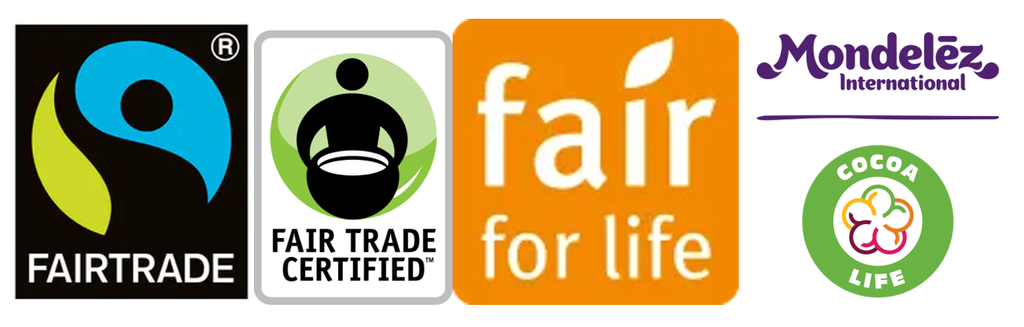
Would you be able to tell the difference? Is one more ethical than the others?
Most people are familiar with “greenwashing”, the practice of companies making questionable environmental claims to appear more eco-friendly than they are. But similar practices can occur when companies make claims about how workers are treated. This is sometimes referred to as “socialwashing”. Every day, brands make sweeping assertions about the people behind our products, declaring products as “ethically sourced” or “responsibly grown”. Consumers might believe these products to be entirely free of child labour, forced labour, and exploitation. Turn over your favorite coffee beans, tea box, or chocolate bar, and you’ll find a patchwork of these reassuring claims.
If a supplement company claimed its new pill cured hypertension without presenting peer-reviewed trials or raw data, we would soon expect a segment on the Skeptics with a K podcast breaking down the claim. Yet, consumers tend to accept these ”ethically sourced” or “fair trade” assertions at face value without understanding the complex systems operating behind these claims or seeing the data.
Setting the standard
Each of the labels above operates on an underlying standard or set of rules. The standard establishes differing thresholds for minimum pay, child labor prevention, and working hours. But should the farm be assessed under the local laws of the country where the cocoa is farmed? Held to UK/EU/US standards where the product might be sold? Or somewhere in between? If the requirements are too demanding, fewer suppliers may be able or willing to participate. If they are too permissive, these claims risk losing credibility.
In 2017, the UK retailer Sainsbury’s announced it would no longer use the internationally recognised Fairtrade standard for its tea. Instead, they would replace it with their own “fairly traded” company-run programme. Sainsbury’s chief executive, Mike Coupe, defended the decision at the company’s AGM, arguing that the retailer was “trying to bring clarity to a very complicated environment.” However, by 2022, the “Fairly Traded” label was gone, and Sainsbury’s announced a return to Fairtrade in 2025.
But who defines what ‘fair’ means? A company-run program is not necessarily ineffective or dishonest, but consumers should recognise that its incentives and accountability structure differ from those of an independently governed certification programme. Independent governance can make it harder for companies to define ethical requirements solely according to their own commercial interests. Whatever its original intentions, once Sainsbury’s tried to create its own definition of ‘fair’, consumers had fewer ways to compare those claims.
Fairtrade International is run by a multi-stakeholder non-profit where producers sit on their Supervisory Board. Fair Trade Certified is a label issued by Fair Trade USA, also a non-profit that split from Fair Trade International in 2011, but with no producer representation on the board. Fair for Life is a privately owned standard administered by French organic certifier Ecocert, with oversight from a multi-stakeholder advisory committee. Finally, CocoaLife is a corporate programme owned and governed by Mondelēz International, using internal targets verified by external auditors from FLOCERT (not to be confused with the aforementioned Ecocert).
How it gets done
As consumers, we cannot personally inspect the factories, farms, and warehouses behind the products we buy. We rely on companies and standard owners to give us reliable information. But how do they do this? One of the most common tools in the ethical sourcing space is the social compliance audit. These audits – sometimes called assessments, inspections, or verifications – use trained auditors to determine whether or not the auditee meets certain criteria. A social audit is essentially a visit designed to assess whether the workplace appears to follow a specified set of rules at the time of the audit.
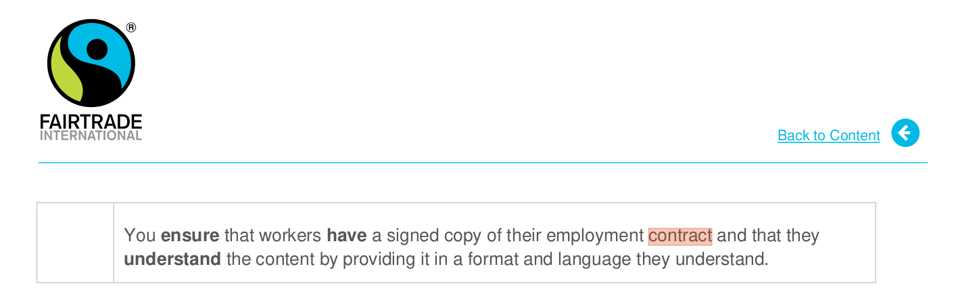
One specific rule that the auditor might check would be whether the employees all received a working contract in a language that they understand.
However, an auditor cannot realistically interview every worker or inspect every shift. They have to rely on samples. According to the Fair Trade USA Assurance Manual for their Factory Production Standard, if a facility has 150 workers, the auditor is expected to spend 2.5 days on-site and interview about 15 workers, or 10% of the workforce. A larger facility of, say, 740 workers would be a 4.5-day audit with around 18 workers, or 2.5% of the workforce, interviewed.
Sampling is not inherently a weakness. It is the only way to complete the assessment within the time provided. So, if a large number of workers do not understand their contracts (or have none at all), interviewing 15 randomly selected workers gives a decent chance of encountering at least one affected worker. If only a small number are affected by a critical issue, the probability drops when the sample size remains small.
For social compliance auditing, sampling is also impacted by the fact that the facility knows the audit is going to take place, as they are often the ones paying for it. Audits take place either during an announced period or during a semi-announced window (often a 3-6 week period). Advance notice creates an opportunity for conditions to be temporarily altered, making the auditor potentially see things differently from ordinary operating conditions. Auditors cannot extend the audit, as the client would need to agree to pay for the additional time, and in many cases, there is an audit at another facility beginning the following day.
Another challenge is how someone can validate whether a worker truly understands the content of their contract. If a worker is functionally illiterate, a signed contract only proves that they saw a document. It does not mean that they understand their legal rights when it comes to overtime, paid leave, or health and safety. This assumes that the auditor is able to assess this information in the short amount of time they are able to spend with the workers (an interview is expected to last 10-20 minutes). Auditors must also be able to communicate effectively with a migrant workforce that may speak several different languages.
The limitations of this claim verification model are not theoretical. When The New York Times investigated the surge of migrant child labour across US supply chains in late 2023, reporter Hannah Dreier found that nearly every facility had passed multiple third-party social compliance audits. The auditors checked the paperwork and sampled their requisite ~12 workers. Yet they entirely missed the children working the night shifts.
Regulators have attempted to address these shortcomings. In 2024, California passed AB 3234, which required companies that engage in social compliance audits to “post a clear and conspicuous link on its internet website to a report detailing the findings of the employer’s compliance with child labor laws.” The European Union’s Corporate Sustainability Due Diligence Directive (CSDDD), alongside domestic legislation like the German Supply Chain Act (Lieferkettensorgfaltspflichtengesetz) and the French Devoir de Vigilance, has also attempted to address these “ethical sourcing” claims. These laws, which contained civil liability mechanisms that allow victims of labour abuses to sue parent corporations in European courts, were fiercely contested and ultimately watered down by those companies.
The purpose of this article is not to imply that corporate sustainability initiatives are all meaningless. Skeptical consumers should look more closely at who controls them and who benefits from them. If companies get to decide for themselves what ‘fair’ means, ethical consumption can easily become another form of marketing. A ‘fair’ or ‘ethical’ label tells us much less if we do not also know who created the standard and whose interests it serves.