

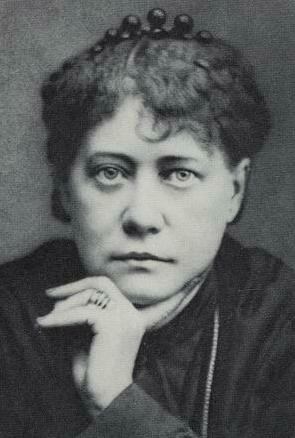
When it comes to the historical figures who laid the foundations for the pseudoscience we see today, few can lay claim to having lived as varied and fascinating a life as Helena Blavatsky. Admittedly that’s because, for large parts of her life, most of what we know comes from her own uncorroborated accounts written later in her life and, while Helena was many things, an accurate and honest autobiographer is not one of them. By the time she was telling her tales in 1873, she had spent 40 years creating contradictory stories and outright fabrications.
Helena Petrovna Hahn von Rottenstern was born on 12 August 1831 – though, given her birthplace of Yekaterinoslav in the Russian Empire (now Dnipro in Ukraine) hadn’t yet adopted the Gregorian calendar, she was officially born on 31 July 1831. It would not be the last inconsistency in her life story, but would at least be the most easily explained.
To hear Helena tell it, she was born in the middle of a cholera epidemic that almost took her mother’s life, yet miraculously both mother and child survived. She was born into nobility – her mother the daughter of a Russian princess and her father descended from German aristocrats. Her great-great grandfather was a French nobleman who served in the court of Catherine the Great… if the stories are to be believed.
Throughout her childhood she moved around a lot – to Odessa, Astrakhan, Saratov, and Poltava. As a child she was described (almost certainly euphemistically) as “wayward” and “a beguiling story-teller”, who “loved to play pranks on people”. While in Saratov she claims (beguilingly) to have found the personal library of her maternal great-grandfather, a Russian prince and 18th century Freemason, containing his books on esotericism. She also, waywardly, claimed to have visions of “a Mysterious Indian man” – a man she would go on to meet in the flesh (although, of course, there is nothing to corroborate the story).
At the age of 13, after the death of her mother, her father took her to England where she learned piano from various famous virtuosos (except there is no record of this happening, even in the memoirs kept by her sister). The visions of her mysterious Indian man continued, and soon she was able to astral project.
At 17, she married Nikifor Blavatsky, who was in his 40s, though her enthusiasm for the union was lacking; after unsuccessfully trying to cancel the wedding, she absconded – to hear her tell the story as an older woman, she slipped away from her escorts before bribing the captain of a ship to take her to Constantinople, where she spent the next decade travelling the world, alone, with nobody who could verify her travels and keeping zero written account of any of it. Even historians of esotericism admit everything we know about this pivotal time in her life is based on “her own largely uncorroborated accounts”, which are marred by being “occasionally conflicting in their chronology”.
Dubious adventures
For the next quarter of a century, there is no reliable account of her life – only her word. According to Blavatsky, she saved a Hungarian opera singer from being murdered, toured Egypt with a Countess, met a mesmerist in Paris, survived a shipwreck near the Cape of Good Hope, joined England’s Royal Philharmonic Society as a concert musician, got injured fighting at the Battle of Mentana, and agreed to be a guide for a Tartar Shaman in Kashmir looking to make it to Siberia (they pair never got there, as they got lost along the way). Oh, and then she (medical records MIA).
As her adventures and accomplishments grew, so too did her paranormal abilities. Along with her recurrent visions, she claimed her furniture would move around of its own volition, and that she would be followed by mysterious creaking sounds as if pursued by a spirit.
It was during her time in England that she bumped into Master Morya, who she said was the mysterious Indian man from her visions. Fittingly, the details of their meeting shifted depending on who Blavatsky was talking to – sometimes in London, other times in Ramsgate, with the dates and details changing on each telling. What remained consistent (though almost certainly untrue), is that Morya sent her on a spiritual mission to Tibet, on a trip that saw her travel through Canada, the USA, Mexico, and India, before arriving at the border of Tibet… only to be initially turned away by the British. Some time later, following her recovery from the coma she fell into after injuring her spine in a horse-riding accident… Master Morya sent her back to Tibet and, on the second attempt, she was allowed entry.
Perfecting the paranormal
Her goal in Tibet was to meet with Master Koot Hoomi (sometimes written as Kot Humi) – a Kashmiri of Punjabi origin, who trained her further in the paranormal. She learned to harness psychic powers, including “clairvoyance, clairaudience, telepathy, and the ability to control another’s consciousness, to dematerialize and rematerialize physical objects, and to project their astral bodies”. He even taught her an ancient, unknown language, called Senzar. She was soon fully trained in the paranormal arts, though she believed that psychic powers were not actually evidence of communication with spirits of the dead, but actually “mischievous elementals” or the “shells” left behind by the deceased.
Determined to prove to the world that Spiritualism was objectively real, and definitely not the work of frauds and fantasists, she sailed for Cairo. Characteristically, her ship exploded mid-journey, and she was one of only 16 survivors. Nevertheless, she made it to Egypt and founded her own spiritualist society to set about proving the paranormal was real. The group lasted just two weeks – she shut it down when, according to her, she realised that the other mediums in the society were frauds. A less charitable interpretation, with a skeptical eye, might suggest she realised they were not quite as good at faking psychic talents as she was, and she wasn’t keen to tie herself to the mast of that particular sinking ship.
Founding Theosophy
Soon, her Master Morya came to her in a vision and told her to go to New York, where she read in the newspapers about a pair of brothers in Vermont who could levitate and manifest spiritual phenomena. The reporter assigned to the story was Henry Steel Olcott, who was convinced the brothers were genuinely psychic. Blavatsky, however, was unimpressed, telling him that at least some of the demonstrations were faked. However, she did take the opportunity to show Olcott her own ability to manifest spiritual phenomena, and he was so impressed that he immediately became her disciple and acolyte.
Allegedly inspired by visions given to Blavatsky by her Masters Morya and Koot Humi, she and Olcott founded their own spiritualist group “The Miracle Club”, later renamed to “The Theosophical Society”, picking up an existing esoteric term from the Greek for “god” and “wisdom”. It was largely funded by Olcott’s ongoing work as a lawyer – despite Blavatsky having by this time inherited a considerable sum of money from her father’s estate.
Blavatsky used the newfound emotional and financial support of Olcott to pen a book outlining her philosophy, Isis Unveiled, which she claims was written via channelling a second consciousness within her. Far from an original piece of writing, critics pointed out that the text consisted of extensive quotes from 100 other esoteric or religious texts. However, Blavatsky was not guilty of plagiarism, Olcott assured people, because she didn’t physically have access to those 100 books while she was writing. The book was an instant hit, selling 1,000 copies in its first week, and attracting fans including Thomas Edison.
Flushed by their success in the US, Blavatsky and Olcott headed to India, where they impressed the locals with their willingness to put Indian religions at the heart of the new religious movement they were defining. Blavatsky continued to grow her influence and her following with demonstrations of her psychic powers – she would make contact with spirits for impressed audiences, and on one occasion materialised a cup and saucer during a picnic.
Such manifestations were enough to convince keen spiritualists like Alfred Percy Sinnett and A. O. Hume that she was the real deal. Sinnett persuaded Blavatsky to contact her gurus, Mahatmas Koot Hoomi and Morya, and she allow them to channel through her, so that their words could be committed to paper for their devoted followers. Through her writing trance, Blavatsky produced 1,400 pages of her guru’s thoughts on life, the universe, and the nature of religion, for Sinnett and Hume to inspect. The text became known as the Mahatma Letters, which Sinnett would go on to summarise in his book, Esoteric Buddhism – both foundational texts in the theosophic movement.
The story unravels
Unsurprisingly, the more Blavatsky talked about her gurus, the more clear it became to some that her story did not make sense. Blavatsky claimed to be the only person who ever met Mahatma Koot Hoomi, describing him as being a Punjabi Indian who had studied in Germany. However, Koot Hoomi could not speak German, nor Hindi nor even Punjabi. In the writing she attributes to him, he speaks French and English (two languages she spoke too), and ‘he’ wrote both languages with all the characteristic styling typical of a Russian writing in their second or third languages.
Critics have also pointed out that the name ‘Koot Hoomi’, or ‘Kott Humi’, is a portmanteau of two prominent men Blavatsky’s life at the time of her first telling these stories – Olcott and Hume. Most scholars agree that Koot Hoomi was almost certainly a deliberate hoax by Blavatsky, possibly with the aid of Olcott. Nevertheless, theosophy took off across India, with branches of the Theosophical Society springing up all across the country.
In 1882, Blavatsky and Olcott set sail for England in order to establish their new religious movement through London society, though Blavatsky found progress frustrating – groups had initially been formed successfully, but she soon found herself out of favour with her new followers, who described her as “an unbearable snobbish woman”, leading to a schism in her movement that went on to form the Hermetic Society.
Meanwhile, in her absence, the headquarters back in India was rocked by accusations of misappropriated funds by those left in charge. In the resulting wrangle, her former deputies attempted to blackmail the Society with letters they claimed proved Blavatsky’s paranormal demonstrations had been knowingly fraudulent all along. The letters would be published in The Times, in London, but did little to diminish the popularity and influence of Blavatsky and her movement in India, which by this point housed 106 of the 121 international Theosophical Society lodges.
In 1885, in ailing health and with question marks over her reputation, Blavatsky resigned from the Society and headed for retirement in Europe. Soon after, the Society for Psychical Research published the Hodgson Report into the Theosophical Society, the Mahatma Letters, and Blavatsky’s paranormal claims. It concluded that Blavatsky was in fact a hoax, describing her as:
“one of the most accomplished, ingenious, and interesting impostors in history.”
The report explained that an examination of the physical spaces where her paranormal demonstrations took place revealed concealed features that allowed her to hide and then produce her decidedly un-paranormal objects.
While the Hodgson Report discredited Blavatsky and her society in the eyes of the public, many of her followers stuck by her and supported her through her final years. She moved back to London, staying with various theosophists, as she tried to rescue the London Lodge from what she then saw as Sinnett’s mismanagement. While there, she was visited by occultist and poet W. B. Yeats, and by an Indian lawyer named Mohandas Gandhi – who would go on to earn the honorific she had co-opted for her fictional guides, Mahatma.
In those final years in London, she finished writing her final book on theosophy, The Secret Doctrine, which rewrote the tenets of her new religious movement, sweeping the previously crucial paranormal elements under the carpet to focus on broader philosophical themes – a post-exposure pivot, you might call it.
According to Blavatksy, the book is a commentary on the Book of Dzyan, a religious text written in Senzar, that ancient language she was taught by Koot Hoomi those many years ago. It explains how the universe, the planets, and the human species came to exist. Every expert scholar who has examined it has concluded that there was no such text as the Book of Dzyan, and that Blavatsky made it all up.
In 1891, Blavatsky contracted the influenza strain that was raging across Europe and died on 8 May – leaving behind a worldwide movement of more than 100,000 followers, and an awful lot of tall tales.