




Malcolm Nicolson got the story by accident. He was a crime reporter on The Bulletin, a Glasgow morning paper, and his evening habit was to ring round the police stations. On 23 September 1954, Lawmoor Street told him there was nothing doing; then he heard laughter in the background and a voice saying somebody should tell him about the vampire.
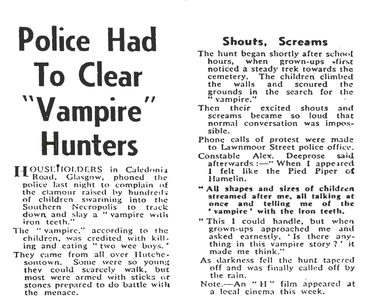
He went down to the station, talked to the constable who had dealt with it, and filed in time for the later editions. Sandy Hobbs and David Cornwell, who interviewed both men in 1985, reproduce his cutting. Householders in Caledonia Road had phoned to complain about the din from the Southern Necropolis.
Constable Alex Deeprose went in and found it full of children from Hutchesontown, some so young they could scarcely walk, most carrying sticks or stones. He “felt like the Pied Piper of Hamelin”: they streamed after him, all talking at once, telling him about the vampire with the iron teeth. Rain finished the hunt. It ran again the next night, and by the Monday The Bulletin was reporting that the vampire didn’t scare anyone anymore.
Nicolson’s copy was flat and descriptive. No injuries, no arrests, no damage. It ended with a one-line note that an “H” film had been showing locally that week; thirty years later he could not remember which film he meant. That note is the only explanation in the first report. Every other explanation was supplied by people who never went near the cemetery.
The inference
Written out plainly, the explanation that won goes as follows: something frightening happened; horror comics exist and are frightening; therefore horror comics caused it. Hobbs and Cornwell, following the coverage day by day, found that the link was never argued so much as arranged. In their words, “all that happened was that more and more people were presenting statements about the comics and statements about the hunt side by side”. The Daily Record ran the vampire as a hook for pieces about comics; a councillor waved a comic at the press that turned out to have nothing relevant in it; and by the second week the connection was being reported as something the week’s events had established.
Two things were missing from the inference. One was the base rate. Children in that square mile had been doing this for a generation. Hobbs and Cornwell’s informants remembered hundreds of Hutchesontown children turning out in the mid-1930s, and thousands in about 1938, to wait for Springheeled Jack near Dixon’s Blazes ironworks, where escaping gas seems to have given them something to see. Their table of children’s “hunts” runs from a banshee in Govan in the early 1930s to a ghost at Dean Castle, Kilmarnock, in the 1980s, several of them running over more than one night. An event that recurs every decade or so without the influence of comics is weak evidence that comics are to blame.
The other missing thing was the obvious one: nobody asked the children. Not the reporters, not the councillors, not the MPs who retold the story five months later when the Commons gave the Harmful Publications Bill its second reading. One of them, E. L. Mallalieu, stated the standard of proof with unusual candour. Colleagues had disclaimed any ability to tie comics to delinquency, and he agreed with them: “How can we possibly connect the two things together with any certainty? But can anyone claim any good for the horror comics?” So, he went on, “Some of us may have a suspicion – and in the absence of any good that is enough”. The evidence for the cause was the absence of a defence for the suspect.
The usual suspect
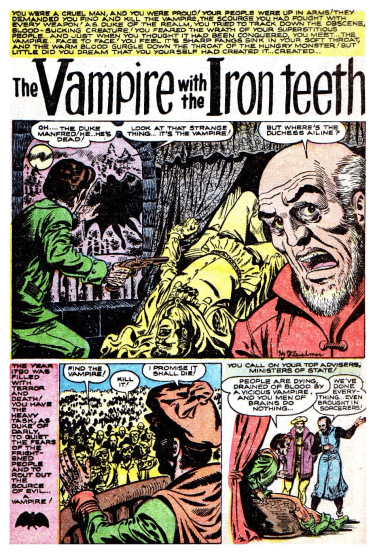
Ask today what the children had been reading and you will be handed a title: “The Vampire with the Iron Teeth”, a story in the American comic Dark Mysteries no. 15, dated December 1953. The Case Hunter’s account of the hunt shows the cover. The comic exists and it has iron teeth in it, and that is the entire case. Nobody produced it in 1954, when campaigners were bringing comics to the newspapers. Nobody has since shown that a copy reached the Gorbals, or that any child who went over the cemetery wall had seen one. Hobbs and Cornwell, after a year of appeals in the Glasgow press and on radio, cinema listings and interviews, reported that no comic and no film featuring a frightening figure with iron teeth had come to light.
The title was found later, by people searching the American output of 1953 for the phrase, and it matched because the search was for a match. That is not tracing a cause; it is a conclusion going back to fetch its premise. With thousands of horror pages in print by 1953 a match was always likely, and finding one says nothing about what a Glasgow ten-year-old had in his pocket.
What was actually in their heads
Hobbs and Cornwell’s paper is worth reading as a method, not only for its answer. They went looking for the sources of the imagery rather than the sources of the alarm. Iron teeth are scriptural. Daniel 7:7 describes a beast “terrible and dreadful and exceedingly strong; and it had great iron teeth”, and the folklorists open their paper with the verse; it was within reach of any child who sat through Bible lessons.
Iron teeth were also local. Alexander Anderson’s Scots poem “Jenny wi’ the Airn Teeth” (1879) is a mother’s bedtime threat, a bogey who carries wakeful bairns off to her den, and it was printed in anthologies issued for use in schools. Listeners to Hobbs’s radio appeal knew it; one correspondent’s father, born in 1878, had been threatened with Jenny as a boy. A Glasgow writer in 1902 traced an earlier “Jenny with the iron teeth” to a spinster near Glasgow Green, a few hundred yards from the Necropolis, whose dentist had left the metal fixings on her front teeth visible. Next to the cemetery stood Dixon’s Blazes, whose furnaces lit the Gorbals sky and served parents as the “bad fire” that misbehaving children were bound for. The Necropolis had its own bogey, “the Fiddler”, who kept children out after dark. The children had a full cast before anyone imported a comic.
The folklorists do not claim the comics played no part; that, they say, would be a very hard case to make. Their point is narrower: “What is unreasonable is to assume without evidence that one particular source had exerted the influence in this case.” The campaigners of 1954 started with a cause and looked for an illustration. Hobbs and Cornwell started with the event and looked for anything that could have fed it, from a Bowery Boys monster comedy showing locally to a “thing” in the sky over Glasgow the night before (an advertising plane, it turned out). They ended with several plausible inputs and no single culprit, which is what an honest answer about crowd behaviour usually looks like.
The shape of it
Strip out the period detail and the structure is familiar. A real fear for society: children in a cemetery with sticks. A cause already to hand, with a campaign attached: the movement against American comics was organised and in print before the hunt gave it a picture. And an authority that gains from naming the cause, because the naming turns a puzzling event into a mandate.
The template was imported. Fredric Wertham’s Seduction of the Innocent came out in the United States that spring; the Daily Record had borrowed its title for a headline within five days of the hunt, and in the Commons Eirene White cited the book’s forthcoming British edition for its figures. Wertham’s clinical evidence was taken on trust for half a century. When his papers were opened in 2010, Carol Tilley went through them and documented how he had “manipulated, overstated, compromised, and fabricated evidence – especially that evidence he attributed to personal clinical research with young people – for rhetorical gain”. The authority the British campaign leaned on was itself doing the thing the campaign was doing.
The nearest anyone in that debate came to asking children was Somerville Hastings, who chaired the management committee of a boys’ remand home. His boys told him they preferred American horror comics, and he added that he “would not put too much store on this because boys in remand homes are apt to say whatever they think will please, and because they are not a fair cross-section of the child population”. It is the most skeptical sentence spoken that day. He backed the Bill anyway.
The Act passed and is still in force. The argument about what children look at has since moved to screens, and the same three-part machine is running on new parts. Whether it has the cause right this time is an empirical question. The Gorbals shows what it costs to skip it.
References
- Sandy Hobbs and David Cornwell, “Hunting the Monster with Iron Teeth”, in Gillian Bennett and Paul Smith (eds), Perspectives on Contemporary Legend III (Sheffield: Sheffield Academic Press, 1988), pp. 115–137.
- HC Deb 22 February 1955, vol. 537, cols 1072–1186 (Mallalieu cols 1153–1154; White cols 1158–1159; Hastings cols 1161–1162).
- Carol L. Tilley, “Seducing the Innocent: Fredric Wertham and the Falsifications That Helped Condemn Comics”, Information & Culture 47.4 (2012), pp. 383–413.
- Martin Barker, A Haunt of Fears: The Strange History of the British Horror Comics Campaign (London: Pluto Press, 1984).
- Alexander Anderson, Ballads and Sonnets (1879), for “Jenny wi’ the Airn Teeth”; Hugh Macintosh (1902) on the Glasgow Green “Jenny”, both as cited by Hobbs and Cornwell.