




You’re floating above your own body, looking down at yourself on the table below. You can see the surgeons working, hear their conversations. You feel calm. Detached, observant, weightless. You drift toward a bright light, and familiar faces appear to greet you.
It’s a classic out-of-body experience. Some argue that such episodes are evidence of consciousness existing beyond the brain. Others say there’s a less unearthly explanation and, however vivid the experience, it never took you anywhere.
We can consider perhaps two different models for what ‘consciousness’ is. In the first model, consciousness is an emergent property of the brain. Once a brain becomes sufficiently intricate, reaching some critical level of complexity, then consciousness emerges. This notion of an emergent property can itself be challenging to grasp, so we can consider a more relatable example. An individual molecule of water can’t really be said to be ‘wet’ in any way which makes sense for the common interpretation of the word. However, when you gather enough water molecules together, this property of ‘wetness’ emerges. In this same sense, consciousness is not a property which exists in any individual neuron but manifests only once there are enough of them arranged together.
The alternative view is that consciousness exists independent of the brain. The body is just a meat puppet and consciousness is the little homunculus driving it. Or if you take a more Pantheist view of things, perhaps consciousness is a property of the universe itself. Like electro-magnetism or the Higgs field, consciousness permeates the universe, and influences the material universe by interacting with a brain. This view holds that consciousness is not a property of the brain, but exists independently and comes from the universe itself.
One line of evidence which points at this second interpretation is the out-of-body experience. If consciousness is part of our brain, it follows that it should be no more able to leave our brain than wetness can leave the water. If people truly are having out-of-body experiences, where their conscious self leaves their body, that means consciousness cannot be a property of the brain.
One of the more famous reports of an out-of-body experience, which seems to confirm this idea that consciousness is independent of the brain, is the case of Pam Reynolds. In 1991, Reynolds was undergoing brain surgery to remove a complicated aneurysm near her brain stem. The location of the aneurysm meant that the usual techniques to deal with this wouldn’t work, and so she had to undergo a radical seven-hour surgical procedure. Doctors cooled her body to 15°C and halted her blood circulation – a technique called deep hypothermic circulatory arrest. This deflated the aneurysm so it would become operable.
This remarkable procedure was a success, but for significant parts of it Reynolds was clinically dead. There was no blood flowing, her heart had stopped, and there was no measurable brain activity. However, after she recovered she reported having a vivid out-of-body experience. She claimed she left her body, watched the operation taking place, and overheard conversations among the surgical staff. She was able to describe some of the surgical tools used during the procedure, including a device she described as looking like an electric toothbrush but with interchangeable blades. Reynolds also commented that she heard a female voice talking about how her arteries were very small.
What’s fascinating about Reynolds’ account is that she is mostly correct. The description she gives of the ‘toothbrush’ device does resemble the pneumatic surgical saw that was used during the procedure to open her skull. Not only that, but the female cardiac surgeon did make a comment during the procedure that the blood vessels on Reynold’s left side were too small, before she switched to the right.
Throughout the operation, Reynolds had been anaesthetised. Her eyes were taped shut and she had special headphones, moulded to the shape of her ears, which played clicking noises so they could measure her brain activity. She should not, on the face of it, be able to describe what the saw looked like, or recall conversations that happened when she was under. That she was able to is why this case became so famous in discussions about out-of-body experiences.
The incurious response to these sorts of reports is to simply dismiss them as lies or embellishment, but I think we can do better than that. If consciousness is indeed a property of the brain, and does not exist independently – we have to ask what is actually happening to people when they report out-of-body experiences? And how do we know?
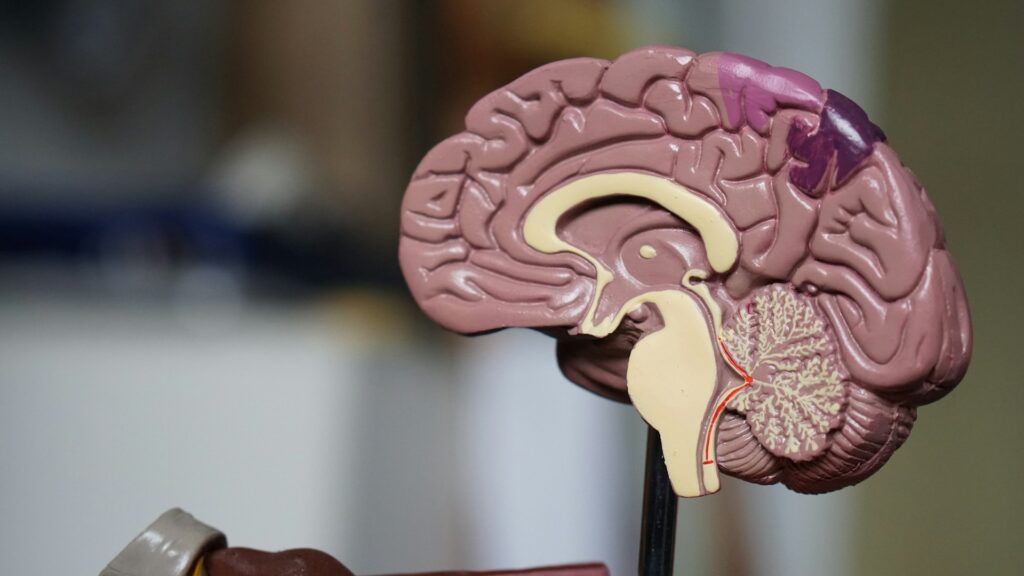
A landmark breakthrough in the understanding of out-of-body experiences came in 2002, when a neuroscientist named Olaf Blanke published a report in Nature where he claimed to be able to reliably cause out-of-body experiences. Blanke was preparing a 43-year-old woman with epilepsy for surgery when his team discovered that stimulating a particular area of her brain reliably prompted an out-of-body experience. His patient reported that it made her feel like she was floating above herself, and could see herself lying on the bed below. This square-centimetre-sized piece of tissue, located at the junction between the temporal lobe and the parietal lobe, could turn the experience on and off like a light switch. It was jokingly suggested that Blanke had found the ‘eject button for the soul’.
The location of this piece of cerebral tissue is interesting. Blanke has since suggested that to cause an out-of-body experience, you have to disrupt two systems. The first is the system that anchors your sense of self inside your body – telling you that you are here, rather than somewhere else. The second is the system that distinguishes your personal self from the world around you. This system is also disrupted by LSD, producing this sensation of being ‘one with everything’, because it affects the part of your brain responsible for the distinction.
The location of the temporo-parietal junction, Blanke’s eject button, is a convergence zone of these two systems. Stimulating that one area can disrupt both. Combined with a little imagination, this can explain all of the sensations reported during out-of-body experiences.
Some people might get tripped up on my use of the word imagination here, and argue that I’m being dismissive in suggesting that people who report out-of-body experiences are simply imagining it, but that’s not what I mean at all. The world we perceive is very much not the world that is. It is a construct, a best-guess emulation of the world, created for us by our brains. Our brains take in all of the information about what is going on around us – sight, sound, temperature, proprioception, and more – to create a coherent experience of the world.
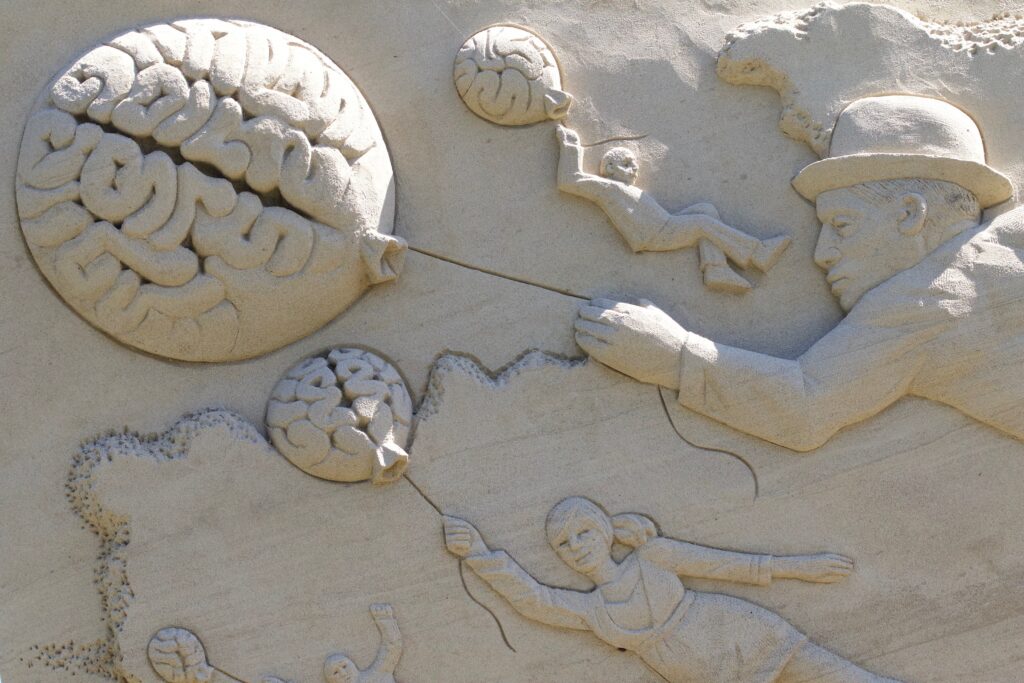
When these systems are disrupted and the information feeding this emulation becomes unreliable, our brains nevertheless try to make sense of it. The sensation of observing yourself from outside your own body is the best guess they can come up with.
The question might be reasonably asked, however – how do we know? This may be a plausible explanation for what is happening, with emulations and temporo-parietal junctions and proprioception… but how do we know people are not simply leaving their bodies, as they perceive themselves to be?
To investigate this question, fifteen hospitals across the UK, the US and Europe took part in the AWARE study (AWAreness during REsuscitation). Shelves were installed in high places throughout the hospitals, with pictures placed on them such that they were only visible if you were above them.
Across 2,060 cardiac arrest events that happened in those hospitals over the following months, the researchers interviewed the patients to see if they’d had an out-of-body experience and if they could describe the pictures on the shelves. While a small percentage of patients did have out-of-body experiences during their cardiac arrests, the researchers reported that none of them could accurately describe the pictures.
AWARE II followed up on this a few years later, with more hospitals and more patients involved. They found exactly the same thing: none of the patients who reported an out-of-body experience were able to describe the pictures left on the shelves.
If people were literally floating above their bodies, this was precisely the kind of information they should have been able to report. The absence of a single correct hit across thousands of cardiac arrests is good evidence against the literal interpretation of out-of-body experiences.
But what about Pam Reynolds? She was able to describe things that happened during her aneurysm surgery, apparently while she was ‘dead’. Except, when we really interrogate that situation – we discover that’s not what happened at all.
For example, the conversation about her blood vessels being too small happened while the cardiac surgeon was trying to cannulate her in preparation for the circulatory arrest. It can’t, therefore, have happened during the time she was clinically dead, because it was part of the prep work that preceded that. The bone saw she described was also used early in the procedure, before the circulatory arrest. The surgeons did as much work as they possibly could before putting her into arrest, as they had only a very limited amount of time with her in that state before they would be unable to revive her. This included the portion of the procedure when the saw was used.
The very simple explanation for what Reynolds reported is: she could hear. This is an effect called anaesthesia awareness, where the brain still is able to process some external information, typically sound, even during anaesthesia. It is reported to happen in around 1 in 2,000 cases.
While Reynolds was wearing headphones during the procedure, making a clicking noise to facilitate monitoring of her brain activity, the rate of clicks was around 10 per second. This leaves ample room for other sounds to leak in during those gaps, when she would be able to hear the conversation about her blood vessels and the sound of the bone saw. Those pneumatic saws make a sound much like a dental drill, or an electric toothbrush.
Her brain will have woven all of this information together into a coherent narrative, where she now remembers floating above herself, witnessing the conversations she only heard, and ‘seeing’ objects she could only hear. You may have experienced something similar yourself, if you’ve ever fallen asleep with the TV on or listening to a podcast. Your brain will sometimes try to integrate what you’re hearing into your dreams.
The anaesthetist Dr Gerald Woerlee, in his paper on the subject, also pointed out that Reynolds’ astral form would not have been able to hear. Sound is a vibration in the air, a longitudinal wave of compressions and rarefactions which rattle the tympanic membranes in the ears, transmitted to the cochlea and translated into nerve impulses which are interpreted as sound. How could Reynolds’ consciousness, external to her body, have heard anything at all? It doesn’t have eardrums or a cochlea. How are the sound vibrations perturbing her astral form, when that same form can float through a wall?
How can her astral form see when it has no retinas? Her astral self is invisible; how is it absorbing reflected photons to be able to see? How is it possible for a disembodied consciousness to see or hear anything at all? Proponents of the independent consciousness seem to be smuggling in assumptions from ghost stories, folklore and popular culture – where disembodied souls can conveniently see and hear. But these are mechanical processes that are well understood.
Out-of-body experiences are real experiences that people have. They’re not lying, they’re not making it up. But the explanation for these experiences does not require a consciousness that exists independent of the brain.
We know that stimulating specific areas of the brain can reliably produce such experiences. We know that disrupting the systems responsible for integrating our sense of body location and our distinction between self and environment with drugs gives this sensation of being outside of yourself, or of being at one with your environment. And we know that when we actually test whether people having these experiences can obtain information that would be visible only from outside their bodies, they can’t do it.
The neuroscientific explanation for out-of-body experiences is not only sufficient to explain what people report, it’s actually way more interesting than hand-waving about how consciousness is a field which permeates the universe. The real explanation informs our understanding of how our brains construct our experience. The real explanation shows us that what we perceive as the world around us is actually a sophisticated emulation, constantly updated with new sensory information.
When that system breaks down, when the inputs become unreliable or contradictory, our brains still try to make sense of it all. Sometimes that means constructing an experience of observing ourselves from the outside. And understanding that is far richer than any supernatural explanation could ever be.