




This is the second article I’ve written for The Skeptic which opens by celebrating the anniversary of a Japanese-originated legacy home entertainment format. While 2025 was the 40th anniversary of the Nintendo Entertainment system, 2026 marks the 50th anniversary of VHS, which dominated the home video market throughout the 1980s and 1990s.
VHS was a cassette-based video recording format created by JVC. It initially launched in Japan in 1976, before coming to the United States in 1977, and the UK in 1978. By the end of the 1980s, VHS emerged victorious from the home video format wars, which saw manufacturers compete for control of the home video market. While several formats battled for the crown, the only two which really mattered were VHS from JVC and Sony’s Betamax.
These days, Betamax is remembered by a lay audience as an also-ran; the butt of sitcom jokes. For a particular slice of the population, however, its reputation is quite different. For some, Betamax is lamented as a technically superior product whose failure demonstrates the power of marketing over quality. While there is some truth to that perspective, it has been heavily oversold.
To explore why, we’re first going to step back to the late 1960s, when Sony collaborated with JVC and Matsushita to create a new home video standard for the Japanese market. The result of those efforts was a format named U-Matic, a cassette-based video tape recorder initially conceived as a consumer product to allow people to record broadcast television at home and watch it at a later date.
The name U-Matic supposedly came from the way the tape would unspool from the cassette and thread into the machine during use, making a U-shape around the video head drum. It failed as a consumer format, probably because the machines were very expensive, but did see some adoption within the professional market where it became a favoured format of small broadcasters, like local TV news stations. Sony quickly pivoted U-Matic toward that audience so these days it is largely remembered as a professional or semi-pro format.
This still left the consumer market open, so a few years later Sony tried again with a new format they named Betamax. The format was heavily inspired by U-Matic but used a smaller cassette which Sony felt would be more convenient for consumers. The size of the tapes was supposedly inspired by the Sony employee handbook, which was used as a reference for what was a convenient size to hold in your hand.
Like U-Matic before it, the name Betamax came in part from the path the tape took as it travelled through the machine when threaded – which resembled the Greek letter Beta. The suffix ‘-max’ was used to invoke ‘maximum’, hinting at the greatness of the format. Looksmaxxers everywhere rejoice.
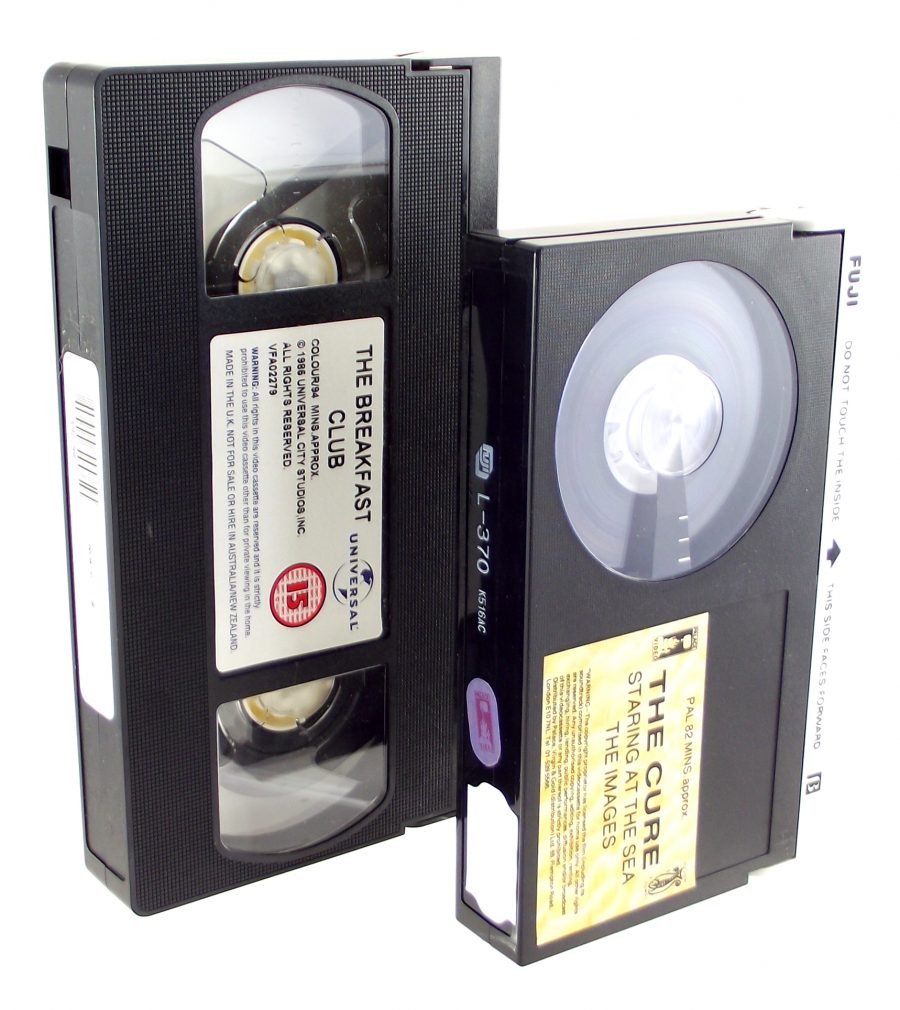
Betamax was introduced in 1975, but faced competition almost immediately from VHS, which had been in development at JVC. VHS was not the only rival to Betamax, of course. Another notable competitor was Video 2000, developed by Philips and largely inspired by their compact cassette format. As such, Video 2000 tapes look like a chunky audio tape, and you could even flip them over and record on the other side, which wasn’t possible with VHS or Betamax.
Much like U-Matic before it, Betamax evolved into a professional format after its failure in the consumer market. This format, named Betacam, used the same tapes as Betamax but was otherwise completely incompatible. Betacam and its successor Digital Betacam were widely used in the television industry well into the 2000s.
Even today, the consumer version of Betamax has its fans, especially within the videophile community, who regard it as a superior product that unfairly lost out. In this context, the term ‘Betamaxed’ is sometimes used to refer to a product which failed despite being better than its competitors. But is that narrative true?
A common narrative which circulates claims that VHS only won because of pornography. As the story goes, Sony refused to allow porn on the Betamax format, whereas JVC had no such qualms. Consequently, more consumers bought VHS machines – the unspoken implication being that the Dads making the purchasing decisions were swayed toward VHS machines because they could also use them to watch porn.
This story was repeated in 2006, when Ron Wagner of E! Entertainment told Macworld magazine that it was the porn industry’s support of VHS that caused Betamax to die. He went on to say that E! was backing Blu-ray over the alternative HD-DVD for the same reason.
Another article, published by Thrillist in 2014, claimed that Sony refused to allow adult films on the Betamax format, and that by the end of the 1970s, erotic films accounted for over half of all videotape sales in the United States.
However, despite the prevalence of this myth and its common repetition in dreadful listicles, it is nonsense. We know this for a few reasons, but the most obvious being: there was Betamax porn. Sony created the recording format and media, but they were not content publishers. They did not control what material was published on their format, any more than Philips could stop saucy audiobooks being published on cassette, or Kodak could stop people from shooting porn on film.
In a modern context, where so much of our media sits in a walled garden, this might seem unusual. You can’t get an app on the App Store without Apple’s approval. You can’t publish your movie onto Netflix without their approval. But these sorts of restrictions are relatively new, and Sony did not and could not control whether porn was published on Betamax.
I suspect the origin of this myth to be a misunderstanding of Sony’s tape duplication policies. When studios look to distribute a movie for home video, they wouldn’t typically run off the tapes themselves. Instead, they would take a master tape to a duplication house, where it was copied onto hundreds or thousands of machines at once. While Sony was on the record as saying they would not permit adult films to be made on their equipment, this likely refers to their tape duplication service. They have the same policy today – Sony’s Blu-ray plants won’t duplicate porn either. But this isn’t much of an obstacle, since there are and were independent duplication houses who will happily duplicate porn onto Sony formats.
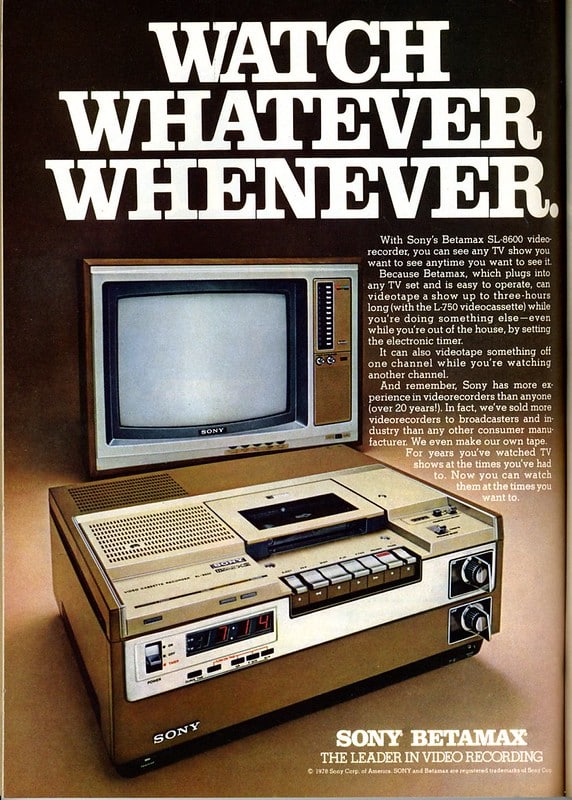
It’s also worth pointing out that when video tape recorders were first introduced in the mid-1970s, the intention was for them to be used for recording from the TV. They were marketed for use as ‘timeshifting’ devices, allowing viewers to catch programmes they otherwise would have missed. The home video market, where publishers sell commercial copies of popular film and television titles, came later, and didn’t really become significant until the early-to-mid 1980s. Early consumers were buying machines for recording, not buying pre-recorded tapes, porn or otherwise. This fact alone undermines the ‘VHS won because of porn’ story.
Another common claim is that Betamax had better picture quality than VHS. To understand the comparison, it helps to think about how standard definition television worked. These days we measure video resolution in pixels. HD video is 1920 × 1080, for example, and 4K UHD is 3840 × 2160. But old standard definition televisions don’t map neatly to pixels. Until the introduction of flat-panel displays, televisions worked by using strong magnets to sweep a beam of electrons across phosphor-coated glass, building up the picture line-by-line in a process called raster-scanning. In the UK standard, there were 625 lines in the raster, 576 of which were used for the picture. So the vertical resolution can reasonably be thought of as 576 pixels high.
However, the horizontal resolution is a more nebulous measurement. One way we can think about it is by how many alternating vertical black-and-white bars we can draw on the screen before they blur together – a measurement called TVL. Imagine a square television screen where the left half of the screen is all white and the right half is all black. This would be 2 TVL, as there are two bars (one black, one white) on the screen. If we double that, so there are now four bars on the screen (black, white, black, white), that would be 4 TVL.
Broadcast television in standard definition was able to display around 400 TVL before the bars could no longer be distinguished from each other. VHS could not match broadcast quality but could manage around 240 TVL. That’s still pretty good but noticeably worse than a broadcast signal. Betamax was better, in so much as you could get more lines before things turned to mush. That number is 250 TVL. Ten more lines, or around 4% better in relative terms. To think of it another way, VHS captured roughly 60% of the resolution of a typical broadcast transmission and Betamax captured 62.5%.
So yes, on paper, Betamax had a technically superior picture. In practice, there really wasn’t much in it for the average consumer. The technical superiority of Betamax has been exaggerated by its fans in the years since, and that quality gap quickly closed. When Sony introduced the Beta II standard in 1977 (which permitted double the recording time) that came with a drop in resolution from 250 to 240 TVL, the same as VHS. The technical advantage was gone. By the early 1980s, many Betamax machines didn’t even support recording in the original Beta I standard.
So to what can we attribute the consumer failure of the Betamax format? There were two major factors: tape duration, and licensing.
At launch, the longest blank tape available for a Betamax machine was an L-500, which in the US offered around one hour of recording time. One hour. You can’t fit a movie on a one-hour tape. You can’t fit a football match on a one-hour tape. You can’t even fit a full episode of Columbo on a one-hour tape! For a device marketed as a way to record programmes you’d otherwise have missed, just an hour of recording time is a serious problem.
This one-hour limit seems to have been inherited from U-Matic, where it was perfectly adequate for recording news segments and short interviews. At home, it was close to useless. VHS, on the other hand, offered two-hour tapes, double the length. This was still a restriction but a far smaller one.
That problem was compounded by Sony’s decision to keep Betamax as a proprietary format. JVC were very happy to license the VHS technology to other manufacturers, allowing them to create their own VHS machines. With very limited exceptions, Sony decided they wanted to be the exclusive manufacturer of Betamax units. This had two important effects. First, multiple manufacturers competing to build VHS machines drove prices down, making them more affordable than their Betamax counterparts. Second, and more significantly, it allowed other companies to influence the standard.
The Radio Corporation of America (RCA) had tried to license Betamax from Sony and failed. So they went to JVC with a question: a two-hour tape is good, but what would it take to get a four-hour tape? JVC weren’t keen, but said they could perhaps slow the tape down. It would reduce quality slightly, they said, but it could be done and would increase the duration of the recordings. So RCA licensed the VHS designs and worked with Matsushita to introduce that slower-speed function under the name ‘Long Play’. With Long Play, a two-hour tape became a four-hour tape – which crucially was enough to record a game of American football, including stoppages, advertising, and the half-time show. That was a significant selling point.
Sony’s response to VHS Long Play was Beta II, which also doubled their recording time but only to two hours. That was better for films, but still not enough for football. Combined with the fact that Betamax machines were more expensive to buy or rent, this drove consumers to choose VHS.
Sony tried making their magnetic tape thinner, to allow more to fit inside the cassette housing, eventually achieving recording times of 5 hours using ultra-thin tape and the even slower Beta III standard. JVC simply did the same thing, and eventually were selling VHS units which supported over 10 hours of recording. Fundamentally, VHS cassettes were physically larger, and could always accommodate more tape, no matter what Sony did.
Ultimately, the fatal blows to Betamax didn’t come from consumers but from Sony themselves. It was their choice to prioritise a small cassette, which limited the amount of tape which could fit inside. It was their choice to restrict licensing their technology to other vendors. But to this day, the myth persists that Betamax was a superior product which failed because consumers made the wrong choices – when the evidence really doesn’t support that.