

The buzz word at the 2023 World Economic Forum was ‘polycrisis’, Collins Dictionary’s word of the year. Historian Niall Fergusson’s response was that we already have a word for that: it’s called ‘history’. Simultaneous disruption from pandemics, war, inflation and famine, he argued, is the baseline state of human history.
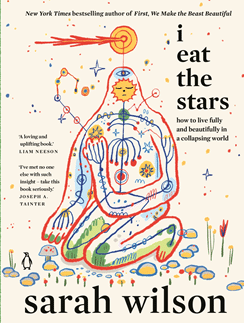
In ‘I Eat the Stars; how to live fully and beautifully in a collapsing world’, Sarah Wilson is convinced that this time it’s different. That the current crop of intersecting crises means collapse is not just happening, but unstoppable. There are no solutions, only outcomes and ways of being, and the future will bring “massive unrest and despair at a level that we can’t fathom.”
After a career as a high profile Australian journalist, magazine editor, television presenter and social commentator, Wilson has reinvented herself as a futurist and prophet, after being – in her words – cast out by the mainstream media for appearing to question the safety of childhood vaccines. The result is a compilation of posts to her 60,000 Substack followers in twenty six bite-sized chapters, with punchy titles like ‘hope’, ‘truth’, ‘relief’, ‘collapse’, ‘death’, ‘denial’ and ‘homecoming’. Together, they describe her “collapse awareness mission” as it arcs from curiosity to rage, acceptance, enlightenment, and finally lands on bliss – a state achieved by replacing one form of hope with three types of truth.
The introduction promises that this book will replace ‘hopium,’ the look-away, wishful-thinking form of hope, with epistemic (i.e. testable), emotional and sacred truths. But by the time we reach the fourth and longest chapter, ‘Collapse,’ it’s clear that facts are taking a back seat as everything that follows rests on three unsafe assumptions; that societal collapse is inevitable, unstoppable and natural.
Inevitable
The sense of inevitability is based on a cyclical view of history, popular in the early twentieth century and revived every few decades in best-selling big histories. In ‘The Decline of The West,’ Oswald Spengler suggested four stages based on the human lifespan: childhood, youth, maturity, and decline. Arnold Toynbee proposed five in ‘A Study of History’: genesis, growth, troubles, unity, and disintegration. John Glubb’s ‘The Fate of Empires’ described seven stages, ending with decadence, in a cycle lasting around ten generations.
Contemporary historians suggest there are two problems with this view of societies as organic entities that are born, mature, and die. First, societies are not genetically programmed to die like individuals, but mutate, adapt, transform and live on. Second, neatly delineating periods and cycles, such as Wilson’s claim that every civilisation in the last 5,000 years has collapsed within three hundred years, requires selective definitions, like splitting the Roman Empire in two phases and ignoring the Byzantine, Ottoman, Olmec, Vedic, and other any civilisations that were inconveniently long. In history as in life, the story is in the variance, not the mean.
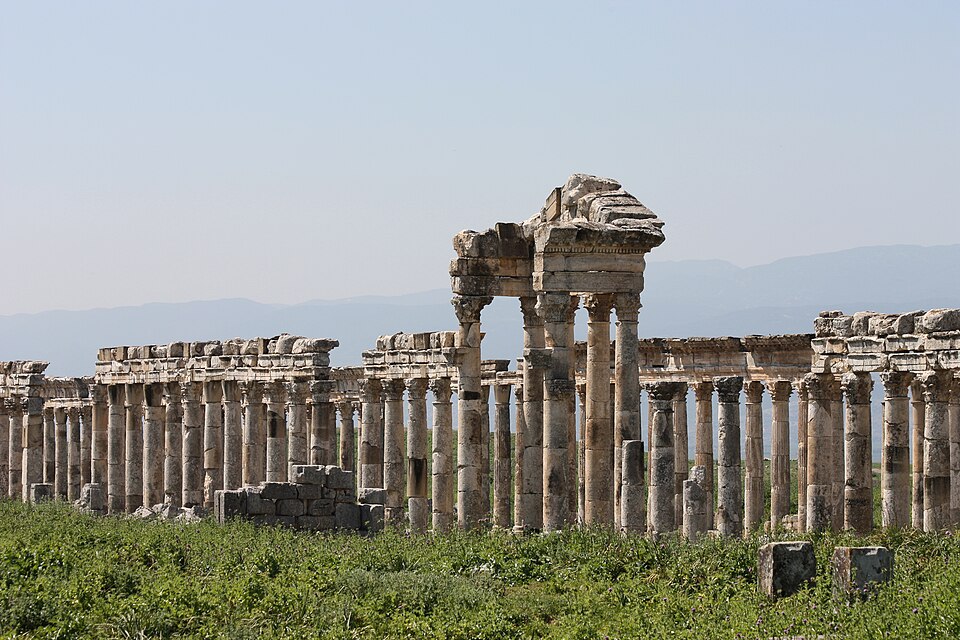
Historian Joseph Tainter avoids the term civilisation as it lacks an agreed definition. In his classic 1988 study ‘The Collapse of Complex Societies’, Tainter examined the fall of seventeen societies from Rome to Mesoamerica, assessing the various explanations offered for their collapse, from environmental catastrophe to resource depletion, invasion, class conflict, and disease. While these explanations often featured as triggers for collapse, the underlying common factor was, in his words, “decreasing marginal returns on investment in social and economic complexity.” As societies become more complex, solving each problem creates more, which drains the capacity for problem solving. Tainter concluded that when a society reaches this state of decreasing marginal returns, it faces a choice: collapse or transform. In Wilson’s world, however, transformation is not an option. Collapse is not only underway – it cannot be stopped.
Unstoppable
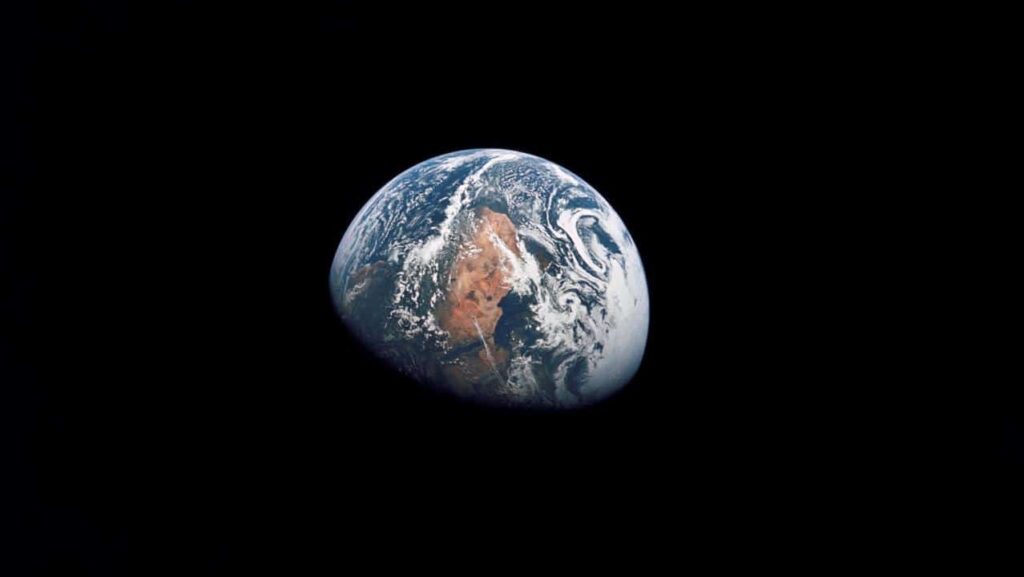
The idea of unstoppable collapse rests on two concepts: planetary boundaries and demographic collapse. The concept of planetary boundaries first appeared in 2009 from the new discipline of earth systems science, as an attempt to integrate the physical, chemical and biological processes that support life, inspired in part by James Lovelock’s Gaia hypothesis. The nine planetary boundaries identify thresholds that, if crossed, would trigger catastrophic and irreversible environmental change. But it’s worth remembering that these boundaries are modelled, not measured. Because this approach reduces the vastly complex local and regional interconnectedness of ecological systems to neat global thresholds, ecologists have argued most of the boundaries and tipping points are arbitrary, untestable, and therefore inappropriate.
In the chapter titled ‘Death,’ we learn that once global population peaks at around ten billion later this century, it will uncontrollably decline to pre-industrial levels of one billion. This is based on the claim that once the fertility rate falls below 2.1 children per woman, it can never come back – a claim that is neither historically nor biologically accurate. Israel and Kazakhstan have both demonstrated rebounding fertility rates, and there are no biological reasons why rebound cannot occur. Demographers know from experience which policies are capable of bending the fertility curve when applied consistently. To support this claim, Wilson cites a paper projecting long-term human population size under four different fertility rebound scenarios, but chooses the one scenario with no rebound as humanity’s inevitable fate.
Natural
Towards the end of the book, the force behind the inevitable and unstoppable nature of collapse is revealed to be life itself:
Collapse might just be a matter of life unfolding in its own, knowing way, correcting for excess and other imbalances and driving humans (back) to who they really are.
We learn that we need to allow “the divine flow of life and all its entangled cycles to do their thing” as we are “ultimately being steered by a collective force more powerful than anything we can ever imagine.” While the concept of Gaia is not mentioned, James Lovelock’s hypothesis that the Earth is a living organism capable of revenge for human excesses lies at the heart of this book.
This raises the question: if the Earth is alive, how does it evolve? The Earth represents a population of one. Evolution by natural selection requires variability between individuals within a population of many, from which nature in the form of a changing environment ‘selects’ the best adapted through a process of elimination.
Alternative theories have been proposed to explain how the cycling of water, carbon, nitrogen and the other processes that sustain life could have evolved to become self-reinforcing, but these do not assume sentience, and operate at global scale over millions of years, so are untestable other than through models. Which, as the statistician George Box reminded us, are ‘always wrong but sometimes useful’. Always wrong, because models are inherently gross simplifications of a vastly complex reality. In life as in history, the story is in the variance, not the mean.
Righteous purge
In the end, questioning the logic behind belief in imminent collapse is less important than the belief itself. Comments from Wilson’s Substack subscribers sprinkled throughout the text reinforce the view that the old world will soon be swept aside to make way for the new. It is a sentiment reminiscent of that expressed in Britain in the early twentieth century by influential writers like Rupert Brooke, Julian Grenfell and Arthur Conan Doyle, who viewed war as a spiritual event that would cleanse society’s moral and physical degeneration. In this instance, the idea of a righteous purge draws inspiration not from heaven, but belief in a sentient Earth.
While societal collapse is possible, it is neither predetermined nor inevitable. Here’s how Joseph Tainter responded in a recent interview to the question how might collapse be avoided: “We are a species that muddles through. It’s all we’ve ever done, all we ever will do.”
I Eat The Stars: how to live fully and beautifully in a collapsing world by Sarah Wilson is available June 2026, from Penguin.