
If you’re of a similar vintage to me you may remember being a teenager in the mid-1990s and catching BBC 2’s Weird Night: The Fortean Review of the Year, a fast-paced 15-minute magazine show about paranormal claims cunningly scheduled for broadcast immediately following The X-Files. You might also remember the brief mention it gave to a story about an “unusual visitor” that paid a visit to an African playground on 16th September, 1994, and how it was earnestly described by impressively poised and articulate primary school children.
This was the first time I’d heard about Zimbabwe’s Ariel Primary School and the apparent mass encounter with a landed UFO and humanoid alien beings.
If, like me, you occasionally tuned into paranormal TV programs of that time – such as Fox’s Sightings – you would have seen the case featured early the following year. It was this show, and their follow-up episode in November, 1996, that first broadcast clips of the interviews Dr John E. Mack, Harvard professor of psychiatry and Pulitzer Prize winner, conducted with some of the Ariel School witnesses.
Sightings based its show on a presentation made by Cynthia Hind, Africa’s principal field investigator for the Mutual UFO Network (MUFON), at the British UFO research Association (BUFORA) conference in Sheffield, England. She lived in Zimbabwe, and had visited the school a few days after the event, where she talked with some of the children and was convinced that something out of this world had landed there, and that its occupants had interacted with the children. Sightings began its coverage by repeating Hind’s claim that the children hadn’t “any exposure to popular press accounts of UFOs” – a claim I’ve previously shown to be false.
Dr. Mack had been contacted by BBC journalist Tim Leach, at the request of Hind, to come and investigate. Leach faxed Mack’s Program for Extraordinary Experience Research (PEER) at Harvard to say that after lights had been seen in the sky over Zimbabwe earlier that week in September, 1994, he’d received reports of (alien) “abductions” – precisely the area of research Mack was pursuing, and the topic of Mack’s then newly-published book Abduction: Human Encounters With Aliens (1994).
Mack accepted the invitation. Coincidentally, he’d already scheduled to visit Africa as part of his expanding research into alien abduction cases outside of North America, so he added a visit to Zimbabwe to his itinerary. He arrived at the school in November, more than ten weeks after the event.
Cynthia Hind had actually met Dr Mack the previous year at a 1993 MUFON conference in the US. His credentials, and the fact that he took the study of UFOs and alien contact seriously, impressed her. In her self-published newsletter, UFO Afrinews, she wrote that UFOs and aliens were not only being encountered in one continent (North America), but “in the most outlandish places, like remote rural areas in Africa”. What a coincidence then that the following year, the “biggest story of the 20th century” would land right on Hind’s doorstep at a school in a rural area of Zimbabwe, and she would be the person to invite Dr Mack, via BBC journalist Tim Leach, to come and investigate.
After an initial flurry of media coverage in the 1990s – Dr Mack would frequently mention Ariel School in television interviews – public awareness of the case was attended to sporadically over the decades by several TV and film projects, all of which feature clips of Mack’s interviews.
By far the best use of the Ariel School interview footage is in Enlevés or Experiencers (2004), an unembellished documentary by French journalist Stéphane Allix (an “experiencer” is, broadly, someone who claims to have had anomalous experiences such as contact with or abduction by aliens). It opens with footage from Mack’s funeral service, as he had been accidentally killed by a drunk driver in London in September that year, and the film is as much a tribute to him as it is a portrait of those people who sincerely believe they have had alien encounters.
After Allix’s 2004 film there was a lull in media visibility of the Ariel School case. If you’re like me, the case likely dropped off your radar during the period between the early 2000s and late 2010s. Both the principal investigators had died – Cynthia Hind in 2000 and Mack in 2004 – and their interview footage from their respective visits to Ariel School, although available as low quality snippets online, lacked authoritative packaging.
Around 2009 you may have heard about an upcoming film project about Dr Mack, when news of its forthcoming production made the mainstream press. It was to make use of the 1994 interviews that had been shot on video by Nicole Carter, then a journalist working for South African Broadcast Corporation. In 2007 Mack’s research assistant Dominique Callimanopulos, who conducted the interviews alongside Mack, entrusted the footage to Randall Nickerson. Nickerson claims to be an alien abductee, and is a former patient of Mack’s (although Mack favoured the less formal term “experiencer participant”) whose account features in Mack’s book. They even appeared together on The Oprah Winfrey Show, in April, 1994, a few days prior to the book’s publication. In Allix’s film we see Nickerson playing piano at Mack’s memorial service.
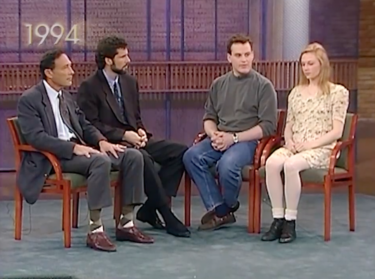
(April 1994: Dr John Mack (left), Randall Nickerson (second from right).
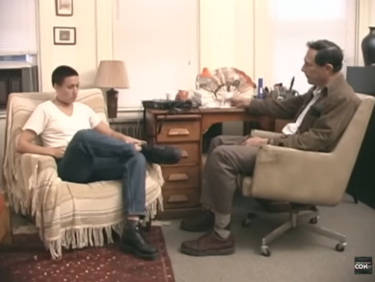
The Ariel interview footage was always meant to be made into a film about Mack’s academically contested work on the phenomenon of alien contact. As far back as Sightings, we hear that Dr Mack was making a documentary about the Ariel School. Cynthia Hind claimed that during his visit Dr Mack “came up with some startling evidence which he himself will soon reveal.” However, the documentary spearheaded by Carter never came to fruition, and the startling evidence appears to have been the claim that the children received telepathic warnings from the aliens – which had not emerged from any of the numerous other interviews conducted by journalists in the previous ten weeks.
It is interesting that Mack’s visit to Ariel school occurred right in the middle of the investigation into his methodology that began in May 1994. This is often referred to as an infringement on Mack’s academic freedom to study alien abductions, but was really about ensuring his patients were being given proper clinical care. The investigation concluded in July 1995, clearing Mack to continue with his research.
Nickerson’s film project struggled to find anything new that had not already been said in Allix’s documentary, and it took an interminable 15 years to complete. After two shorter versions, made up mostly of Mack’s interview footage, a feature-length film excessively padded with landscape photography and travel montage was released as Ariel Phenomenon (2022). It had been pre-empted two years earlier by The Phenomenon (2020) by American filmmaker James Fox, which included a tight ten minute segment on Ariel School, again using some of the Mack interview footage. Both projects featured interviews with some of the – now adult – witnesses, who offered additional comments about that strange moment in their childhood.
It was around this time, in 2020, that there was online chatter about the full interview footage being made public. In the lead up to the release of his film, Nickerson, who had made himself the go-to authority on the Ariel case, appeared on a podcast radio show and fielded questions from callers. One caller asked when and where the full interviews might be made available. Nickerson agreed that it was “important…that they can be seen by the public”, but couldn’t offer any specifics other than recommending people wait to see his film.
In 2021 New York Times Journalist Ralph Blumenthal published his biography of John Mack, The Believer. He wrote that besides the clinical files, he had access to Mack’s archives “without conditions” and mentions that the Ariel School interviews had been transcribed and ran to “104 pages.”
Most recently in 2023 Netflix released an episode of their UFO themed show Encounters (which I previously reviewed for The Skeptical Inquirer). It featured yet more clips from Mack’s interviews, and presented us with a few previously unheard remarks from the children – such as those from one girl who was visibly terrorised by the belief that the aliens would kill her, and another who worried that aliens might come into her house to steal her toys.
Kuleshov Effect
Mack’s interviews are the backbone of all these media projects that have aired over the past 32 years. Yet all of them are versions of the story. The interviews with 12 children make up several hours of video and audio, but editorial constraints have meant choices have been made about which clips to use and how they are juxtaposed with other footage.
Such restrictions have meant that inevitably a Kuleshov Effect can occur in the making of any “documentary” films. This is an effect, described by Alfred Hitchcock, where the choices about how to assemble footage can create wildly different impressions. Two examples of this occur in Nickerson’s film. A shot of Tim Leach recalling how he’d contacted Mack at Harvard is immediately followed by a shot of Mack walking the grounds at Ariel School – eliding the more than ten week time gap. Another moment intercuts one witness describing the face of the alien she saw with that of another witness holding up a drawing he’d made of a face with large dark eyes. The impression created is that this was the face they both saw that day in 1994, but having spoken with this former pupil he told me it was a face he’d seen in a dream sometime afterwards – he’d not actually seen any aliens that day.
This is just one of the reasons why having access to the interviews in their entirety to see them without edits or choices made about their juxtaposition would be the simplest way to bypass such distorting effects.
It might also be a reason why the full interviews have not been made accessible. Seeing the interviews in their entirety might reveal inconsistencies in testimony, undermine the claim that they all saw the same thing, and would likely show how editors made choices about what details they believed most supportive of the alien visitation narrative, and which they left out.
John Mack considered the group sighting exceptional and declared it “a planetary first” – and perhaps last, since no comparable documented event has happened since. Elsewhere he said:
if there was any case that could persuade a skeptic that something is going on it’s this one.
Yet, Mack produced very little writing on the case, no academic paper, and only a few paragraphs in his popular books about anomalous experience: Abduction (1995 Revised Edition) and Passport to the Cosmos: Human Transformation and Alien Encounters (1999).
Given the potential magnitude of the claims about the case, it is surprising that three decades later the entirety of the interviews that could persuade a skeptic are still not available to researchers.
A persistent claim amongst conspiracy theorists is that Mack was silenced before he could produce a detailed report on Ariel School, but he died a decade later on September 27, 2004 after being struck by a drunk driver while on a visit to London. His death was not suspicious. The driver, Raymond Czechowski, was convicted and jailed, despite the Mack family’s appeal for leniency. But this didn’t stop false rumours that the accident was intentional, or the work of the Men in Black, with some going as far as promoting the totally unsupported claim that “on the day John Mack was killed in England, three other John Macks were killed in England.”
Archives of the Impossible
However, all this seemed set to change, and the possibility for a skeptical researcher to be converted by gaining an unembellished look at the evidence seemed imminent. In May 2023, Rice University in Houston, Texas, had a public conference for their “Archives of the Impossible” – a new repository of UFO related material. The project manager of the Center for the Impossible, Karin Austin, stated that “all of the tapes, all tapes, all media has been digitised” by archivist Will Bueché and the Ariel School interviews would be made available to the public…“ultimately.”
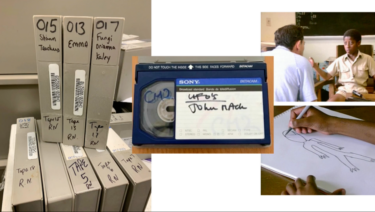
Having been aware of the case for so long, this was a fascinating development, and since that 2023 presentation I’ve been in correspondence with Rice University to try to pinpoint when “ultimately” might be. Sadly, they have given shifting explanations for why the films aren’t yet available even to supervised viewing by researchers.
I first asked whether in lieu of the videos and audio being made available (they were at that time licensed by a filmmaker) I could read the interview transcripts that are known to exist (as mentioned in Blumenthal’s book). This request was denied, and the perplexing reason given was that an “AI based” research project was underway. I was later told that the transcripts were only rough, and needed to be redone.
I then waited two years before trying again. Despite the interviews being gifted to the archive they cited more reasons for delay: a commercial “moratorium”, then a four-to-six year “processing time”, “structural staffing issues,” an excessive workload due to the vast size of the donation to the archive (some 150 boxes of files and hand written notes), and most recently the need to “onboard a dedicated archivist.”
There are obvious problems with all of this. A request to view the materials does not conflict with any copyright negotiations. It’s a narrow request to review – not publish – a tiny, non-clinical subset of the wider Mack collection. Since they were recorded in 1994, clips from only eight of twelve interviews have been used in the various TV and film projects about the case, and the remaining four interviews are unknown. What we do know is that the interviews were conducted on school grounds with several adults present, including the school’s headmaster at the time Colin Mackie, and were with children who have since reflected on those interviews publicly. We also know that they’ve already been digitised – as stated above. What we don’t know is how only twelve children were selected for an interview from the reported 60+ witnesses.
It should be easy for the Archives of the Impossible to share these materials with anyone curious enough to sit through the hours of footage to get a real sense of the full conversation. Yet, there’s been no progress since the 2023 announcement.
It’s hard not to speculate about why such a gap exists between the access granted for commercial use and that afforded to independent researchers, especially considering how this contradicts the university’s stated commitment to transparency.
For example, in April 2024 Amanda Focke, Rice University’s head of special collections, stated in an official news release that the archives are “open for research” and that there is material to interest everyone, “whether you’re a skeptic or a believer,” – which sounds encouraging. However, it wasn’t until I was years into making my enquiries as a transparently skeptical researcher that I realised this ideal is not being upheld.
After almost three years of emailing back and forth with Jeffrey Kripal, professor of Religion at Rice and founder of the Archives of the Impossible, I was put in touch with Karin Austin who in his words is “the decider” about what access would be given to researchers. Karin was John Mack’s assistant, she features in Allix’s film, as does archivist Will Buché, and both consider themselves “experiencers”. She has also expressed her moral obligation to protect experiencers, and considers it beyond question that the Ariel children reported a “real, anomalous event”.
In January of this year, I had a lengthy Zoom conversation with Karin Austin. She reiterated some of the previously mentioned reasons for the delays in making the materials available, none of which made much sense to me. For example, allowing researchers to read an interview transcript does not damage that data nor prevent it from being used in another research project. But she was also persistent in questioning my motivations for being interested in seeing the interviews in full. This struck me as a little odd at the time, but I answered her honestly and explained what led me to research the possibility that the figures the children saw might have actually been community theatre puppets known to have been operated by troupes giving impromptu performances in outdoor rural areas, who would seek out and approach groups of children, and whose uncanny physical characteristics and movements matched the descriptions the children gave of the figures they had glimpsed more than 100m outside their school grounds.
Despite our clear differences of opinion, our conversation was friendly, and we ended it with the intention to speak again at some point in the future. To my surprise, in a follow-up afterwards Karin was able to share a longer, unedited clip from Emma Kristiansen’s interview – the girl whose “we mustn’t get too technoleged” remark (a message she said was conveyed by the aliens) has become the most well-known sound bite of the case. It was intriguing to watch the four minute unedited clip, as it revealed the intensity of interest Mack had in Emma’s answers, and showed how many adults there were in the room hanging off her every word – but it was also interesting because of how easy it was for Karin to share that clip with me.
What happened next is unfortunate. After a review of my published articles and social media, Karin cited a tweet where I mentioned the fact that Mack went to Ariel because he was looking for evidence of alien abduction (this is true, as referenced above), and that hypnosis was a research method he used to “recover” memories of traumatic experiences with aliens. He even used the method on children – Mack tells us this explicitly in Abduction: Human Encounters With Aliens. This, along with discovering that skeptic Mick West had “favourably cited” my work, prompted Karin to decide that my motivations were to “debunk” the case, which was a “red flag” that left her “unsettled”.
What’s more unsettling is that the current trajectory of the Archives of the Impossible suggests a model of stewardship that leans closer to narrative management than neutral archiving – if you are a skeptical researcher you will be vetted and treated with suspicion. While the public is invited to believe the collections are open to researchers “whether you’re a skeptic or a believer,” the practice of social media vetting and the characterisation of skeptical research as “unsettling” reveals a troubling gatekeeping instinct. This instinct is seen more broadly amongst people making UFO claims, yet who refuse scrutiny of their data.
For decades, only curated believer-friendly excerpts of Mack’s interviews have been allowed to circulate in the media, which effectively insulates the Ariel narrative from the very scrutiny that could establish its ultimate validity as a truly anomalous event.
Ultimately, if the Ariel School encounter is truly a “planetary first” capable of persuading even a skeptic, then the institution housing its records should match that claim with extraordinary transparency – but there appears to be no sense of urgency to bring all the evidence forward in an open way. Continuing to obscure the full interviews behind shifting bureaucratic and commercial moratoriums does not protect the witnesses; rather, it enables the very conspiratorial rabbit hole the archive’s leadership claims to fear.
To honour Dr Mack’s own commitment to open inquiry, and his stated desire in Abduction: Human Encounters With Aliens to give “those who would be naturally skeptical, the opportunity to make up their own minds”, Rice University should make it a priority to release the full, unedited interviews. Only by moving beyond the restricted aperture of commercial production and storytelling can the archive truly fulfil its stated mission of open research.
Skepticism isn’t about denying people their weird experiences, but when a claim is made that a whole group of people experienced the same weird thing, and there might be evidence available which could support that claim, then that evidence should be made available as widely as possible, without conditions and without fear that skeptics might ask troubling questions. If experiencers want to be taken seriously, they should shake off their fragility, embrace skeptical pushback, and not limit the retelling of their stories to curated media.
Disclosure now!
I informed Karin Austin, Will Buché, Amanda Focke, and Jeffrey Kripal of my intention to publish this chronology of my attempts to review the Ariel School interviews and asked them for comment on the gap between the Archives pledge of openness and their apparent unwillingness to accommodate skeptical researchers – however no comment was provided.