




Content Warning: This article deals with tragic accidents that resulted in human and animal loss of life. No animals were harmed in the writing of the piece, but – like glue and Jello® – this story wouldn’t exist without them.
Monster narratives feature a frequently sighted but rarely cited event to provide plausible explanations for decidedly unusual animals being witnessed: The Circus Train Wreck (CTW).
As an explanation, it doesn’t tax the laws of physics or biology, though it might do some harsh deformation to the rubbery bounds of probability. This presumes the CTW claim is made in good faith, or as a sincere reach for a grounded explanation. However, it transpires that many who invoke the CTW do so because it conjures up the wonder of a big show rather than because it rings of truth.
Many monster stories start with CTWs – for instance, in The Beast of Boggy Creek, cryptozoology writer Lyle Blackburn writes:
The first theory that usually comes up in conversation is that of the so-called “circus train wreck.” In this scenario, which is by no means exclusive to the Fouke Monster, the sightings are attributed to a circus animal, namely a primate, that has survived the wreck and promptly taken up residence in the nearby woods.
Blackburn, 162
Some of these CTW-related monsters fall into the “obvious folklore” category. The Beaman Monster of Missouri is sometimes an anthropoid ape, and other times a wolf-ape chimera, reminiscent of modern “dogman” sightings. The Pope Lick monster – a modern satyr – is said to haunt a Kentucky train trestle, but even the inherent biological implausibility of such a creature has not discouraged legend-trippers from risking their lives for a chance to see for themselves. People have died pursuing this one. Down on the Gulf Coast, the fairly obvious hoax of the Honey Island Swamp Monster is sometimes sourced to various apes escaping a circus train disaster and then slaking their amorous desires on the hapless indigenous alligator population.
Other CTW-related monster tales fall into the “out of place” (OOP) animal category. This will be familiar to UK readers, because it’s the category that includes a lot of “alien big cat” stories (ABCs) – which make such sightings more Fortean than fantastical. In the United States, phantom kangaroos are often attributed to circus escapes, and the proverbial train wreck is their constant companion. As a kid growing up on Saturday morning cartoons, reruns of Looney Tunes regular Sylvester the Cat featured a recurring character Hippety Hopper – a frequently escaping kangaroo that would be mistaken for a giant mouse by the hapless feline. At the time I didn’t connect the poor cat’s nemesis to real-life news stories, but unexplained kangaroos have long been a recurring character in OOPs stories here in the states. Cryptozoologist Loren Coleman has written about phantom kangaroos and locomotive disaster escapes, and his book Mysterious America sports 14 entries for “circus escape theory.”
Circus train wrecks have been a classic ‘wipe’ – the ending for mystery animal stories for years. The pattern is typical. A strange beast is seen around, sightings are recorded, search parties are dispatched, tracks or dead livestock are discovered, but no animals like the ones being seen can be caught or killed. A news reporter or local sheriff then comes forth with the rumor that a ‘wrecked circus train’ is responsible for an escaped black leopard or African lion. Quickly the story dies away, the sightings cease, the ridicule factor quiets all, and the wave is dead.
Coleman, 122-123
Our OOPs entries also feature big cats here in the States. We do have indigenous large cats in North America, but their range has been significantly shrunk by human settlement. Pennsylvania has a long history of strife between the state’s official claim that no cougar populations exist, and the citizens’ frequent reports of sightings. There’s nothing inherently impossible about a cougar surviving in rural Pennsylvania, but the adversarial nature of the discourse implies the State thinks the witnesses are lyin’.
But big cat sightings aren’t limited to out of place indigenous fauna. An AP news story from 1931 hit papers across the United States with the claim that a breeding population of Bengal tigers were thriving near Villa del Carbón, Mexico due to “a circus train wreck 18 years ago.”
Persistent folklore about invasive armadillo populations in Florida attributes them to, variously, a circus train wreck, or a circus truck losing a breeding pair. Despite an unimpeded land route between Texas and Florida, for many the circus explanation is more satisfactory than the reality of slow but persistent population creep.
However, the purpose of this article is not to enumerate every unusual creature that is attributed to Circus Train Wrecks. I want to share my data about the surprising frequency with which such disasters used to occur, and also the irony that most of the monster stories associated with CTWs don’t occur near the loci of actual historic wrecks. Furthermore, most of the areas where CTWs did occur – even with escaped exotic animals – failed to become historically associated with monsters. It is worth considering why the CTW sits at this peculiar intersection of fact and folklore, and why the data seems to diverge in opposition to what one might expect.
How common were Circus Train Wrecks?
Thanks to advances in digitisation, it is possible to dive into the newspaper archives from the comfort of my own basement. The kind and generous listeners of MonsterTalk fund my subscription to Newspapers.com and it was enormously helpful in this research. Honestly, what I expected to find was that Circus Train Wrecks were rare, but not unheard of. I knew of one fictional, but highly influential depiction of such an incident: Cecil B. DeMille’s The Greatest Show on Earth (1952) – a moment of cinema history so striking that Steven Spielberg attributes the scene to being a major factor in his decision to become a filmmaker.
My hypothesis that such wrecks were uncommon was absolutely shattered within moments of starting my search. I quickly switched from worry that I wouldn’t uncover enough examples, to being overwhelmed with the sheer quantity of cases. I now have a better understanding of why these spectacular and often tragic events took place, but I want to share some of my findings and thoughts about this class of disaster before we return to its influence on monster and OOPs lore.
What I found is summarised in a table that I’ve made available here for other researchers or interested parties. The far-left column of that data includes links to the underlying newspaper stories sourcing the information.
You might find yourself – as I did – quite shocked at the frequency with which circus trains were involved with wrecks and disasters! Because some news stories had different details, I’ve culled this down to 59 unique incidents and usually reference a single article on the wreck in question. However, many of these accidents prompted weeks of coverage, wire stories that spread across the country, and follow-up stories about anniversaries and resultant legal cases.
| Feature | Raw Count | % of total |
| Human Injuries/Fatalities | 49 | 80% |
| Animal Injuries/Fatalities | 26 | 43% |
| Animal Escapes | 18 | 30% |
| Decade | Wrecks Count |
| 1870s | 1 |
| 1880s | 13 |
| 1890s | 11 |
| 1900s | 22 |
| 1910s | 6 |
| 1920s | 6 |
| 1930s | 0 |
| 1940s | 2 |
These 59 wrecks took place between 1877 and 1949, with the majority ending before 1929 (more on which shortly). Here are some features of the incidents.
Across the active years of 1877 to 1929, we see 59 incidents in 53 years, or a little more than 1.1 per year. The decade you picked mattered enormously: from 1900 to 1909, with 22 wrecks, the average ran to 2.2 a year.
In my data I took note of cases where escapes are mentioned, and there are some harrowing stories there of how communities reacted to these former inmates. An especially poignant tale took place in my home state of Georgia involving an elephant named Gypsy. Elephant lovers might want to skip that one. Horses fared the worst during these incidents. Horses are notoriously susceptible to leg injuries. When these incidents took place horses were beloved, ubiquitous, and mastery of their behavior was a staple of the circus performance. Train cars full of valuable and fragile horse cargo could turn into an absolute disaster during a collision, and the newspaper archives are rife with photos of wrecked trains with piles of dead horses. It is grim stuff.
But where there is tragedy there is often heroism on display. Some of these incidents led to memorable acts of bravery. The historic record tells of sacrifices made in attempt to prevent the wrecks, and injuries and deaths in the attempts to save survivors. It is against this colorful tapestry that several of the major wrecks inspired commemorative periodic remembrances and special cemetery monuments.
Let’s take a look at a couple of dramatic examples from the data I compiled.
Walter L. Main – 1893
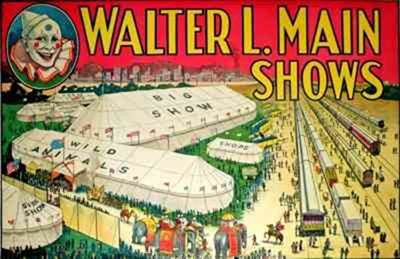
Perhaps the most influential – and certainly one of the most dramatic – of these CTWs took place on the United State’s Memorial Day, May 30th, 1893.
That morning the Walter L. Main circus train was coming down the very steep Tyrone & Clearfield grade in central Pennsylvania when something went wrong, and the circus cars began tumbling over an embankment. The train operators had been concerned and asked for an additional engine to help control the train’s speed, but the request was made to people who did not know the train consisted of special longer-than-normal cars. Whatever calculations led them to reject the request, the results of that decision made tragic history.
The crash was spectacular and horrific. Between 47 and 68 horses (reports vary) plus a herd of “sacred” cattle that were part of the circus menagerie were killed. Five men died from the immediate crash, two more died of injuries and one of the rescuers was injured and succumbed to his wounds. The train had 16 menagerie cages which were all crushed in the event – loosing the circus animals on the community. For several hours Tyrone was witness to big cats, a bear, a hyena, a water buffalo, alligators and snakes – and an ape called “Man Slayer.”
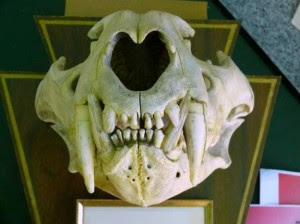
For the most part the animals, used to a life of captivity, were well-behaved and easy to recapture. Man Slayer was roped up and did not live up to his name. But in one of the most dramatic events associated with such a wreck, a Bengal tiger made its way to farmer Alfred Thomas’s property where it killed a cow that his wife was milking. I can’t imagine what a moment that was, but when she screamed, he came running with his gun.
The tiger’s skull is still on display at the Tyrone Sportsmen’s Club.
Nine days after the crash, the circus gave a special performance for the community that had helped it recover from such a tragedy. For years the performers would make regular stops to give thanks to the community and to lay flowers at the graves in memory of the deceased. This quickly organised show, so soon after the wreck, was a demonstration of the circus industry’s famous “the show must go on” mentality that modern audiences might find difficult to fathom.
This wreck is sometimes said to have been a primary inspiration for the train wreck in Cecil B. DeMille’s The Greatest Show on Earth – but like a lot of the things I investigate, I was unable to find any definitive documentary evidence to substantiate that claim. Furthermore, my own research shows that DeMille had plenty of other real train disasters from which to draw inspiration. We cannot know for sure, but he also may have seen the 1913 silent film Wild Beasts at Large as another visual inspiration.
Frank A. Robbins Circus – 1910
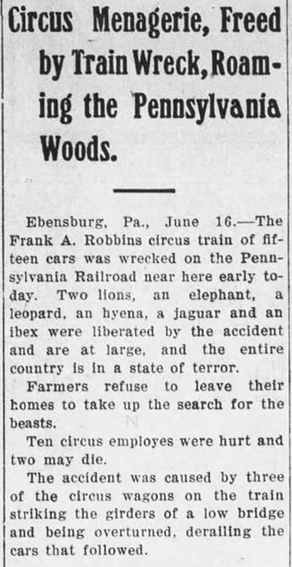
Seventeen years and about forty miles separate the Robbins circus wreck in Ebensburg, PA from the Walter L. Main wreck in Tyrone, PA. On June 16, 1910, the circus train crashed when three of the circus’s large and ornate parade wagons which had been loaded on flatbed train cars struck a low bridge. They overturned and caused the cars to derail – which shattered the menagerie cars, freeing animals into the nearby land. Two lions, a leopard, a hyena, jaguar, an ibex and an elephant escaped into the surrounding Pennsylvania forest.
Initial news coverage reported that the “entire country is in a state of terror,” but a more interesting and, like the animals in question, subdued story soon emerged. Two lions were recaptured when their handlers found them on a roadside “peacefully eating catnip and enjoying the meal.” The jaguar was distracted with a tossed coat and then lassoed. The Ibex was found stealing hay in a nearby barn and a farmhand calmly roped and captured it. The hyena didn’t fare so well. When confronted by an armed local, it refused to run or fight. After a warning shot didn’t scare it off, the local – a man named Howard Dressley – shot and killed it.
There was a local concern about snakes being lost. Of all the escaped animals, the snakes seem to be the ones most associated with follow-up sightings or stories in my reading. But in this wreck, despite local concern and sightings, all the circus snakes were accounted for. All in all, the animal wrangling was accomplished within a day.
The Italian Job –1945
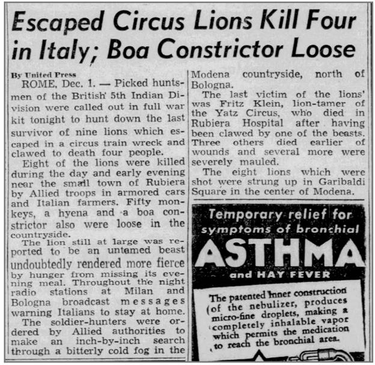
Probably the most dramatic example of a circus train wreck with animal escapes in the archives was not in the United States. It took place in December 1945 in post-WWII Italy. It works well as a template for the kinds of stories people attribute to circus train wrecks, but I had difficulty finding much information in English. I was concerned because the only English coverage was very thin, but very cinematic in its details.
“Escaped Circus Lions Kill Four in Italy; Boa Constrictor Loose” reads the United Press headline detailing the incidents behind “the night of the lions.” The story was full of dramatic elements, but I only found one English follow-up to what certainly sounded like a bigger story.
The English-language media coverage garbled a lot of details. The escaped lions killed three people and gave the community a legendary night of cinematic tragedy, terror, and intense confusion. It really is amazing. People are described as being killed by effortless swipes of lion paws, teams of post-war civilians and military personnel hunt the big cats in the cold winter night with guns recently used in World War II.
There is a particularly harrowing incident where two uncles set out from a farmhouse leaving a child behind to wait. Decades later, his recollections match the news coverage. The uncles return to dry out their guns when the lion comes to the window and tries to get in. The two men hurriedly reassemble their weapons and dispatch the lion with a blast of submachine gun fire. Between the news coverage and the blog post, we also see the “fog of war” at play as stories tell of the desperate hunt for a 10th lion – a phantom big cat that never existed.
The circus was named Circo Togni. The tragedy was caused when the train pulling the circus cars was diverted to a siding to let a military convoy pass – only unbeknownst to everyone, the siding had been blown up by allied bombing and there was a huge unrepaired crater where the rail was supposed to extend.
Whoops.
I worried because I could not find further documentation of this disaster, but thanks to a real life FOAF chain, folklorist Roberto Labanti passed this amazing article along to Cultural Studies (and Cryptozoology) scholar Justin Mullis who shared it with me. An Italian-language blog post by author Stefania Cigarini recounts the extended tale of what happened with the lions after that very real circus train wreck. I received further confirmation of the details of the crash from Italian scholar and skeptic Massimo Polidoro.
I frequently lament when Hollywood markets fictional supernatural films (thinly veiled with elements from real history) as “based on a true story.” Meanwhile the incredible true story of the Villa Bagno circus train disaster is practically unknown outside of Italy.
One More Notable News Entry
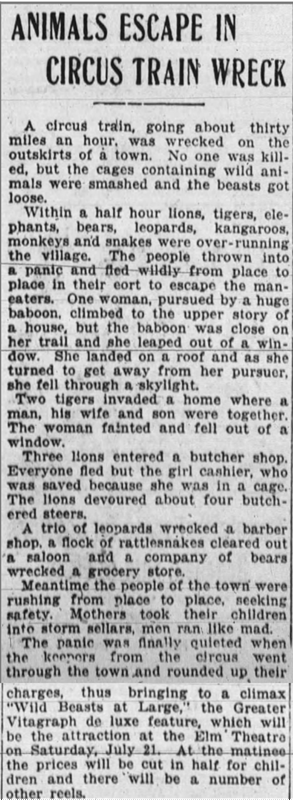
I thought I’d found the absolute motherlode of circus train wreck stories when I came across this astonishing bit of news copy. It opens with the sort of thrilling “escaped animals go wild” sort of narrative I had hoped to find. “ANIMALS ESCAPE IN CIRCUS TRAIN WRECK. A circus train going about thirty miles an hour was wrecked on the outskirts of town. No one was killed, but the cages containing wild animals were smashed and the beasts got loose,” began the clipping. It then spends several paragraphs detailing the drama that unfolded, only to finally reveal itself as an advertisement.
This was the silent film Wild Beasts at Large (1913) which continued to pop up here and there for several years of archive results as it slowly toured the country.
Technically this kind of “advertising disguised as a news story” was already disallowed when the promoters paid for it to be run in the July 19, 1917 edition of the Courier-Post in Camden, NJ. Despite false hits like this one, there were many, many real rail tragedies involving escapes from menageries beyond this reel one.
A Brief Roster of Notable Escapes
The following is a subset of my circus train findings, with stories explicitly mentioning escaped animals.
- 1872 – John Robinson’s Circus – West Haven, CT – bridge strike, not a wreck proper: lion and tapir loose (quickly secured), 50 monkeys escaped into nearby woods
- 1882 – Sells Bros. – Paint Lick, KY – tiger escaped its crushed cage and roamed the Kentucky hills before recapture
- 1887 – John Robinson Circus – St. Louis, MO – lions, tiger, leopard, and hyena briefly loosed; easily recaptured
- 1893 – Walter L. Main – Tyrone, PA – the crown jewel: three lions, two tigers, panthers, bear, hyena, water buffalo, alligators, snakes, monkeys, and “Man Slayer” the ape; one tiger shot by farmer Alfred Thomas, one panther shot; snakes and birds never recovered
- 1893 – Sells & Rentfrow – Sacramento or Grass Valley, CA – bears loosed, but recaptured
- 1895 – George W. Hall – Chicago, IL – boa constrictor loose in the city
- 1905 – show unidentified – Arkansas City (likely KS) – “many animals escape”
- 1905 – Campbell Bros. – near Temple, TX – “nearly all the animals escaped to the woods… panic prevails”
- 1906 – John Robinson Circus – Edison, OH – elephants loosed, later rounded up and put to work clearing the wreck
- 1910 – Frank A. Robbins – Ebensburg, PA – two lions, an elephant, a leopard, a hyena, a jaguar, and an ibex at large
- 1915 – Con T. Kennedy Shows – Columbus, GA – parrots flew away unrecovered; monkeys took to the trees (shot by circus employees); escaped-bear rumor unresolved in print
- 1921 – Palmer Bros. – Lincoln, NE – wild animals loosed; one man killed
- 1923 – Hagenbeck-Wallace – Topeka, KS – tiger (Lenin) loose; hunted down and killed by the show’s riflemen
- 1925 – Ringling Bros. and Barnum & Bailey – Norwood, NY – kangaroo and emu missing, never recovered
- 1945 – Circo Togni – Italy – dramatic escape of numerous animals including lions that kill and wound locals; armed troops and civilians hunt down the escaped animals.
The Evolution of Animal Escape Narratives
As you can see from the provided data, the use of the trope of “escaped from a circus train wreck” is not inherently nonsense. These wrecks were far more ubiquitous – especially prior to 1929 – than I would have imagined. However, at least in the USA, things changed after 1929. The precipitous drop in incidents had more to do with circuses being consolidated after the economic crash that led to The Great Depression. Prior to the market crash, circus crashes were often caused by the trains traveling off schedule, overnight, in a time with limited warning systems, reduced brakes to save money, and in cars made of wood and lit by oil lanterns.
But the notion of the circus train wreck as a plausible explanation for monsters and OOPs has itself become a folklore motif, as the creatures so ascribed are rarely affiliated with any actual corresponding historical wreck. The inclusion of a CTW as a story element no longer serves to anchor the unusual sighting in the jurisdiction of reality but rather signposts the tale as being off the rails.
I came across multiple stories describing how Florida was being invaded by armadillos that had escaped from either a circus train wreck, or perhaps an overturned circus truck. The same could be said of Oklahoma. In both cases, the real culprit was the armadillos themselves slowly marching their way out from Texas. They have reached my home state of Georgia now, no circus train required.
Armadillos have also reached North Carolina. While we’re here, the town of Brevard, famous for its white furred squirrels, claims on their official city website that this pale population descended from a pair that escaped when “a carnival truck had overturned.”
The previously mentioned phantom kangaroo flaps – which still occur today as recent stories from Ohio and West Virginia demonstrate – are frequently sourced to menagerie escapes. I hope I’m making a clear case here that “escaped from a menagerie” is a rich class of folklore attribution with sub-types of “circus train wreck,” “private menagerie,” and “local zoo.” But – let’s follow this history a little further. Before locomotives there were traveling circuses and carnivals. And before them – and after – there were the private menageries of royals, the wealthy, the privileged, the mad, and the inevitable Venn overlap of those groups.
Notices of escaped animals inspire frantic searches by a concerned public, and the Skeptic literature is rich with examples of how being primed to expect a certain kind of sighting can influence what you see. Within this class of “menagerie escapes” perhaps no case is more illustrative of that effect than the famous Rotterdam red panda escape of 1978.
In that case, the red panda escaped the zoo, and the community was alerted to be on the lookout for any sightings (it turns out red pandas are notoriously good at escapes). More than 100 reports came in of sightings, but – sadly – the animal was found near the zoo on train tracks where it had been struck and killed almost immediately after escaping. These multiple sightings – one presumes mostly sincere – have led to the term “the Red Panda effect” to describe how expectation can affect what we see.
What about the Alien Big Cats?
I had Britain’s Alien Big Cats (ABCs) in mind as I started this research project. Britain doesn’t have a historical tradition of circus train wrecks, but it does have a robust history of large cat sightings and those usually paired to an “escaped from a menagerie” explanation. The narrative often followed these lines (or perhaps lions): “after the passage of the Dangerous Wild Animals act of 1976 many wealthy owners of exotic big cats avoided tax or license fees by simply freeing their pets into the wilds of England.”
While that sounds farfetched, it was literally possible to buy a lion cub from Harrods in the 1960s. The famous story of Christian the lion who was successfully purchased in Harrods, raised in a flat, and rewilded in Africa ends in a famously heartwarming bit of reunion footage that you can watch on YouTube.
In 1988 and 1989 non-native jungle cats were struck and killed by motor vehicles. Experts widely attribute them to menagerie escapes. It is not inherently impossible that breeding populations of large non-native cats survive in various parts of the UK, which is why ABCs remain a favorite over more exciting but decidedly implausible neighbors like Nessie or Owlman.
Modern examples aside, some notable 19th century English menagerie escapes include:
- 1816 – Winterslow – a lioness escapes from Ballard’s traveling menagerie. It attacks a mail coach and injures one of the horses. In the end, Ballard ends up touring the big cat and maimed horse together.
- 1827 – A tiger escapes Wombwell’s caravan.
- 1835 – Wombwell’s again! Wallace the lion and a tigress escape and kill four people.
- 1839 – Finally, someone investigated the security at Wombwell’s! A tiger escaped and Wombwell’s was called into court. During the proceedings it was revealed that a polar bear escaped the same year. Wombwells!
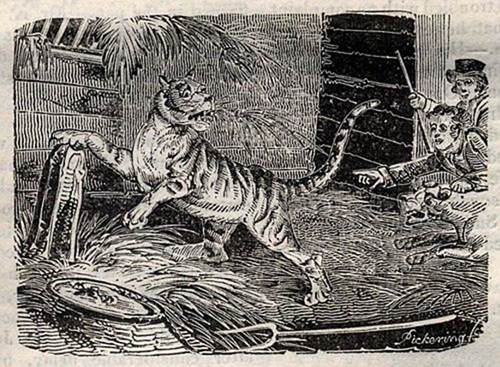
But when it comes to monster stories that are claimed to have come from a menagerie escape, there is none more famous than the Beast of Gévaudan (1764-1767). During the time when the killings were on the lips of everyone in Paris, contemporary theorists suggested that the mysterious qualities of the beast might best be explained by it not being a mere wolf, but some exotic escapee from a menagerie. Lions and hyenas were the prime suspects, and the former figures heavily into the dramatic 2001 film about the case, Brotherhood of the Wolf. Jay M. Smith wrote about this – and was similarly struck by the historical underpinnings of this case at the cusp of The Enlightenment.
La Bête and the Myth of Enlightenment
By an accident of timing, as I was working on this research I was reminded of the mythic narrative of The Enlightenment. Writers like Carl Sagan (The Demon-Haunted World) and Steven Pinker (Enlightenment Now) posit a simplified historical narrative where the rise of scientific thinking illuminates human culture and banishes magical thinking and irrationality into the dustbin of history thus freeing us from the fetters of superstition. Were that narrative true, the case of La Bête would surely be illustrative, because the killings behind the attribution of a beast happened in the heart of the time when this enlightened thinking was allegedly taking over Western thought.
Historian Jay M. Smith argues in his excellent book Monsters of the Gevaudan that there was no single monster behind the killings that inspired the legend of a beast. Instead, what transpired was that in a landscape with reduced prey, packs of wolves began attacking humans. The nascent newspaper business – then as now – was hungry for spectacle and spread the narrative that a single unkillable monster was behind the tragically real – but also mundane – string of killings. This was firmly within even the narrowest historical bands of time said to encompass The Enlightenment. One would expect, I think, to find a mixture of notable science communicators and theorists trying to explain these events using rational and non-supernatural framing. And one would also expect to find the uneducated commoners promoting a narrative of mystical and magical thinking – perhaps attributing the deaths to werewolves or as a punishment from God for man’s sins?
But Jay Smith also reminds us that periodic incidents of wolves predating on humans was a cyclical occurrence in French history and the real change was the newspapers providing an ecosystem for myths to grow and spread. If the mythic narrative of The Enlightenment were correct, these earlier periods of wolf attacks would surely be attributed to God’s punishment by supernatural beasts and later views of such attacks would be pragmatically attributed to wolves and nothing else.
What we actually find is quite messy and abruptly disabused me of this beloved myth of the rationalist community.
Before La Bête, it turns out there were clear narratives that the attacks were not supernatural. In fact, the loudest and most powerful proponent of a natural explanation came not from some bedraggled proto-scientist begging to be heard as the mob wanders off with pitchforks to kill the monster. No – it was from the Catholic Church whose clergy lamented the superstitions of the peasantry.
And after La Bête, one of the most notable books on the topic comes in the form of Abbe Pourcher’s tome Histoire de la bête du Gévaudan, véritable fléau de Dieu, published in 1889. More than a century out from the events and well within the enlightened present, he largely argues that the beast was, in fact, a punishment from God after all. I am reminded of Jason Josephson Storm’s The Myth of Disenchantment, which goes to great lengths to debunk the notion that we’ve ever been disenchanted as a culture. I’d posit – similarly – there’s little broad cultural evidence that we’ve moved into any new age of scientific enlightenment – at least as regards monster theory.
What we really have are enclaves of narrative decorum, and in the literature of science it is unseemly to posit that monsters have any existence beyond that which is bound in scientific plausibility. Conversely, within the magisterium of the paranormal, it’s similarly frowned upon to posit merely materialist explanations. Cryptozoology lies in the borderlands of these domains in a Quixotic effort to pull monsters over into the domain of material reality. This is what Roger Grimshaw and Paul Lester called the “scientisation of folklore.” Their Loch Ness paper describes how scientific finds in fields like paleontology provide a framework that gives a monster like Nessie a scientific passport to the realm of plausibility. That paper is from 1976, the same year the Dangerous Wild Animals Act would cover our “escaped from a menagerie” trope with a legislative alibi.
Conclusion
And so, I must conclude my research into CTWs here. Along the journey I’ve found more folklore than I expected – yet also a huge body of historical data cataloging real tragedy and real drama around animal escapes. This is an incredibly messy topic for anyone looking for a tidy story. Real circus train wrecks and menagerie escapes lead to real animals being spotted in unusual locations. Unexplained animals are seen when no such menagerie or wreck is present. Normal animal migrations are attributed to exotic sources. Exotic animals are spotted with no physical evidence whatsoever. It seems there is no creature so fantastic it can’t have come from a circus train wreck – so long as no such wreck took place nearby.
Folklore is unconstrained by the rules of biology or plausibility. Ultimately there is no menagerie more exotic than that of the human mind, and it seems this is where the most fantastical escapes have come from despite the broken cages left by real disasters. Will such rail disasters eventually be retired as a folkloric explanation? Not until the public has a lot more – or perhaps a lot less – training.
Bibliography
- Blackburn, Lyle. “Chapter 7 / Blame the Train.” Essay. In The Beast of Boggy Creek, 162-63. San Antonio, TX: Anomalist Books, 2012.
- Coleman, Loren. Mysterious America: The Ultimate Guide to the Nation’s Weirdest Wonders, Strangest Spots, and Creepiest Creatures. New York: Pocket Books, 2007.
- Grimshaw, Roger, and Paul Lester. The Meaning of the Loch Ness Monster. Stencilled Occasional Paper. Birmingham: Centre for Contemporary Cultural Studies, University of Birmingham, 1976.
- Josephson-Storm, Jason Ānanda. The Myth of Disenchantment: Magic, Modernity, and the Birth of the Human Sciences. Chicago: University of Chicago Press, 2017.
- Pinker, Steven. Enlightenment Now: The Case for Reason, Science, Humanism, and Progress. New York: Viking, 2018.
- Pourcher, Abbé Pierre. Histoire de la bête du Gévaudan, véritable fléau de Dieu. Saint-Martin-de-Boubaux, 1889.
- Sagan, Carl. The Demon-Haunted World: Science as a Candle in the Dark. New York: Random House, 1995.
- Smith, Jay M. Monsters of the Gévaudan: The Making of a Beast. Cambridge, MA: Harvard University Press, 2011.
- Smith, Jay M. (2015). DREADFUL ENEMIES: THE “BEAST,” THE HYENA, AND NATURAL HISTORY IN THE ENLIGHTENMENT. Modern Intellectual History. 33-61. 10.1017/S1479244315000050.
- Zitzler, Paula, with Susie O’Brien. Unscheduled Stop: The Town of Tyrone and the Wreck of the Walter L. Main Circus Train. America’s Stories, 2008.
- A tabular list of relevant newspaper articles are available in the linked spreadsheet.
Thanks
A special thanks to fellow cryptozoology researcher Sharon Hill (Sharon’s Strange Times) for going well out of her way to help me obtain a copy of the definitive history of the Walter L. Main circus wreck near Tyrone, PA. ‘Unscheduled Stop: The Town of Tyrone and the Wreck of the Walter L. Main Circus Train’ by Paula Zitzler with Susie O’Brien is a thorough tale of the wreck and paints a vivid picture of the setting just before and during this astonishing disaster. It is only about $15 in the gift shop in Tyrone Area Historical Center if you can make it there, but is quite pricey at online resellers so I’m especially grateful for Sharon making the trip and sending me a copy of this fascinating little book.
Blogger Heather Truckenmiller has put together an astonishingly thorough post about the Tyrone, PA wreck with many historical photos. Valley Girl News
Justin Mullis and Massimo Polidoro provided much needed confirmation of the Italian circus train tragedy. My podcasting friends and colleagues Karen Stollznow and Jeb Card put up with my CTW exuberance and helped me find the story in the noise.