




This story was first published to the website of the New Zealand Skeptics, and is reprinted here with permission.
AG1, formerly Athletic Greens, is a dietary supplement brand launched by an ex-cop from New Zealand. Their flagship product is a green powder that, when mixed with water and taken daily, creates a nutrient-dense drink. (Some of you may think that stating that a powder must be mixed with water is redundant; in that case you’ve never heard of dry-scooping)
Depending on where you spend much of your time on the internet, you may have come across one of the many celebrity endorsements or YouTube sponsorships for AG1, or you caught Scott Carney’s mini-expose or Jonathan Milne’s 2024 explosive investigation on his Powder Keg podcast with newsroom.
Admittedly, I had my nose stuck into my postgraduate research during this time, but it felt like AG1 was being promoted quite heavily before disappearing, and at that time competitor Bloom muscled in to fill the void. It has only been recently that I’ve seen fresh sponsorships for AG1, now that Bloom has eased off.

So, I thought it was time for the Skeptics to get acquainted (or reacquainted) with AG1 and its various controversies.
Who is Chris Ashenden?

Christopher Mark Ashenden has at least three dead blogs. He shares a fairly similar story in his bio across all three. He played rugby at an elite level as a youngster in New Zealand, and had a family that loved to travel, enabling him to see 43 countries by the age of 13. He was educated in Sports Science at the University of Auckland. In 2009, Chris claims on his online CV that he started working for Human Performance Specialists as their Director of Marketing, while also beginning a relationship with Athletic Greens as an official spokesperson.
In a 2021 interview with Dana Cavalea, Ashenden shared that he actually dropped out of his Sport Sciences degree before graduation to start his first company, which was also a nutritional supplement company that failed. The loss of this first company knocked his confidence a bit, and he held numerous odd jobs in sales and in the labour market, including a stint selling used cars to used car dealers. An older friend from his sports days, who had been a cop for 27 years, advised him to take a more secure job to pay off his debts from the failed supplement business. This led Ashenden into the police force, where he worked for three years in what he described as the busiest part of New Zealand. After reading books like Rich Dad Poor Dad, Ashenden left the Police and got into the real estate market by flipping and selling houses.
In this same interview, Chris flippantly glosses over what happened to him during the 2008-2011 period, stating that everything he built with his real estate and finance companies was wiped out with the global financial crisis, and that he had some pretty dark times with litigation and bankruptcy. Not only did he lose money, he lost his parents’ money, their house, and that of other investors. In all he estimated that he lost nearly $5 million of other people’s money.
But the real story is much worse.
In 2010, Ashenden had interests (often sole interests) in at least 34 companies and trusts in NZ, Australia, and the US. Relevant to this story was his role in a rent-to-own property scheme. He had three companies (The Home Finance Company Limited, Meguro Limited, and CMA Property Investments) that purchased residential properties in South Auckland. The promise to house hunters was that they could get on the property ladder with a low deposit, and pay a set amount weekly for 30 years to clear the purchase price. One family profiled by the NZ Herald put down a $2,000 deposit, and agreed to pay $370/week for 30 years to clear the $180,000 purchase price of a weatherboard home in Otara. Jonathan Milne and Mike Wesley-Smith reported that the subsequent interest rate (10.3%) was more than the family would have paid in rent or on a mortgage.
These kinds of schemes are not illegal or unlawful, but they are far more risky than traditional home loans and tend to target vulnerable individuals who are more likely to be excluded from conventional home-ownership. This vulnerability may include poor financial literacy and limited access to independent legal counsel. The rug pull in this instance is that the purchasers were not listed as legal owners of their homes, but were only granted the right to occupy, and the responsibility to maintain and repair, the property until the 30-year contract completed. At that point they would be the homeowners. Until then, the mortgages/titles were registered with one of Ashenden’s investment companies. Additionally, potential purchasers would be referred to a “…’tame’ solicitor who could be relied upon not to fully and properly explain the many disadvantageous features of the scheme and the risks which purchasers were subjected…”
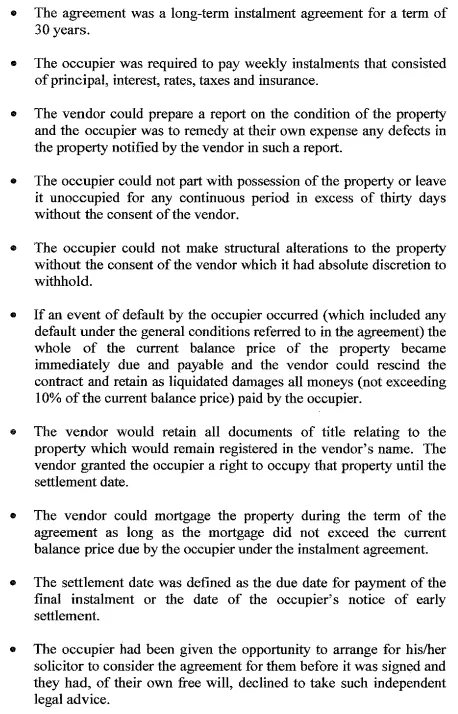
Anyone who tried to exit this scheme early was hit with a $10,000 fee, plus there was a 16-page instalment payment schedule of conditions, which modified the so-called purchase agreement.
Through such agreements, it can be easy for families to fall behind on their payments, be evicted, or leave the transaction with nothing (or even less) despite the value of the property improving due to market shifts or improvements made by the purchaser (either by choice or by the agreement).
In total, 15 victims were identified who had purchased homes whose prices (as of 2004) ranged from $169,000 to $280,900 before fees. Court documents noted that at that time in Auckland, these homes were at the bottom end of the market. While reparations were ordered, Ashenden’s business structure was labyrinthine, and it is unclear what happened with the reparations. In October 2024, Milne and Wesley-Smith reported that victims did not receive the $182,000 in fines that both the Auckland and Invercargill courts had ordered; Scott Carney was advised by AG1 that Ashenden had paid all reparations by 2014. One victim received $5000 Ashenden was personally ordered to pay, but she did not receive the other $5000 reparation ordered from one of his companies, Meguro.
Ashenden declared bankruptcy in 2010, but insolvency reports showed that three of the creditors were companies in which Ashenden was the sole director and secretary. The bankruptcy was viewed cynically, and not as a true picture of what Ashenden was worth. Ultimately, Ashenden was charged with 43 criminal breaches of the Fair Trading Act, but by then he had moved over to the United States, allegedly dismissed his legal team, and was able to avoid an arrest warrant. He also started selling a supplement called Brainquicken, which was owned by Tim Ferris.
Around the time of the 2008 financial crisis, and the collapse of his business empire, Ashenden was struggling with his health, and eventually ended up at an unnamed clinic in Phoenix. While he doesn’t give the name of the condition, Ashenden describes the diagnosis as his body not absorbing nutrients correctly, with the clinic offering a $100/day customised supplement regimen. This sticker shock is what led him to seek a more cost-effective way to address his health problems.
The resulting product, the AG1 powder, is a blend of 75 ingredients. While each individual ingredient may be backed by science, the use of the term “proprietary blends” is controversial. Companies use the term proprietary blends to protect their intellectual property, but it can also obfuscate the actual dosage of ingredients and their resulting macros – critical information for the audience AG1 targets. It can also be a means to include large amounts of filler ingredients, something the current CEO denies. What is listed on the label is described as a combination of vitamins and minerals in nominal quantities, and others that are 100 to 1000% the daily recommended dosage. Fortunately, these excessive amounts are not dangerous. Like most supplements, you will just pee them out.
Powder Keg
Jonathan Milne’s Powder Keg podcast about AG1 and its founder, Chris Ashenden, is equal parts frustrating and fascinating. Fascinating with regards to the depth and breadth of his investigation, and frustrating to hear about how he was allegedly scooped by Scott Carney in May 2024.
Carney re-broke the story about Ashenden’s criminal charges, information Milne says that Carney would not have possessed if Milne hadn’t shared that information first. But them’s the breaks when you’re a professional journalist in a lawsuit-phobic country, and maybe the October 2024 release of Powder Keg ultimately worked in its favour as it would be Carney who would bear the brunt of AG1’s initial legal posturing, while Milne’s work down under continued to be underestimated.
Audio clips are played throughout the podcast in which Ashenden downplays the seriousness of the charges he faced. As Milne notes, Ashenden allegedly misleads his audiences about the extent to which reparations were and were not paid, and frames the whole real estate debacle as something he persevered without any remorse about the victims. Milne, for his part, interviewed Ashenden’s former employees, investors, and ex-tenants with minimal interference.
Foundational nutrition
AG1 promotes its flagship product as daily foundational nutrition, claiming it can eliminate the need for other supplements (i.e., competitors’ products).
What products does AG1 replace?
One daily serving of AG1 can eliminate the need for many other supplements such as multivitamins and minerals, probiotics, greens and superfood powders, vitamin B complexes and vitamin C tablets.
It does not claim to be a complete nutritional replacement system, like Soylent, but the concept of Foundational Nutrition is one to be skeptical of. In episode 6 of the podcasts one of Jonathan’s experts, Will Evans, said the term was fabricated, but gives the impression that AG1 is on the cutting edge. A quick Google search of the question “is foundational nutrition real” pushes out an AI overview that is mobbed by AG1 sources.
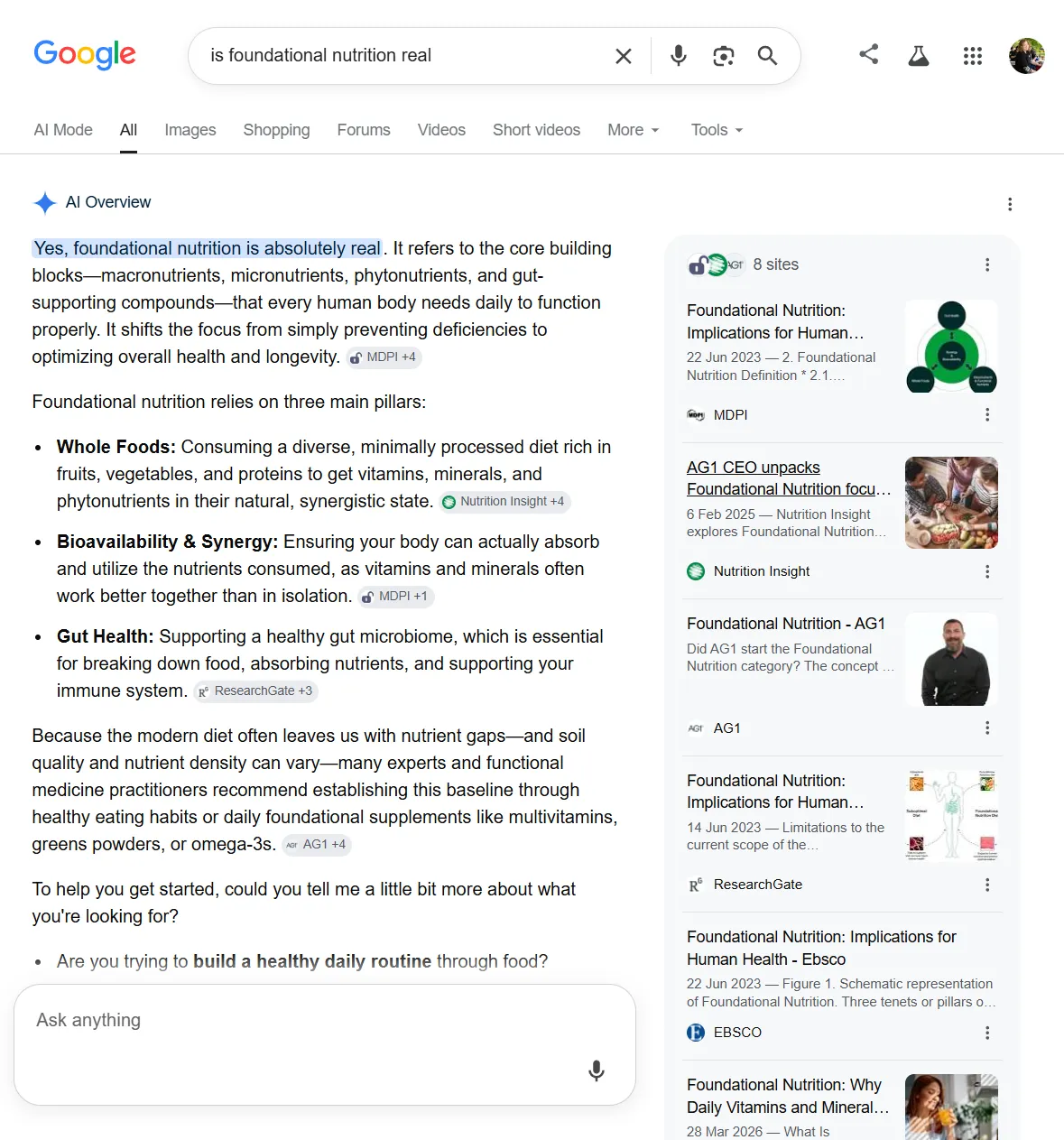
And don’t be fooled by the references to a paper called Foundational Nutrition: Implications for Human Health. The lead author and three other co-authors are employed by Athletic Greens, and the company funded the article processing fees. As Milne explains in episode 8, the publisher of the journal which that article appeared in, MDPI, appeared on Jeffrey Beall’s predatory journals list between 2014-2015. Predatory journals is a term to describe a class of academic journal where there is a higher risk of fraud or deceptive practices; who is being deceived varies. One of the chief issues with these journals is the high turnaround of articles for publication without peer review, seeking fees in return for publication, and fraudulently listing academics on review boards. However, MDPI is reported as putting enough pressure on Beall that the list itself was shut down in 2017, but it remains a publisher of concern worldwide today.
Made in New Zealand? Once upon a time…
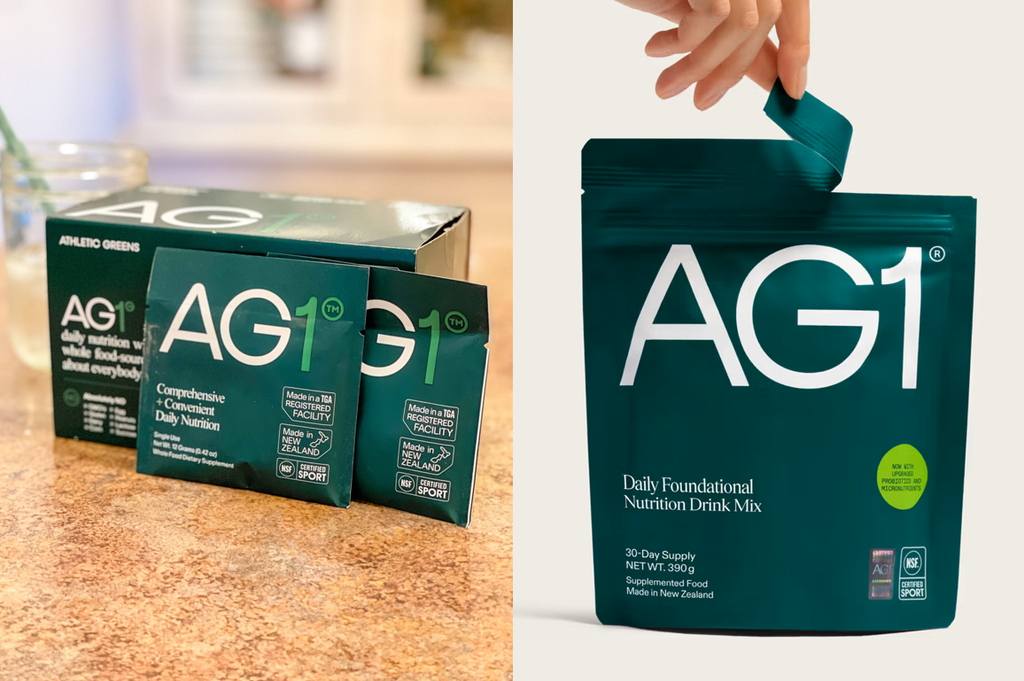
In 2024, AG1 was not available for purchase or direct shipping to New Zealand, despite being made in New Zealand. The “Made in New Zealand” branding, which trades on the country’s reputation for being green and clean, was a big selling point for AG1 until recently. Unfortunately for David Farrier, his ad read for AG1 on the Flightless Bird podcast appears three times throughout Powder Keg: In episode 1, to demonstrate the reach of AG1’s advertising at the apex of its popularity, in episode 6, where Milne responds to Farrier’s Webworm post, and in episode 7 to emphasise how customers believed that the product was made in New Zealand.
In reality, it was produced by Alaron, the Nelson-based manufacturer who were blending the green drink. Blending being the operative word, as many ingredients were sourced from international suppliers. Now that manufacturing has moved to Utah, the Made in New Zealand label has been dropped, and nearly 180 people were laid-off as AG1 had come to account for 80% of Alaron’s business.
Milne’s most illuminating interviews came from present and former employees, as well as Nelson Mayor Dr Nic Smith. Smith’s commentary on the situation in particular might give Skeptics in the area some sense of cheer:
The difficulty with products that are not necessarily backed by scientific proof is they run a risk of being fashion products. There becomes a period where they are very popular and are widely used, and can then simply slip out of fashion. So I think they do have a higher level of risk than your, what you might call mainstream products.
I’ve watched both as a parliamentarian and as a mayor, the real philosophical tension between those that say it’s my body and how dare the government regulate what is available and what can be sold, with those that are very worried about unscientific claims being made or purported or associated with products…Mega-billions involved in the industry with questionable health gains.
However, Smith eventually does shoot from the hip and asks when do the regulators and public bodies have a duty to protect the public from modern snake oil salesmen.
The secret in the mix
AG1 has this disclaimer at the bottom of the page:
Do not exceed the indicated daily intake. Keep out of reach of children. Please inform and consult your doctor before consuming this product. Not suitable for children and adolescents under 18 years, pregnant or breastfeeding women. Persons taking anticoagulant medication should seek medical advice before consuming vitamin K-containing supplements.
So, it remains quite possible that AG1 is not the cause of reported health issues simply because of the undisclosed underdosing. It also implies that there are variations to its formulation according to the market in question.
** Based on formula prior to upgrades. For more information on our upgraded formula available in your region, click HERE.
While I was able to find the full ingredient list for what I believe is the US market, I could only find the nutritional information table for the NZ/Australia market. Between the two, the antipodean formulation has minor increases in calorie count, as well as magnesium and copper content. There is a small decrease in carbohydrates and various reductions in sodium, potassium, Vitamin A, Folates, Calcium, Magnesium, and Zinc levels. The Aus/NZ formulation has Selenium, while the American recipe has Benfotiamine, which is a synthetic derivative of vitamin B1 (thiamine). As can be seen in the images below, the amount of vitamin B12 available in AG1 for the Southern Hemisphere is 16,667% of daily intake, Biotin is 1100%, vitamin C is 1111% and vitamin E is 200%.
Essentially, your urine will have a higher vitamin content than you will at the end of the day.
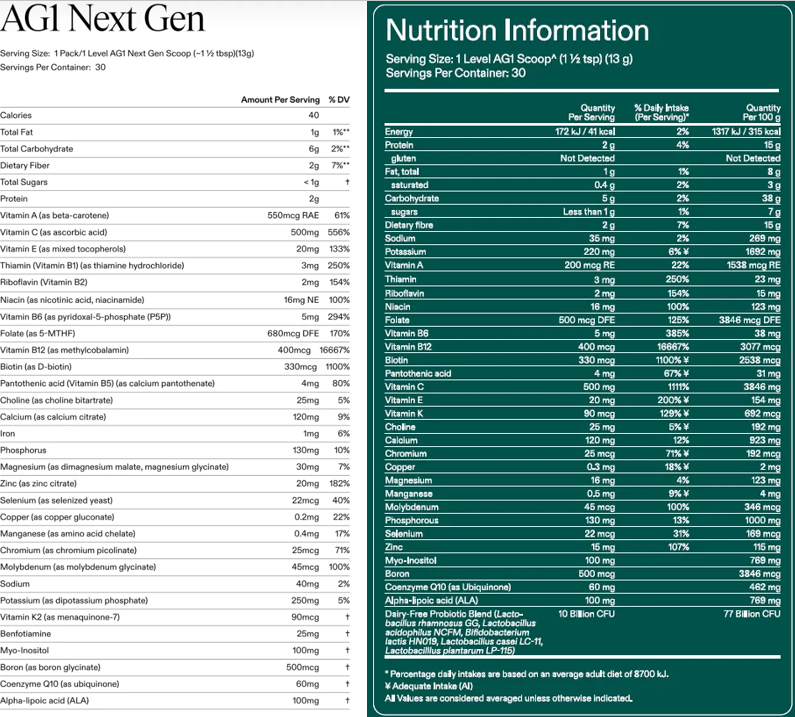
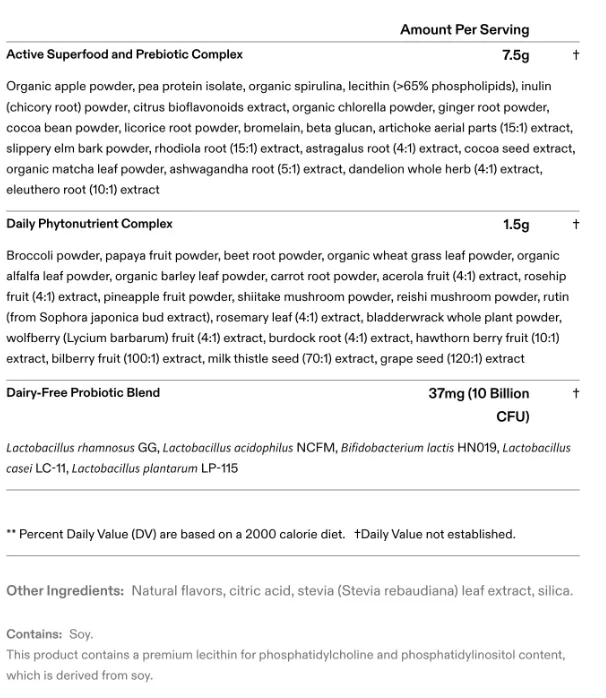
In total, the superfood and prebiotic complex and the phytonutrient complex account for 9g of AG1’s formulation. If the 21 ingredients of the superfood complex were included equally, they would each account for 0.35g of the 7.5g mix. Due to the company’s claims to secrecy, it is difficult to ascertain whether 0.35g (or really any amount, really), when given daily for an indefinite period of time without the oversight of a registered health care practitioner, is safe.
Ashwagandha, for example, is mainly used to reduce stress and anxiety, and help with sleep. What is less spoken about are the side effects (nausea, headache, drowsiness, and diarrhea), contraindications (may increase the rare risk of miscarriage in higher doses, injury to the liver, risk of hypoglycaemia when taking other diabetes medications, testosterone-sensitive cancers), and drug interactions (increased sedative effect with anticonvulsants/barbiturates/benzodiazepines).
Further, it is not known how well Ashwagandha can be tolerated beyond 3 months. Indeed, multiple complaints have been made to the American Food and Drug Administration about AG1 increasing liver enzymes; fortunately, it appears that most complainants were able to resolve this by discontinuing the product, although 9 were admitted to hospital.
However, the math doesn’t always add up. Former employees alleged that the quantities for some ingredients are so small as to be possibly negligible in individual pouches post-manufacturing. As in 100g of an ingredient tipped into what would end up being a 1-metric-tonne mix. As for ingredients in larger quantities, they are just tipped in from their packaging rather than carefully measured and, sometimes, when they are left with an extra bag during their end-of-day stock reconciliation, a mix may get an extra bag of barley or another ingredient.
To put this amount into perspective, a 1-metric-tonne mix is equivalent to 1,000,000g. So, 100g is 0.01% of the mix. Currently, pouches are 390g, which allows for 30 doses at 13g of powder per dose. 1 metric tonne is enough to make 2,564 pouches. When it comes to the smaller quantity ingredients, only 0.039g/3.9mg of 100g added to the original mix will make it into a pouch, presuming perfect equilibrium in distribution. Divide that by 30 doses, this means that only .0013g, or 1.3mg, would be ingested daily.
The presumption that amounts of some ingredients are not reaching all consumers is supported in episode 9, when Milne had AG1 tested at the National Center for Natural Products Research at the University of Mississippi. While the center could only test for 45 of the then 75 ingredients in AG1 at the time, they did detect 40 of those ingredients and did not find any unexpected or dangerous substances. Two of the missing ingredients, grape seed extract and Astragalus root, are described by Milne as being expensive, premium ingredients. Grape seed extract is used to lower cholesterol and reduce inflammation, but there is so little research done that adverse reactions and contraindications are unclear. Astragalus is used to help with reducing nausea and fatigue associated with chemotherapy. Similar to grape seed extract, contraindications are also unclear, but there is more data about possible drug interactions with immunosuppressants, hormonal therapies, antihypertensives, and anticoagulants.
AG1 Post-2024
By the time Powder Keg was released, Ashenden had resigned from AG1’s day-to-day operations but, as of October 2024, remained on their Board of Directors. While no longer NZ-made, the product is now available for direct purchase by New Zealanders; a subsidiary of the company has been established in NZ, and is operated by Ashenden’s father.
In 2025, AG1 introduced a new formulation (which was discussed above) with 83 ingredients and a serving size of 13g rather than 12g. New probiotics were added, as well as increases to vitamins B6, B12, C, and magnesium. Green tea extract (which can cause liver toxicity), selenomethionine, and spinach were removed.
AG1 is slowly making its way back into influencers’ hearts, but the real test will be whether consumers are willing to open their wallets again. In light of AG1’s online-only sales, kiwi herbal supplement suppliers are keen to offer more accessible alternatives. One commonly suggested product is Nuzest’s Good Greens Vitality powder, which contains 77 ingredients. One thing Milne notes, and then drops like a hot potato in the podcast, is that until 2021, the director of Good Greens was Ashenden’s uncle, Geoff Ashenden. Unlike AG1, Nuzest does share the exact formulation of its green drink.
Whether there is any deeper connection between the two products besides familial ties is unknown, but a far more pressing question is whether this expansion into the New Zealand market is too little, too late.