




This article originally appeared in The Skeptic, Volume 7, Issue 5, from 1993.
The ‘Big Bang’ is one of modern cosmology’s most widely known theories: the origin of the entire universe in the explosion of an infinitesimal point, and its expansion ever since. However, the details of this theory are far from complete, and there are a few who argue that much research in this field is not ‘good science’, because of the influence of aesthetic prejudices, mysticism, and religious ideals. So, what is the ‘Big Bang controversy’?
Any theory that explains the history of the observed universe by an explosive expansion from a very highly compressed initial state is a Big Bang theory. So ‘the Big Bang’ is really a family of theories rather similar to the way that biological evolution is a family of theories that explain the history of life by descent with modification, including theories of Neo-darwinism, hopeful monsters, punctuated equilibrium, and so on.
Again analogously to evolution, the Big Bang as a cosmological idea is broad enough that sniping at details of the current frontrunner will not bring down the theory as a whole: many members of the same family are waiting to take its place. For example, the usual Big Bang theories declare that the element boron should have been formed only in the primeval explosion, and thus is comparatively rare. However, should boron now be observed in unexpected abundance, variant Big Bang theories that postulate a non-uniform expansion that would allow for more boron are strengthened.
Lest the Big Bang start looking like an invulnerable, thus uninformative cosmology, we can immediately state that it is falsifiable. At the least, all Big Bangs give us an expansionary universe. There are other, similar, fundamental positions that can be attacked to damage the Big Bang. However, a more interesting case would be that of not ruling out a Big Bang, but forcing increasingly complex and forced variants of it to take centre stage. In this case, alternative cosmologies that present cleaner solutions get an opportunity to become the dominant view.
So, there are two general questions of interest to skeptics. The first is the probability of a Big Bang according to the information currently available. Cosmology is not a minor question in the public mind, and we’d like to know if the Big Bang is as reliable as presented, since we use it to a degree in countering the pseudoscientific claims of the ‘Creationists’. Plus it helps to be informed. If ideally – though imperfectly – science is a process that embodies constructive skepticism in action, we’d better know a bit about the current state.
The second question is probably more interesting, as controversy enters. Some critics of Big Bang cosmologies are not content to claim that these are not well supported, but add that there is a decidedly unscientific character in the way that the enterprise of cosmology is conducted today. In that there is an accusation of pseudoscience residing in the physics departments of universities, using a skeptic’s language and forms of argument, this is something that deserves our attention.
In this article I will give an overview of the physics involved in the Big Bang. My main sources for the strong claims against the Big Bang are Eric Lerner’s book The Big Bang Never Happened, and the essay by Geoffrey Burbidge of UCSD in February 1992’s Scientific American. Both are worth a glance, though as a warning, Lerner’s book is very strident and includes enough ridiculosities to obscure material that is worth consideration. Burbidge’s theories are associated with Hoyle and Wickramasinghe, who certainly do not shrink from weird propositions (life from outer space, faked Archaeopteryx…).
The Big Bang and its inadequacies
The main strengths of a Big Bang cosmology that has gravity as the main force that matters, and thus general relativity as the theoretical context to operate in, are threefold. Much help, though, is needed from particle and nuclear physics.
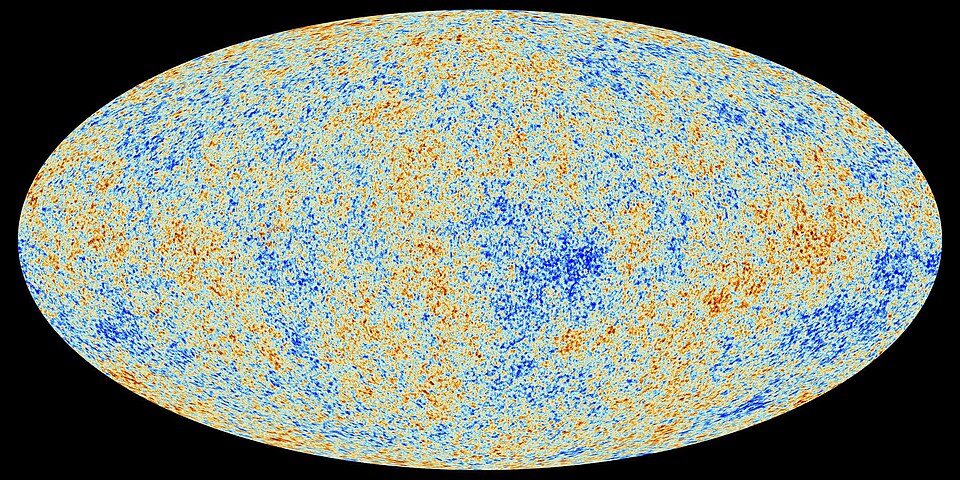
The most obvious strength is the observation that the universe appears to be expanding, in a rather uniform fashion: the distance of a galaxy to us, and its speed away from us, are proportional. The speed is determined by the famous ‘redshift’, something that jumps easily out of general relativity. It becomes plausible to think it all started out from an initial explosion. There is some uncertainty about the proportionality constant (the Hubble constant), but using it we get the usual ‘age of the universe’ of around 20 billion years. Then, and what impresses physicists the most, there is the cosmic ‘microwave background’ radiation. One would expect that at some point after the Big Bang, usual matter and photons (radiation) would decouple, leaving a cosmic ‘radiation noise’ that comes uniformly from all around, and does not deviate from a constant temperature spectrum. Finally, the Big Bang has proved useful to obtain abundances of light elements such as hydrogen and helium. The other elements are mainly produced within stars and the like. Not bad, but observational problems were quick to appear.
I won’t detail the particular problems that led to the introduction of the idea of ‘inflation’, a period of exponential expansion very shortly after the Big Bang. This expansion would give – without incredible fine tuning of parameters – a microwave background that was very smooth as observed, a universe that would appear flat (as far as we can see, space is not strangely warped, but much like what we’d expect from ordinary geometry), and provide a source of energy for the whole explosion. So the situation would be that inflationary Big Bang theories explain a lot about cosmology, and have problems, but not more than what makes for a healthy and exciting field of research. Some observational and theoretical questions must be noted, however.
Inflation would make space about flat, and in the context of the Big Bang, this curvature is determined by the density of matter in the universe. But what we see in the way of ordinary matter is not more than 10% (perhaps an optimistic estimate) of what would be necessary. So cosmologists have taken this as a sign that something called ‘dark matter’ exists, and that this would supply the missing gravity. The evidence for the presence of this, about 90% of all matter, is slim. There is little observational evidence, and claims that galaxy rotation speeds provided indications of at least some of it can be brought into question. Particle physics has produced an exotic zoo of unobserved candidates, and no great reason why they should be present outside of imaginations.
The problem that has attracted most attention is that of large scale structure in the universe. With the Big Bang, the lumpiness of the universe, in the forms of stars, galaxies, and so on, should go away at some scale, where the distribution will look uniform. The age of the universe, around 20 billion years, gives us constraints on this scale – after all, things must have time to form. Plus, the only mechanism provided is that of quantum fluctuations (even a vacuum does not sit still in a quantum world) in the early universe expanding out to provide for the large unevenness we see today (gravity, the dominant force in current cosmology to the extent of ignoring others, can’t do the job alone). Superclusters of galaxies observed today are so large that offhand estimates for times of formation easily reach 100 billion years. There are ways to avoid this, but none entirely free of problems. Then, there is the problem of this degree of clumpiness not showing up on the microwave background (since this is a remnant, we should see effects of fluctuations, which would have to be before decoupling to be large enough). Recent observations suggest that at the largest scales looked at so far, structures are within Big Bang allowances, but questions remain.
Alternative theories
It is entirely possible that the Big Bang family will generate its own candidate that will work nicely to cover all bases. A truly successful quantum gravity theory could provide a basis for the Big Bang event itself, along with solving all its problems. Clearly, none of the difficulties mentioned mortally wounds the fundamental Big Bang idea. But, while cosmologists prefer this line of continuing research, it is worthwhile to ask if this is the best use of resources. For if the potential of cosmic generative explosions is not exhausted, we still may be at a point where the limits of it are strained.
Having to introduce Dark Matter and other ‘predictions’ in an ad hoc manner in order to save the theory from observation is not a sign of health. Neither is the fact that reputations can be made by discussing ‘New-Super-Extended-Hyper…Inflationary’ theories that have long lost contact with experiment and introduce immense complication, in the name of solving theoretical fine tuning problems. A more fundamental theory might solve all and preserve an explosion at the dawn of time itself. But, with the lack of such a definitive case, non-Bang cosmologies have an opportunity.
The climate of cosmology today is one of confidence in the Big Bang, so alternatives among true cosmologists’ work is rare. And all are relatively unknown; though in a physics department, only a student and perhaps more open to new lunacy, I know of only two, and not through normal scientific channels. The Hoyle, Burbidge et al cosmology is a variation on the old ‘Steady State’ universe. This picture involves a universe with no definite beginning in time, but with continuous, steady creation of matter that then joins an expanding universe. The improved version incorporates some Bang ideas, creation taking place in a ‘series of Little Bangs’. A merit of the theory is said to be that inflation, which has some arbitrariness to it in the standard Big Bang, occurs naturally in this cosmology. Though I am not competent to evaluate this scenario, my impression is that it’s not likely to be a winner.
The more interesting contender that I know of, coming from outside of the astrophysics community, is ‘plasma cosmology’. The basic premise here is that known but complex plasma processes, observed in the laboratory, can be scaled up to astronomical distances. Thus electromagnetism becomes a major force in giving structure to the universe. Naturally, those who push this idea are plasma physicists, primarily the Nobel laureate Hannes Alfven. The formation of galaxies and clusters is driven by plasma processes, a thin gas of ions and electrons admitting currents and instabilities called ‘filaments’. Structures arise easily, and the claim is that outer space, not being just a simple vacuum, allows plasma descriptions to account for large scale clumpings. A number of nasty astrophysical problems appear approachable in this manner.
There are many fascinating details, but we can focus on the form in which it can be cast so as to threaten the Big Bang. Firstly, timescales that are definitely beyond the accepted ‘age of the universe’ are needed for large structure formation. This is accepted, not taken as a flaw. The Big Bang theories can predict about 25% helium in the universe, almost all as a result of a primordial process. Plasma cosmologists propose a less cataclysmic way of getting it: through shock waves (from supernovae, amongst other objects) in galaxies. They also say that the energy involved in such a mechanism is just what is needed to produce the microwave background. The interesting aspect, its smoothness, is explained by scattering of radiation from plasma filaments, much like a smooth, diffuse light from all around being seen in a fog, because of scattering from droplets in the air. This mechanism is said to generate specific predictions that match the observations better than conventional models.
A pillar of the Big Bang theory is, of course, the expansion of the universe. But we need not just straightforwardly extrapolate everything back to a point. One scenario is that of an explosion, local in a much larger universe, that starts out with what we see in a much smaller volume, but nothing like the microscopic scale of a Big Bang. Alfven has proposed matter-antimatter annihilation as a power source, which might be somewhat plausible (the initial assumption that equal amounts of matter and antimatter would mix rather uniformly and all go up in smoke is incorrect, since separation and explosion away driven by contact along a layer is possible). Others, like Burbidge’s many Little Bangs, can be postulated.
Orthodoxy and metaphysics
Physics does develop its rigidities. Ignoring controversial ideas is not unknown, and probably to be expected in fields where a few leaders can dominate the outlook of all. I happen to favour an inferential basis for statistical mechanics that has been slow in appearing in textbooks, for example, and many physicists can come up with complaints about pigheaded referees. But it’s not a picture of corruption, just slowness in moving; new ideas eventually diffuse throughout the field and find acceptance.
As an illustration, consider some of Emil Wolf’s work, showing that the spectrum of a radiation source need not be observed to be the same from all vantage points. This was some fairly straightforward and interesting optical work. What got him involved in some minor controversy with astrophysicists is that such a mechanism can produce redshifts that are practically indistinguishable from one that would be the result of just speeding away from the observer. He doesn’t think that this need threaten the expansion of the universe, but that didn’t prevent some hostility, because this was ‘obviously wrong’.
Burbidge charges that the Big Bang has become something of a faith as much as a theoretical framework, and that the climate of cosmology is such that no radical departures are tolerated, the subject being treated as closed. Worse, the peer review system is said to act as censorship, screening out obviously incorrect heresies without examination of merits. Even observation time is denied to workers that search for and find evidence against standard cosmology.
Lerner says much the same, observing that plasma cosmologists have been relegated to their own scientific ghetto, and ignored by the theoretical cosmology community. His more interesting contention is that cosmologists and their allies, the particle theorists, have effectively formed a Priesthood of High Theory, attempting to grasp the secrets of the universe by pure thought, making decisions based on elegance, beauty and symmetry. In the process, contact is lost with experimental reality. The motivations for the Big Bang are speculated to be primarily aesthetic and quasireligious, rather than scientific.
The first Big Bang was the priest-physicist Lemaitre’s ‘primeval atom’ theory. Ever since, as there seems to be this irresistible tendency to mix philosophy or metaphysics with physics, the Big Bang has been seen as a creation event. While some physicists like Hawking have pointed out that a finite space-time of current theory does not much correspond to a naive picture of creation ex nihilo, there is enough in it for the theologically inclined to work on. Lerner also attempts to construct sociological reasons for why finite-history cosmologies would be attractive for twentieth century physicists, which are intriguing but far-fetched. Still, it is not totally implausible that non-empirical concerns have driven cosmology.
Related to this is the claim that the practice of cosmology and much of particle physics has gone wrong. Often, these areas of theoretical science are in a strange state, because of lack of experimental data, and the difficulty in obtaining it. So theorists tend to feed on each other, and problems tend to be more and more determined by theoretical considerations and a mathematical sense of aesthetics, rather than a need to explain real information. Lerner goes further and says that this situation is analogous to the ancient Greeks trying to solve everything by ‘pure thought’, like an insistence on circular orbits for the heavenly bodies because of geometrical elegance and perfection. Things have progressed to a degree that contradicting empirical information forces increasingly convoluted theoretical structures in order to preserve the glamour of the original vision. The theories become more and more difficult to understand, the property of an initiated few, and all but untestable practically. If you don’t see dark matter, it has to be because you can’t look hard enough – uncomfortably similar to saying that one has to have faith to be able to see the reality of psychic phenomena.
Lerner describes the attraction of the Big Bang in its explanation of the present in terms of a time when all was simpler, the forces were united; and then things blow apart, obscuring the essential unity of all, and instead of symmetry, lumpiness becomes the rule. But physicists sitting at their desks, writing down principles of symmetry, can reveal the beauty underlying our world of complication and sorrow. A Garden of Eden story in mathematical language, with priests interpreting constellations to produce the true theology.
Other physicists, such as plasma or condensed matter people, tend to have a less enthusiastic view of attempts to find the ‘Theory of Everything’, a re-run of the late 19th Century, when classical physics was thought to have a good chance to explain all and leave us the boring task of working out the details. We simply know too little, and a grandiose field that is not strongly constrained by observation like cosmology is likely to be subject to many changes – overconfidence is a real concern. An appreciation of complexity would do much to temper claims of getting to the bottom of it all.
Conclusions
Cosmology does seem to have some problems, and its practitioners might not always appreciate this. We may well have a case of metaphysics intruding on physics at hand. Yet I have difficulty in condemning a methodology that postulates fundamentals and tries to squeeze the most out of them. However obtained, the primary problem relating to theories has to be whether they are evaluated scientifically. Still, at the least, the ‘fundamental physics’ people suffer from an attitude problem, perhaps forgetting that science is supposed to be tentative always.
Overall, I would say that Big Bang cosmologies have not exhausted their promise, and alternatives have as yet come up with too little in the way of detailed problem solving to become strong contenders. There is no comfort to be found for creationists, however, even in any possible crisis of the Big Bang. We can only note that the alternatives proposed both extend the age of the universe to an indefinite span, possibly infinity, and attack the very idea of a beginning.
Last, but not least, skeptics should not defend current science unconditionally while they attack pseudoscience; our position should also allow us to be effective critics of science. Cosmology may be providing us with an example of a legitimate science into which philosophical prejudices have intruded to the degree of constriction of our horizons, and where complaints of an unresponsive community have a (small) degree of merit. I’m fairly sure that cosmologists will eventually come through, whether by demonstrating that they’d been right all along, or by undergoing one of those minor scientific revolutions. But in any case, we have at hand a fascinating example of science in action, with all its imperfections and controversies.