



This article originally appeared in The Skeptic, Volume 7, Issue 2, from 1993.
Those definitely were the days. I remember it well: in the Spring of 1972, my first real college seminar. The topic was “Contemporary Issues in Anthropological Theory”. Present were one professor, six seniors and graduate students and one precocious sophomore – myself.
One of the readings was the controversial new book, The Teachings of Don Juan, by Carlos Castaneda. In my paper, I firmly declared the book to be fiction. The more mature scholars were less certain and more cautious. My judgement that day was based on general skepticism and, I would like to think, good taste in literature. Imagine my pleasure years later when I discovered that I was absolutely correct in my estimate, and that it would be shared by many. Enough brilliant guesses like that and people will think I’m a genius!
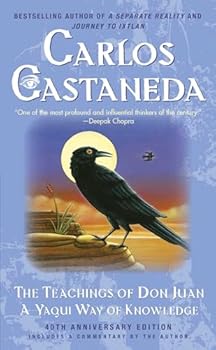
The Teachings of Don Juan: A Yaqui Way of Knowledge by Carlos Castaneda, and its many sequels, claims to be a report of the experiences of an anthropologist who, during the early 1960s, established himself as the student of a shaman. “Don Juan”, the shaman, is said to be a Yaqui Indian from Sonora, Mexico.
The narrative is presented in dialogues and first-person reports of the anthropologist’s experiences. And such experiences! As an apprentice shaman, “Carlos” is introduced to magic rituals and the entire worldview of Don Juan. The rituals included smoking powdered hallucinogenic mushrooms, the experience of which is vividly recounted.
Besides drug trips, Don Juan teaches much “ancient wisdom” of the “warrior’s way”, about “power”, “stalking”, “enemies”, “luminous beings” and other wonders to be encountered in “non-ordinary reality”. If the narrative is to be believed, Don Juan has access to realms of perception and action unknown to Western science.
If this book were presented as fiction or as allegory it would be a remarkable document. However, it is said to be based on actual anthropological observations, and field notes are supposed to exist documenting the story. Furthermore, Castaneda was awarded a PhD in Anthropology from the University of California at Los Angeles (UCLA) for this work. With the seeming scientific validity of the story, the book has been hailed by college students and the counter-culture, and also saluted and praised by the establishment media. Many anthropologists and other scholars have embraced the book, it has been cited and used as a textbook, and the Goddess only knows how many theses and term papers have been written about the book and its sequels. They have sold millions of copies in the Anthropology section of bookstores, and are catalogued in libraries under ‘Yaqui Indians – Religion and Mythology.’
But, there have been skeptics. There are always skeptics. In particular, many anthropologists are skeptical of the work, especially those with knowledge of psycho-pharmacology, the Sonora Desert, or the Yaqui Indians. These skeptics found Castaneda’s work incorrect, impossible, and derivative.
One of the most convincing skeptical studies of the ‘Carlos Castaneda’ affair is The Don Juan Papers. Edited by Richard de Mille, this is a collection of essays and commentary on the Don Juan books, the hoax that they represent, and its implications. About half the book is written by de Mille himself and the balance by other authors. If this book had simply debunked the Don Juan tale as a scientific hoax, it would rank as one of the great books of skeptical inquiry. But de Mille has done much, much more than that. He investigates not only the Castaneda books, but Castaneda himself, how and why the hoax was successful, the nature of skepticism and belief, the relation of religion and science, the psychology and sociology of science, and, I regret to say, a case of serious scientific misconduct.
Let’s begin at the beginning. The Teachings of Don Juan (and the books which followed) is presented as a report of ethnographic field research. However, the raw field notes have never been published, nor have they been made available to other investigators. Nor, indeed, were they ever seen by most of the members of Castaneda’s doctoral committee.
The contributors to The Don Juan Papers show conclusively that the field notes have not been seen because the field work could not have occurred. The evidence is overwhelming that Castaneda’s ‘field work’ was done in the stacks of the UCLA library. The description of the desert, its wildlife, and even the mushrooms that figure so heavily in the story are all flat wrong. “Don Juan” knows few words of Yaqui (and misuses those) and the teachings are a mishmash of Zen, Wittgenstein, and other philosophies that have nothing at all to do with any Native American culture, let alone the Yaquis. In fact, de Mille traces dozens of sources used, including real ethnographies, works of social science, philosophy, metaphysics, occultism, and Edgar Allen Poe.
If Castaneda had simply produced a collage of borrowed texts, the story would end there. But he is no simple plagiarist. For one thing, he cleverly twists his sources to slightly disguise them. For another, his books are artfully constructed to look just like a real ethnographic report, and they have been taken as such by many. Castaneda’s books are not parody, they are allegory. De Mille claims that there is not one single word of truth in the books, that there is no kernel of fact, and that they are pure artifice. They are, if de Mille is correct, an elegant and exquisite anthropological hoax, perhaps the biggest since Piltdown Man.
To understand the Piltdown hoax one must understand the paleontology, anthropology, and nationalist rivalries of the time. To make sense of the Don Juan hoax it is necessary to have a similar background of academic social science and popular culture of the 1960s and 70s. The Don Juan Papers provides part of this understanding, but as a nearly contemporary response to the hoax some of the story it tells may be difficult to follow if you weren’t ‘there’ yourself.
Besides providing the crucial debunking of the fake field work, the contributors to The Don Juan Papers discuss the credulity and outright misbehaviour (de Mille calls it “Sonoragate”) of Castaneda’s publishers, and his academic and popular supporters. The collection contains some ‘conversion’ documents – comments by people who once believed Don Juan and his teachings were literally true and now realise that they were fooled. These documents are interesting because they provide insight into why people believed Castaneda so easily, and fascinating for the fact that so many still value the teachings even after admitting that they are a blatant and dishonest fraud.
Another vital contribution of The Don Juan Papers is the ‘debunking’ of Castaneda himself. Not only are his books fabrications, but his entire life is concealed behind lies. This in itself is not that unusual, but Castaneda’s lies are of a special sort: he is amazingly adept at mirroring back a person’s expectations, so that each one who talks to him sees only their own conceptions ‘reflected’ back to them. De Mille has called Castaneda “the Rorschach man”, after the ink blot test. The Don Juan Papers documents what little is known about Castaneda’s ‘real’ life and builds a (somewhat sad) profile of the psychology of a master hoaxer. This part of the story is, for me, even more interesting that unmasking the hoax, and vastly more interesting than the Don Juan books themselves.
The Don Juan books were a founding influence on the “new shamanism” [2] and are much beloved of poets, neo-pagans, and many New-Agers. Spin-offs and rip-offs have sprung up. I have even read that there is a man who ‘channels’ Don Juan, producing new teachings never heard by “Carlos”. What, indeed, hath Carlos wrought?
References
- Carlos Castaneda, The Teachings of Don Juan: a Yaqui Way of Knowledge, University of California Press, 1968. Paperback edition: Ballantine Books, NY, 1969.
- Chas Clifton, ‘Armchair Shamanism: A Yankee Way of Knowledge’ in Fringes of Unreason: A Whole Earth Catalog, edited by Ted Schultz, Harmony Books, NY, 1989.
- Richard de Mille, ed., The Don Juan Papers: Further Castaneda Controversies, Wadsworth Publishing Company, Belmont, CA, 1990.
Cover image: Sonoran desert in San Carlos, Sonora, Mexico during the blooming season.
© Tomas Castelazo, www.tomascastelazo.com / Wikimedia Commons / CC BY-SA 4.0