




Not a lucky guess: James Costa argues Alfred Russel Wallace was Charles Darwin’s intellectual equal
Who said the following?
“I hate myself, I hate clover, and I hate bees.”
“I hate every wave in the ocean”
“I am very poorly today and very stupid and hate everybody and everything.”
“Oh my God how I do hate species and varieties!”
The answer is Charles Darwin, and in James Costa’s new biography of Alfred Wallace, the co-discoverer of evolution by natural selection, we learn how very different these two men were in temperament as well as class, wealth and education.
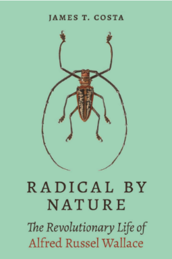
In ‘Radical by Nature: the revolutionary life of Alfred Russel Wallace’ Costa argues that Wallace’s co-discovery was an intellectual feat equal to Darwin’s, and in doing so dismisses two persistent myths about Wallace: that his contribution to natural selection was a lucky flash of inspiration and, at the other extreme, that Darwin stole Wallace’s ideas.
Darwin came from a wealthy family, was university educated, never had a paid job in his life, was terrified of the religious implications of his theory, and used deductive reasoning to launch his idea, arguing that if humans could consciously change species through artificial selection, why couldn’t nature unconsciously change species through natural selection?
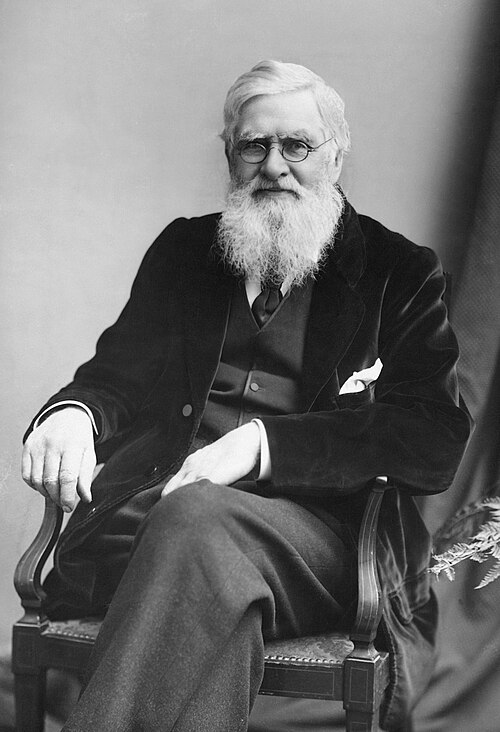
Wallace, by contrast, was a poor boy from Wales who loved collecting beetles, and threw in his job as a surveyor to travel the world as a self-taught professional specimen collector. A utopian socialist and free thinker, he didn’t care how heretical his ideas were, and used bottom-up inductive reasoning to arrive at his concept of natural selection, based on the influence of geography on the distribution of species observed over ten years of collecting. His breakthrough was recognising that geographic boundaries separating related species in the present provided a clue to their evolution from common ancestors in the distant past. Costa argues that Wallace’s generosity in sharing his ideas with Darwin, plus the complimentary nature of their two different approaches, were instrumental in strengthening the case for natural selection.
As for temperament, they were chalk and cheese, as an incident during Wallace’s travels illustrates. On his way home after four years collecting in Brazil, his ship caught fire. Drifting in a life boat in the middle of the Atlantic, having lost thousands of specimens and all but one of his journals, out of food and nearly out of water, what does Wallace record? His delight in seeing a meteor shower, dolphins, and a water spout. He eventually arrived home, and at the age of 29 made an immediate impression on the scientific establishment of London with his observations on the distribution of species.
Their paths to natural selection were also very different. In 1831, aged 22, Darwin was offered a five-year, all-expenses-paid trip around the world as naturalist on The Beagle when his botany lecturer John Henslow dropped out. He had his epiphany about natural selection in 1838 on the voyage home aged 29 still, but was so tormented by its religious implications he did not commit it to paper until he was 35 – an exercise he said was like confessing to a murder. He sealed his description in an envelope and gave it to his wife Emma with instructions to publish if he died unexpectedly.
In 1848, aged 25, Wallace sailed to Brazil with the stated intention of understanding evolution. Writing to his collecting friend William Bates the year before he left, Wallace said:
I begin to feel rather dissatisfied with a mere local collection. I would like to take on some family to study thoroughly – principally with a view to the theory of the origin of species.
Wallace had his ‘eureka moment’ in 1854, aged 31, waiting out the wet season in a guest house on the coast of Sarawak, where he outlined the structure and content of a book on evolution with the working title On The Organic Law of Change. He also submitted a summary of his ideas in the paper ’On the law which has regulated the introduction of new species’ to the Annals of Natural History, which was published the following year. Expecting a vigorous debate over this paper, Wallace was met with complete silence. What he didn’t know is that this paper prompted Charles Lyell, president of the Linnaean Society and author of Principles of Geology, to urge Darwin to get started on his proposed multi-volume book, Natural Selection.
Lyell’s proposition that the Earth was in a constant but almost imperceptible state of change was a major influence on both Darwin and Wallace. Four years after the Sarawak paper, Wallace drafted an extended version of his theory and sent it to Darwin for his opinion, the two having briefly met at the British museum soon after Wallace returned from Brazil. Darwin immediately recognised that Wallace was describing natural selection and, in a state of alarm, sent the paper to Lyell and the botanist Joseph Hooker, two of the few people who knew about Darwin’s theory and the manuscript he was so reluctant to publish. To give equal credit, Lyell read Wallace’s paper and an extract from Darwin’s work in progress at the next meeting of the Linnaean Society in July 1858. They were jointly published in the society’s journal in August, after which Wallace abandoned plans for his book on evolution. The following year Darwin published On the Origin of Species. It has never been out of print and evolution by natural selection has been a matter of public interest ever since.
Darwin is rightly famous for his skill in communicating the concept of natural selection to a general audience. After stepping off The Beagle with vague ideas about his theory, he devoted 24 years to building his reputation as a scientist through publications on coral reefs, fossils, barnacles and numerous other subjects, so that he could launch his heretical idea from a position of authority. While Wallace never achieved Darwin’s public profile, Costa argues his powers of observation and his ability to identify the geological and geographic forces that drive natural selection from patterns of species’ distribution in the present make him Darwin’s intellectual equal.
As for talk of rivalry or worse, it was Darwin who successfully lobbied the government to grant Wallace a lifetime pension when his collecting days were over, against the advice of Thomas Huxley and other members of the scientific establishment. Wallace went on to write 20 books, three of which became classics, one of them simply called Darwinism.
Darwin-Wallace Timeline:
- 1809 – Darwin born in Shrewsbury, Shropshire
- 1823 – Wallace born in Llanbadoc, Monmouthshire
- 1831 – Darwin sets sail on The Beagle aged 22
- 1836 – As Darwin leaves King George Sound in Western Australia he starts his red note book synthesising his observations on species and geography
- 1837 – Darwin’s draws the ‘tree of life’ diagram in his red note book illustrating the proposition that species originate by divergence from a common ancestor
- 1838 – Darwin coins the term natural selection as the force driving adaptation and speciation
- 1845 – Darwin drafts an essay on the case for evolution by natural selection and seals it in an envelope with instructions for his wife Emma to publish it if he should die unexpectedly
- 1847 – Wallace writes to William Bates about his intention to collect professionally, motivated by his desire to ‘understand the origin of species’
- 1852 – Wallace returns from Brazil and presents his paper ‘On the monkeys of the Amazon’ to the Zoological Society of London proposing that geographical barriers separating closely related species could lead to the evolution of new species, published in 1854 in the Journal of Natural History.
- 1854 – Wallace outlines the content of a proposed book ‘On the Organic Law of Change’ in his ‘Species Notebook’ and writes ‘On the law which has regulated the introduction of new species’, published the following year in the Annals and Magazine of Natural History.
- 1858 – Wallace sends Darwin a copy of his paper ‘On the tendency of varieties to depart indefinitely from the original type’ in March which was read at the July meeting of the Linnaean Society together with an outline of Darwin’s theory of natural selection, the two published jointly as ‘On the tendency of species to form varieties; and on the perpetuation of varieties and species by natural means of election’ in the Journal of the Proceedings of the Linnaean Society in August
- 1859 – Darwin publishes On the Origin of Species, the first print run of 1,250 selling out on day one
- 1860 – Wallace publishes ‘On the zoological geography of the Malay archipelago’ in the Journal of the Proceedings of the Linnean Society establishing the ‘Wallace Line’ running between Borneo and Sulawesi in the north and Bali and Lombok in the south which separates monkeys, tigers and other Asian fauna to the east from marsupials, cockatoos and the Australian fauna to the west. Over the next 40 years he wrote 20 books, three of which – The Geographical Distribution of Species, Island Life, and Darwinism – became classics in the fields of biogeography, ecology and evolutionary biology respectively.
Radical by Nature: The Revolutionary Life of Alfred Russel Wallace, by James T Costa, Princeton University Press 2025.