

This article originally appeared in The Skeptic, Volume 7, Issue 3, from 1993.
It isn’t often that I’ve sat in a room and had 200 people yell at me, but that’s what happened when I went to Norwich recently as the token sceptic on a TV programme about ghosts. This was “Anglia Live”, and the star turn – er, featured guest – was Andrew Marshall, author of the recent book Living With Spirits. Also featured on the show were a couple of Grimsby Ghostbusters (that’s what they call themselves), and the Society for Psychical Research’s Tony Cornell. Cornell and I have a lot in common: we both believe that parapsychology, the anecdotal nature of the evidence, and the will to believe, account for most stories. But I think the most likely situation is that if 90 percent of all the sightings can be explained by natural means, then there’s no reason why the other 10 percent can’t be, too. Cornell seems to believe that there is definitely ‘something’ going on.
The audience all had ghost stories to tell. One man saw a telephone table materialise. Well, he didn’t exactly see it materialise; what he saw was a telephone table that someone else later told him wasn’t there – and when he went back to look, it wasn’t. Another woman had a habit of seeing ghostly vacuum cleaners (she said a Hoover, actually, but in this country, unlike the US, you can’t tell whether that’s a specific or generic statement). Most of the stories were more usual, centring on sightings of people. Marshall told one of the less salacious stories from his book, the one about waking up in the middle of the night with a great weight on him.
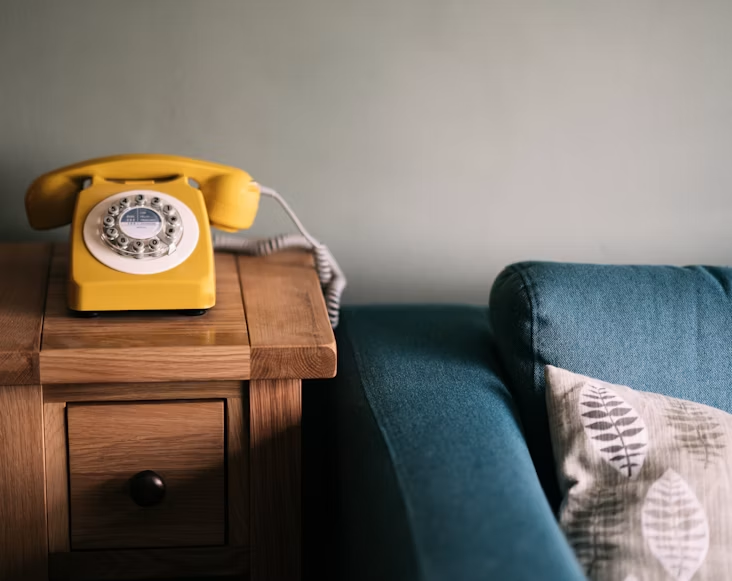
The show does a telephone poll every week, and the results, reported at the end, showed that 86 percent of the callers said they believed in ghosts. The host, a pleasant, intelligent, and humorous chap, turned to me and asked what my response was to this. Well, I said reasonably, I think it shows that people who believe in ghosts are more likely to pick up the phone. That’s when they yelled; this unbelievable roar just sort of rolled over the studio.
It seemed to me perfectly logical, though. I wasn’t arguing about people’s beliefs in that statement, I was merely saying that the telephone poll surveyed a self-selecting sample. First, people who believe in ghosts are more likely to be watching the programme in the first place; second, those who feel strongly about ghosts are more likely to make the telephone call – most people who don’t believe are more likely to say “What rubbish” and go to bed (the show was broadcast late in the evening) than to call in and register a ‘No’ vote. The researchers told me that in fact they’d had a lot of trouble finding non-believers – their way of recruiting audience participants is to advertise for them on air and ask them to call the TV studio to volunteer. Had this been brought out during the programme, though, I suspect most of the audience would have taken it as further support of their views.
The problem here is a serious misunderstanding about the nature of evidence: most of these people think there is proof in numbers. So the fact that the researchers were having a hard time finding non-believers is simply greater proof that the believers are right in the first place. In this view, by saying that the poll proves nothing, I am denying the evidence. Some of this confusion is just human nature; we all have had experiences so powerful that our first reaction is that they must be miraculous – the impact on us is too great for them to be simply the random result of an uncaring universe. Some of it, however, comes from these very audience discussion shows.
Such shows, and there seem to be more and more of them all the time, treat all issues the same way, as social issues, for debate. On social issues – marriage, health care, violence on TV, whether people watch too much television – it is fair for all opinions to be equal, however demented and inferior other people’s opinions may seem to our own. Matters where what matters is evidence rather than opinion, like homeopathy or spiritual healing, are badly served by this treatment.
For one thing, the truth about such things can’t be discovered by debate. For another, the issues beliefs raise, which could legitimately be subjects of debate, are never tackled, so that nothing changes. It would make sense to argue, for example, about whether homeopathy should be available on the NHS that we all pay for, or whether spiritualist churches should be granted the same status as orthodox religious groups, or whether using graphology and astrology is fair recruitment practice.
Why do the shows? Well, there’s always the chance you might raise some doubt in the mind of someone out there who’s never thought about these things, and those people are badly served if it all goes out unchallenged. And it was, er… kind of fun.