




This article originally appeared in The Skeptic, Volume 7, Issue 5, from 1993.
I began collecting scientific anomalies about 30 years ago, after I had become intrigued by some apparent problems in geological theory. The advent of plate tectonics answered some of these nagging questions, but did not dampen my newly-found passion for observations that were not adequately explained by reigning scientific paradigms.
Of course UFOs briefly attracted my attention but, more importantly, so did the books of Charles Fort. It was, in fact, Fort’s mention of the famed “Barisal Guns” of the Ganges Delta (loud bangs of uncertain origin) that stimulated me to collect anomalies in earnest. For when I checked out Fort’s Barisal Guns references in Nature, I also found on nearby pages a host of different scientific anomalies. Curiosity impelled me to begin searching for other puzzling manifestations of nature, and so I naturally commenced with Nature, Volume 1, dated 1870.
I had soon amassed enough geophysical and archaeological anomalies and curiosities to print up 2,000 copies each of Strange Phenomena (volume G1) and Strange Artefacts (volume M1). Despite their notebook formats, these books sold well. The Sourcebook Project was formed in 1973 to handle these and future publications. To date I have published 10 of the loose-leaf Sourcebooks (Phase I), 6 hardcover Handbooks (Phase II), and 13 volumes in the Catalogue of Anomalies (Phase III). In addition, the Project publishes the monthly newsletter Science Frontiers.
I confess that my newsletter is only a teaser to tempt its readers to partake in a much larger, more comprehensive banquet: the Catalog of Anomalies. This work, now comprising 13 volumes of a projected 30, represents my entire file of some 40,000 items gleaned from a survey of about 14,000 volumes of science journals and magazines from 1820 to date. This massive hoard of scientific enigmas, paradoxes, and esoterica was assembled bit by bit from 363 volumes of Nature, 260 volumes of Science, 100 volumes of the Journal of Geophysical Research, and so on with other journals. I believe my collection is unique. It transcends modern computerised databases in its very wide time frame and its focus on the anomalous and curious.
The Catalog of Anomalies represents my personal attempt to assemble the riddles of science and, given a large array of them, to discern some meaning implicit in the mélange. On the practical level, which as a self-employed researcher I cannot avoid, my priorities have had to be as follows: Goal #1 has been the satisfaction of my own curiosity; Goal #2 has been the marketing of enough books to support my research, for no government offices or private foundations seem at all interested in supporting this new discipline of “anomalistics”; Goal #3 has been more altruistic: the anticipation that there may be something scientifically useful in all this. But, even if there is not, the quest has been fulfilling in itself.
Some mainstream scientists may recoil at the thought of 40,000 anomalies and curiosities. Surely nature cannot be that enigmatic and cryptic! Actually, I must stress that my search is still far from complete. Anomalies – those observations that do not yield to mainstream explanations – are ubiquitous and proliferate. I have trawled through only a small fraction of the English-language scientific journals; thousands of volumes of specialised, less-known, publications gather dust untouched. Among them are unexamined books, monographs, informal papers, and popular publications. Foreign-language sources have only been sampled, and I can attest that the fishing there is good, too. And in today’s electronic milieu, anomalies travel from computer screen to computer screen, by e-mail, and by fax. What an immense untapped resource for the Catalog of Anomalies! From all this, I am certain that nature is even more anomalous than the contents of my files intimate.
I admit freely that Catalog of Anomalies harbours a scattering of fraudulent and questionable data. I try to weed these out; but no database can be completely clean. On the other hand, I do not apologise for retaining phenomena upon which mainstream science has ‘closed the book.’ Didn’t science do this to the idea of continental drift until the 1960s, only to canonise the concept in the 1970s? Now, one believer has recommended that data contradicting plate tectonics no longer be published! (Be assured that the pages of Science Frontiers will always welcome such waifs. Scientific political correctness is anathema here.)
Mainstream science’s response to my collections has been remarkably favourable despite my obvious iconoclastic tendencies. For example, Nature has reviewed five of my books without recommending their immediate incineration; other science journals have been likewise generous. The most annoying comment in the scores of reviews in my file has been that science should not waste time with esoterica! This reviewer apparently forgot about that tiny, esoteric advance of Mercury’s perihelion that resisted explanation until Einstein came along. Also troubling have been warnings by more than one reviewer that undergraduates should not be exposed to my books lest the image of science be tarnished.
I would warn against expecting anything profound to emerge from the simple process of collecting anomalies and curiosities. Data collection is, after all, only one part of the scientific process. I have avoided as far as possible the ‘fun’ part of science: theorisation. My purpose has been to keep the database as value-free as possible. It is this value-free aspect of the Catalog of Anomalies plus the eclectic nature of my search that makes my endeavour not only entertaining but liberating. I will explain what I mean by ‘liberating’, and why this feature of anomalistics might be scientifically useful. Unless you have been comatose the past several years, you must know that the entire outlook of science is in flux. The words “chaos” and “complexity” are the current buzz-words. They betoken, finally, the formal recognition by science that nature is frequently:
- unpredictable, as in weather forecasting beyond a few days
- complex, as in any life-form
- non-linear, as in just about all real natural phenomena
- discontinuous, as in saltations in the fossil record
- out-of-equilibrium, as in real economics and even the natural world.
Eroding fast are the philosophical foundation-stones of the clockwork universe: the idea that nature is in balance, that geological processes are uniformitarian, that life evolved in small, random steps, and that the cosmos is deterministic.
My view is that anomaly research, while not science per se, has the potential to destabilise paradigms and accelerate scientific change. Anomalies reveal nature as it really is: complex, chaotic, possibly even unplumbable. Anomalies also encourage the framing of rogue paradigms, such as “morphic resonance” and the steady-state universe. Anomaly research often transcends current scientific currency by celebrating bizarre and incongruous facets of nature, such as coincidence and seriality. However iconoclastic the pages of my books, the history of science tells us that future students of nature will laugh at our conservatism and lack of vision.
Such heavy philosophical fare, however, is not the main diet of the anomalist. The search itself is everything. My greatest thrill, prolonged as it was, was in my forays through the long files of Nature, Science, the English Mechanic, the Monthly Weather Review, the Geological Magazine, and like journals. There, anomalies and curiosities lurked in many an issue, hidden under layers of library dust. These tedious searches were hard on the eyes, but they opened them to a universe not taught by my college professors!
And the end is not in sight. To wax Whitmanesque, when presently recognised anomalies are duly interred under an overburden of theory, still more will arise. And this is as philosophical as I care to get.
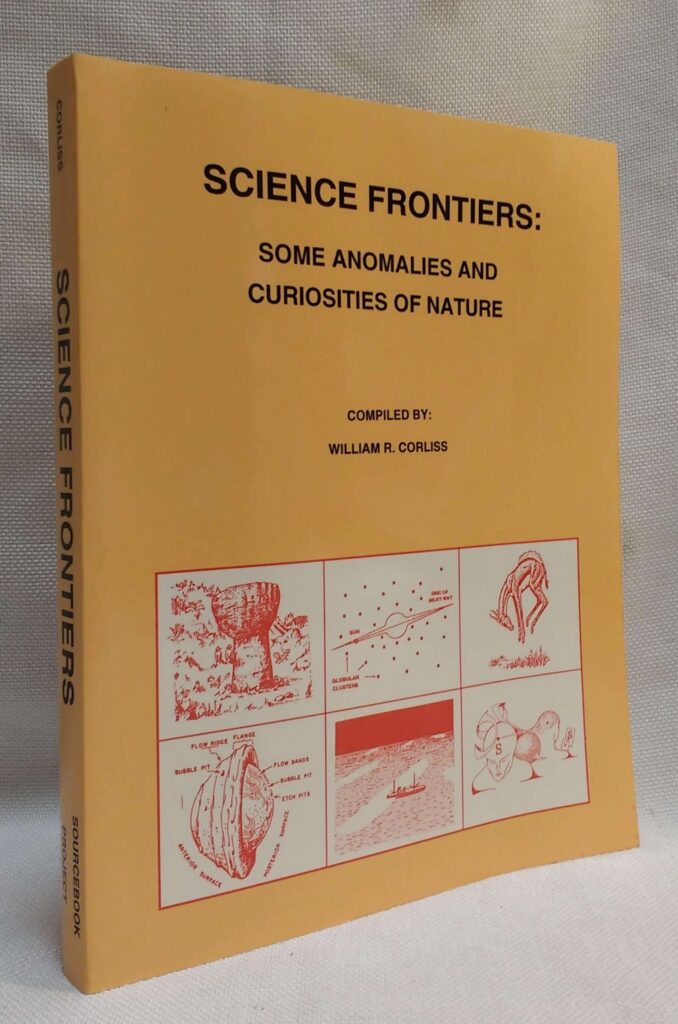
This article is adapted from the Preface to the author’s book, Science Frontiers: Some Anomalies and Curiosities of Nature, a collection of around 1,500 items of science news and research originally published in the first 86 issues of Science Frontiers.