




This article originally appeared in The Skeptic, Volume 7, Issue 6, from 1993.
The story of the Marie Celeste is a remarkable example of how fact, myth and legend can become interwoven. The result is a name that has entered the language which stands for mystery on the high seas. Even such dedicated people as skeptics are beguiled by a story which is no more than a circumstance grafted onto fiction.
There is an eternal fascination in the sea. Perhaps our seafaring traditions locked deep within our psyche predispose us to accept the sea holds mysteries as yet untold. Mention the Marie Celeste and it commands attention, our imagination flies to the ship that was found with all sails set with not a soul on board and the remains of a meal on the table.
Of course the whole thing is total fiction. There never was such a ship as the Marie Celeste. Not in that context. There have been two ships named the Marie Celeste, both small fishing vessels, neither of which were very interesting, nor were they ever found sailing without their crews on board.
When it is said the Marie Celeste was fiction, it is no more nor less than the exact truth. The story of the Marie Celeste was written by the greatest of all story tellers who also created an even greater fictional entity that has assumed a reality in public perception. Who knows whether it was the quality of the writing, or the fame of the author which caught the public imagination. For him it was an embarrassment that his stories should be so popular as to submerge his serious work.
If Sherlock Holmes had never walked the streets of London, it is highly unlikely the public would have bothered to remember the Marie Celeste. Through the ages many ships have been found abandoned, or have disappeared without trace and their names forgotten. A notice in the paper, an overnight sensation and then oblivion. But give the details to Arthur Conan Doyle and you have a writer who turns the mundane into mystery. He it is whose job is to entertain. The story teller weaves a tale to fire the blood. A tale that will pass from generation to generation growing with the telling. Until at last fact replaces fiction.
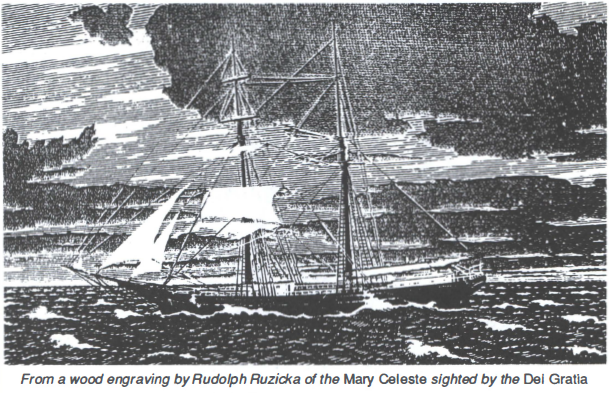
It has long been a matter of argument whether writers are truly inspirational or merely derivative in the source of their plots. Everyone knows the true source of the plays of Shakespeare laying as they do in historic events. Whether it is deliberate searching for interesting material, or whether it is taken subconsciously from a wealth of published material there is no doubt that the heart of many stories spring from actual events rather than fictional imagery. The reportage in the newspapers of the finding of a ship called the Mary Celeste would be part and parcel of many incidents Sir Arthur Conan Doyle would have read during his daily round.
Eleven years after the actual incident, a story appeared in the January 1884 issue of the Cornhill Magazine with the title “J Habakuk Jephson’s Statement”. It did not bear the title of the author and to the extent it was well written and gave what seemed to be a true and accurate account of incidents aboard a ship styled the Marie Celeste, it quickly attracted attention to revive interest in an old mystery. Such was the power of the ‘statement’ it generated a correspondence between the United States Consulate in Gibraltar and the Department of State in Washington. Thus was set in motion a hare that was to run and run. Subsequently the author was revealed but, too late, the myth was born.
In real life the Mary Celeste was found drifting in the Atlantic with no trace of her crew on board. From the day she left port, the Master and part owner, his wife and child together with all five crew members have vanished as if they never existed.
The ship was originally built in Nova Scotia during the years 1860-61 and was named the Amazon. She was at that time of British Registry. It traded for some years before being wrecked at Big Glace Bay, Cape Breton in 1867. The wreck was purchased by Richard W. Haines (and there is a co-incidence if you like) who was an American citizen and re-registered in New York under the name of the Mary Celeste.
A number of changes were made to the ship while being refitted and she became a ‘brigantine’ or ‘half brig’. This means there was the old style square-rig in front with the new style ‘mainsail’ at the rear. It would seem the costs of this were too much for Mr Haines and creditors caused the vessel to be sold at auction, there were yet more financial difficulties and another purchaser who ordered a new refit. The ultimate owners finally were able to trade by finding a charter which would effectively make the purchase profitable.
This history of the ship was such that it gave rise to many stories of a deliberate attempt to defraud the Insurance Companies in order to recoup the losses. In times of bad business such actions are common, however there was never any suggestion the owners were anything other than reputable and were not otherwise short of money. In any event the ship and the cargo were never lost, it was the crew who were missing, and they weren’t insured.
As a matter of history, the ship changed hands several times after the incident and traded for a further twelve years. It ended up being deliberately wrecked on the Rochelais Reef, Haiti, on 3 January 1885. This time there was no error, it was a dummy cargo and the intent was to collect on the insurance. It could perhaps be said to have been an unlucky ship if one believed in such things. One of the difficulties has been to establish with certainty the actual nature of the cargo carried by the Mary Celeste. It seems reasonably clear from all the references in letters from those who examined the ship, and from the insurers that she carried 1,701 barrels of alcohol. The alcohol was proof 93.35 and of specific gravity 0.815. Nine of the barrels were empty and the whole apparently agreed with the Bill of Lading. Whether this description of the alcohol is of one that is very strong and liable to explode, or whether it was drinkable, or indeed what its ultimate purpose was seems to have been lost. It is known that the consignee was unable to repudiate delivery on the ground of damage as the cargo was stated to be in excellent condition.
Whatever caused the crew of the Mary Celeste to abandon her, or whether they were abducted for some reason as yet unidentified seems for ever to remain a complete mystery. The association of alcohol automatically creates an aura of deep suspicion that it must necessarily play a part in the story. The fact that the cargo was untouched suggests it should be ignored as a factor.
Finally, and perhaps most interestingly, the usual perception of a ship found drifting with all sails set, and food freshly prepared in the cabin is wrong. The only account of what was seen comes from the statements made four months later at the enquiry in Gibraltar by the seamen from the Dei Gratia who boarded the Mary Celeste when it was first sighted and subsequently sailed her to port. Necessarily there may be mistakes of recollection of detail by the seamen of the actual condition of the ship.
There was no food in the cabin nor was there any cooked food in the galley. The washing up was all done. The sails were furled except for the topsail gib and the fore-top staysail which were set. The fore-sail and upper fore top sail appeared to be missing. Of particular interest was the condition of the standing rigging. It was said to be “old, it was not broken but wanted repairing”. This is strange in view of the recent extensive refitting prior to departure. It was also noted that on the starboard side only, planking and canvas were nailed outside the glass. The glass was not broken. It can only be assumed this was some form of protection erected during the brief voyage. Although there were davits astern, there was nothing to show whether a boat had been carried, or whether one had been launched.
That the ship itself was sound and well founded is proved by the fact that it was sailed from the place it was found to Gibraltar by a crew of three in the same time as the Dei Gratia with a crew of four. This included putting the ship in order and coming through a storm.
In sum total, the Mary Celeste was found sailing under a small amount of sail, with the possibility of other sails having been blown away. There was little physical damage, three and a half feet of water in the hold and no sign of a crew nor any evidence of how or when the crew left the ship. The Captain’s chronometer, sextant, navigation book, ships register and usual papers were missing. However the ship’s log was present which showed a last entry on 25 November. It was sighted by the Dei Gratia on the afternoon of 5 December at about 1:30 pm.
An unusual circumstance, a mystery, a perplexing problem certainly. This does not mean the explanation may not be very simple. Leaving aside theories of Alien abduction, contorted plots to gain salvage money and scenarios of drunken orgies on board the answer has to be quite straightforward. The fact the ship was under ‘short sail’ means it had not stopped to lower the crew. The missing items, being navigational instruments, suggest an intention to make an independent voyage. Further than this all is speculation. The Captain had his wife and child with him, neither of whom would he be expected to risk in an open boat.
All of which leaves the case very much as it was at the beginning. They vanished leaving not a wrack behind, and an abiding plot to entertain generations to come.