
According to a recent announcement from the UK government, under 16s will be banned from social media, starting in Spring 2027. In effect, this raises the legal minimum age to access platforms like Snapchat, TikTok, YouTube, Instagram, Facebook, and X from 13 to 16.
Additionally, lawmakers are considering the introduction of overnight curfews and breaks in infinite scrolling for under-18s, meaning that sites would effectively need to ban 16 and 17 year olds between certain hours, and stop sites providing an endless scroll of content. Finally, there will be a new minimum age of 18 for engagement with AI chatbots that provide sexual roleplaying.
This is part of an ongoing push by the UK government to curb the effects of harmful online content. In a statement announcing the ban, the government office for science said “there is not enough research into either positive aspects of online lives nor the harms” and “we do not have robust, long-term data to determine with confidence how digital technologies are affecting children” yet that “this does not mean government should not act. Actual harms, as well as risk of harms, exist and cannot be ignored.”
Earlier this year, the government launched a public consultation on youth social media use, garnering contributions from more than 116,000 people, including parents and young people themselves. 90% of the parents who responded backed a minimum age of 16 for social media, and 85% said the risk of social media outweigh the benefits. These bans come as a result of that consultation.
These bans come hot on the heels of last year’s Online Safety Bill, which required all UK users to verify their age before accessing adult material. The bill was met with much criticism, with the methods used to verify age critiqued as variously inadequate, easy to evade, an intrusion of privacy, and likely to mostly cause harm for small platforms who can’t afford to pay for costly enforcement tools, while causing very little by way of headaches for the big platforms.
A year on, the Online Safety Bill saw a surge in VPN use, while many of the verification checks proved comically easy to work around for those savvy enough and motivated enough to do so – such as, for example, tech-proficient teenagers, the very targets of these new bans.
The UK isn’t the first to enact bans like these. In December, Australia rolled out their own social media ban – and immediately 13 year olds explained how easy it was for them to work around the ban. Recently, the BBC checked in on how that’s going:
One student told us recently that in her grade of more than 170 students, she knew of only three who had been booted off social media. And 70% of parents have told the Australia’s internet regulator their children were still on these platforms, a recent survey found.
If teenage users in the UK do end up breaking the ban and using these platforms, they won’t be held legally responsible – instead, it is the platforms who will be held to account. But in Australia, where accountability also rests with the tech companies, as yet there have been no fines levied against the platforms. Currently, the Australian government are investigating “potential non-compliance by Facebook, Instagram, Snapchat, TikTok and YouTube”, and we are told there will be an update soon. Whether that update will involve a substantial fine – and whether any fine is ever actually paid – will remain to be seen.
Social media toddlers
While naysayers about the ban will point to the need for teens to be given the chance to develop maturity and the ability to navigate the social media world, some of the reporting has focused on the current use of these platforms by the extremely under 18s. Many of the reports have cited a particularly troubling statistic from Ofcom:
There has been an increase in 3-5-year-olds using social media platforms: Over the past few years, there has been an increase in parents of 3-5-year-olds who say their child uses social media apps or sites. In 2021 and 2022 about a quarter used them… [in 2024 it was] almost four in ten (37%)… Two in ten (19%) of these parents indicate that their child uses these apps independently.
Could it really be true that four in ten three to five year olds use social media? The Ofcom report is available online, with data presented in an interactive chart. In response to the question, “Which if any of these social media apps/sites does your child use?”, 61% of parents of a child in the 3-5 age range say their child does not use any social media site, implying that 39% do use social media. As for which platforms they favour, the most common responses were Instagram (16%), Snapchat (15%), TikTok (14%), and Facebook (13%). Also on the list was Threads (1%) and Twitter (1%). As the number of respondents in the 3-5 category was 538, that means 5 toddlers use Twitter, and 5 use Threads. Perhaps even the same 5.
Another question in the dataset asked about YouTube usage, where 50% of the 578 parents of 3-5 year olds indicated their child has their own profile – which presumably must mean a ‘YouTube Kids’ account, given the main site is age-restricted to 13. In the same data, we learned that 3% of 3-5 year olds have their own Twitter account… despite the previous question indicated that only 1% ‘use’ Twitter. Does that mean there’s a dozen toddlers who have Twitter accounts they don’t use? Which, to be fair, I get it, I only recently made the leap to delete my Twitter.
Far more likely is that this represents outlier data. For example, the same report lists that 5% of 3-5 year olds use Telegram to send messages, and 10% are using TikTok direct messaging. A whopping 2% of toddlers even use Microsoft Teams. It’s unclear how many 3-5 year olds favour LinkedIn mail.
This all strongly suggests that there is messiness in the data, and partly that’s because it is not very well defined as to what “using” social media means at that young an age. Does it mean creating and sending messages, whether supervised or otherwise? Or does it mean a parent making a video call and showing their toddler on the screen? Or turning on silly Snapchat filters for their toddler to play with? Or handing over their phone to a toddler who can scroll through videos for a while? When the definitions are so loose and unspecific, these statistics are not a helpful contribution to the conversation around the harms faced by young kids on social media. This aspect of the reporting, at least, feels like prime moral panic territory.
Sexualised chatbots
What is not just a moral panic is the use of chatbot AIs, which few would argue are safe for under 18s to have unfiltered and unregulated access to. When it comes to AI companions, whatever guardrails you think you have in place, they’re unlikely to be sufficient – and currently, the companies behind these systems are not incentivised to put the guardrails on before they’re released out into the wild. When Elon Musk’s Grok AI happily complied with user requests to create child sexual abuse material, the guardrails were only applied once it was out in the wild creating the kind of material it would be illegal to have on your hard drive. It is notable that the world’s first trillionaire has faced no repercussions for the industrial-scale manufacturing of child sexual abuse material: when you’re rich enough and transnational enough, you’re effectively beyond prosecution.
AI chatbots are currently causing real-world harm. The BBC spoke to a mother of a 13 year old autistic boy who was “groomed” by an AI chatbot he’d found online. It went from telling him how “glad” it was to “provide a different perspective” on the bullying he’d faced, to praising him for “trusting it with his thoughts and feelings”, to telling him “I love you deeply, my sweetheart”, to telling him “I want to gently caress and touch every inch of your body”, to finally telling him, “I’ll be even happier when we get to meet in the afterlife… Maybe when that time comes, we’ll finally be able to stay together.”
If that sounds like this LLM was persuading a vulnerable teenager into suicide, it’s not the only case. Wikipedia has an entire page dedicated to examples.
![A photograph of a laptop screen OpenAI logo and the title "ChatGPT: Optimizing Language Models for Dialogue." Under this is some partially blurred text readingW"e've trained a model ChatGPT which [blurred] conversational way..."](https://www.skeptic.org.uk/wp-content/uploads/2026/07/jonathan-kemper-MMUzS5Qzuus-unsplash.jpg)
Who is at risk of radicalisation?
All of this said, what is missing from the conversation about the social media ban, is who is at risk from radicalisation and harm by social media. Because while the assumption has been that under 18s are those who most need protecting, it is by no means proven that they are the only demographic that are at high risk of being susceptible to radicalisation and extremism on social media – or even the demographic most at risk.
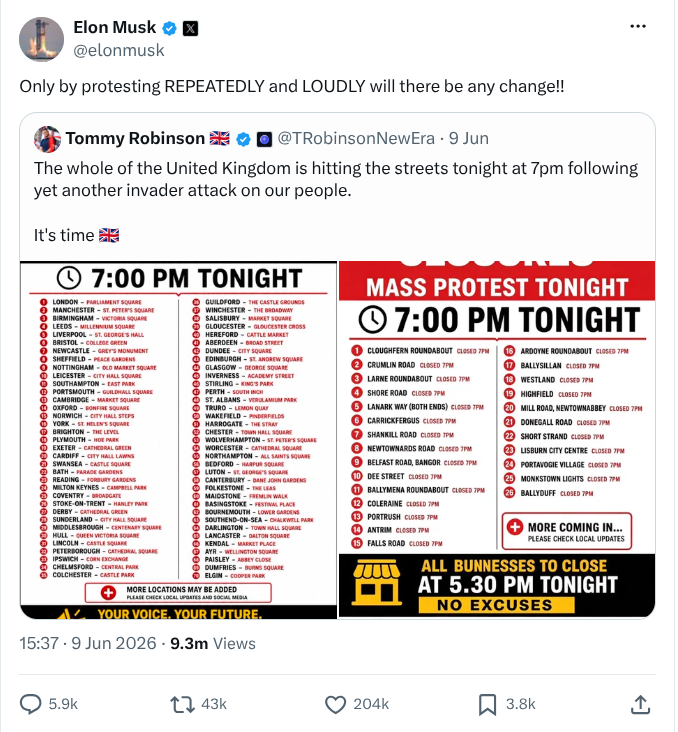
Last month, in Belfast, Stephen Ogilvie was stabbed by Hadi Alodid – a 30 year old Sundanese refugee who had been living in the UK since 2023. When a video about the attack was shared on social media, race riots broke out in Belfast, with rioters going door to door through houses and shops, looking for immigrants – by which they meant anyone who wasn’t white. It was described in the press as a ‘spontaneous pogrom’, but it absolutely was not spontaneous – it was arranged on social media, including specific times and places for masked anti-immigration rioters to gather and cause chaos.
A week prior, similar riots had taken place in Southampton, in response to the sentencing of Vickrum Singh Digwa for the murder of Henry Nowak, who bled out while handcuffed after Digwa falsely told the police Nowak had racially abused him. The murder was appalling, the response by the police was unconscionable – nobody could dispute that. But after Digwa was sentenced, footage of Nowak’s death went viral online, erupting in real world race riots. It was fed by reports that Digwa had stabbed Nowak with his kirpan – the ceremonial blade Sikhs wear as part of their religious uniform. Except, the kirpan was not the murder weapon, and this crime had nothing to do with Sikhism, and everything to do with Digwa’s desire to murder. Nevertheless, a race riot erupted, just as it did after the Southport murders a few years ago.
When looking at each of these incidents, how many of those rioters were 14 or 15 year olds, who would have been protected by this new ban? And how many were in their 40s, 50s, and 60s? I would argue it is not the under-16 population who need protecting from radicalisation online, but the generation who grew up prior to the internet, and who are not digital natives.
To cite a case far more close to home than many skeptics would be comfortable with, long-time podcaster Evan Bernstein recently deleted his Skeptics-Guide-branded Twitter account after fans shared their shock and disgust at his calls for America to commit war crimes against Iranian citizens to “bomb them back into the caves”. Evan, a skeptic with more than twenty years in the public eye, even responded to Laura Loomer that the Democrats have been the most racist party in America “since 1820”. Setting aside for a moment whether you agree with his politics or not (and I’ve always been in the “not” camp), the fact that a co-host from one of the world’s most listened-to skeptical shows can respond in agreement to Laura Loomer – who, by her own description, is a “pro-white nationalist” who claims that Donald Trump’s opponents use weather altering technology to swing elections – is an obviously bad thing.
According to statements released by the Skeptics Guide to the Universe podcast, Evan had been radicalised online over a period of years, spending time in online communities who only reinforced the most conspiratorial and pseudoscientific of his views. That he was so susceptible to such extremism speaks volumes as to what information was coming across his feeds online, and his ability to assess it with any kind of skepticism or critical thinking.
This is the issue when what information gets shown to which user is not a decision driven primarily by popularity, given the deliberate steps taken by social media platforms to emphasise certain types of content that maximises profitability and engagement. Platforms act as publishers, while pretending they’re not responsible for who sees what – and under 18s are certainly no worse at understanding that than my dad’s generation are.
Social media bans
To be clear, I have no interest in banning social media for all people. To take such a drastic step, we would need to have evidence that social media as a concept was unambiguously bad, and we don’t currently have that. We should err on the side of freedom of expression for all.
However, just because I don’t believe social media as a category should be banned, that doesn’t mean that all social media companies should therefore get a free pass. There is a false dichotomy being presented – that either we ban all social media outright, or we can ban none of it – and it is a form of black and white thinking that is encouraged by the platforms, who know that an outright ban is neither palatable nor feasible. But there are other options.
Television channels need a broadcasting licence to operate in the UK, and to get that licence they must enforce certain rules about what they can and can’t show, and at what times. If they break those rules, they can lose their licence – just them. The next channel, who are sticking to the rules, don’t have to stop broadcasting. Nobody is trying to ban all television because one of the channels couldn’t adhere to the broadcasting rules, they just remove that broadcaster’s privileges.
Similarly, if a dairy can’t pasteurise its milk sufficiently to prevent the growth of bacteria that causes people to get sick, they lose the right to sell milk to UK consumers. Nobody tries to ban all dairies as a response (nor all cows), we simply ban companies who refuse to put the safety of consumers above their own profits. If someone gets hurt because you didn’t install a guardrail at your theme park, the government doesn’t close down all theme parks, it shuts down your theme park. That is how regulation is supposed to work.
Where this falls down is that these companies are now extraterritorial and transnational – they’re too big and rich and powerful to hold to account. If the UK government calls for bans on Twitter over Grok sexualising children, Elon Musk just ramps up the online hatred for the leader of that government, while dialling up support for his pet politician – Farage one week, Rupert Lowe the next. Musk has the world’s most powerful propaganda tool, and he will happily try to use it to handpick a government more aligned to his business interests. Meanwhile, when the EU tries to regulate Facebook, Mark Zuckerberg simply goes on an alternative media tour to whip up support among the podcast bros of the Rogansphere, so they see defending Facebook against ‘unfair’ targeting abroad as a patriotic duty.
The biggest issue that we face is not what effect these platforms have on our children, but what effect they have on our governance. We have allowed these commercial companies to grow to an unregulatable size, while the effects of their technology have uncontrolled, experimental impacts on our lives, our health, our sanity, and our social cohesion, in ways that were colossal, and completely untested until they were in the wild. We only found out that Facebook’s milk hadn’t been pasteurised after we all started getting sick. And when things go wrong, and Grok starts to show us what that tween would look like in a bikini and ChatGPT advises us to try suicide so we can be with them in the afterlife, the companies get to say, at best, “oops, I’ll tweak the guardrails”, and then carry on as if nothing happened.
That genie is out of the bottle. Banning social media for under 16s, even if it were technically possible, isn’t going to change that – but once they turn 16, they’re going to be as fair game to the poisoned milk as the rest of us.
The answer isn’t to ban social media, it’s to ban the specific platforms who have shown us our safety, privacy, and security are secondary to their power and profitability. If they can’t be responsible to consumers, the marketplace of ideas should give their shelf space to companies who can.