




This article originally appeared in The Skeptic, Volume 7, Issue 4, from 1993.
One recent Sunday I woke up to find myself struck down with Dabbler’s Disease. I was bored. I couldn’t decide which section of the Sunday paper to read, the choice was so immense to me. I tried listening to records, but couldn’t get past the first track on any; picked books at random off the bookshelves… Leisure wasn’t working.
What about doing things around the house? Today’s options, I was informed by Jane – who was catching up on some work and was supposed not to be disturbed – were bleak: defrost the freezer, clean the car, knock down the shed, or fix the toilet door. In 30 seconds, I had grabbed every ‘what to see in Britain’ book I could find, and I went for a drive.
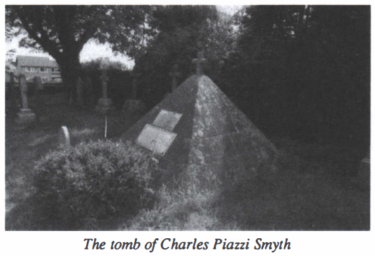
There were two places I wanted to visit in North Yorkshire, both quite bizarre, in their own ways. First was the graveyard of St John’s church, Sharow, where there is a scale model of the Great Pyramid of Cheops at Giza, Egypt. A strange object to find in a graveyard, you might think, but stranger still is the fact that below it lie the remains of a past Astronomer Royal for Scotland, Charles Piazzi Smyth (1819-1900).
Smyth will, I am sure, be familiar to many Skeptic readers, for his extraordinary efforts in seeking esoteric meanings in the dimensions of the Great Pyramid. Smyth purveyed his ideas in three monumental books, Our Inheritance in the Great Pyramid (1865), Life and Work at the Great Pyramid (in three volumes, 1867) and On the Antiquity of Intellectual Man (1868).
Perhaps the best summary of Smyth’s numerology is given by Martin Gardner in his Fads and Fallacies in the Name of Science (Dover, 1957). Gardner’s description of Smyth’s efforts to find connections between the dimensions of the pyramid, and the calendar, the distance of the Earth from the Sun, the mean density of the Earth, and so on, is for my money informed skeptical writing at its very best.
Smyth also crops up (inevitably) in Umberto Eco’s Foucault’s Pendulum, where Eco uses a similar analogy to Gardner (who refers to the Washington Monument) to show that such numerical correspondences can also be readily found in the measurements of mundane objects, such as a wooden booth used for selling lottery tickets.
Smyth was, perhaps a little unkindly, classed as a ‘pyramidiot’ in Barry Williams’ article ‘Pyramyths and Pyramidiots’ (The Skeptic, 3.3), but he was in fact a highly respected and intelligent man. As Gardner points out, Smyth’s passionate belief in his theories was supported by his extraction of a web of seemingly self-consistent numerical correlations from a huge mass of data. Smyth’s pyramidical tomb remains a thought-provoking monument to pseudoscience.
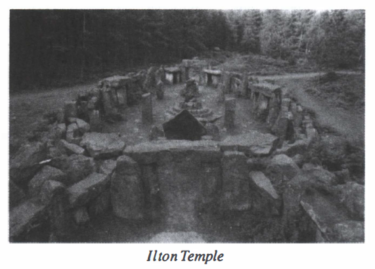
In search of another eccentric figure, I headed north-west for the village of Masham, and eventually found ‘Ilton Temple‘. This extraordinary collection of standing stones, mounds and lintel-bearing uprights, also known as the ‘Druid Circle’, looks for all the world like a remarkably well-preserved ancient monument. But it is, in fact, a complete fake. It is a folly, built in the 1820’s by Squire William Danby of Swinton Hall.
It’s a rather overdone affair, too. Like Smyth’s tomb, Ilton Temple is a miniature. There is a stone-clad recess set into the hillside, fronted by an altarstone, and all around the temple are cairns and stacks of stones.
Whether or not Danby built the folly to provide work for the local populace, or whether he had deeper esoteric intentions, is not clear. Some writers say that Ilton Temple has an aura of darkness about it, and that it stirs sinister vibrations in visitors.
I thought it was a rather silly place. After a day walking around the traces of these two characters I drove home feeling rather uninteresting. I doubt if I will ever be able to leave my mark on the landscape by building a folly, or arranging to be buried underneath a huge golden monolith celebrating The Skeptic. But I could knock down that shed in the garden…