

The public conversation about artificial intelligence runs on two registers. In the first, the machine understands, feels, is on the verge of waking up. In the second, it is about to replace us, deceive us and quite possibly end us. Notice what these sworn enemies have in common: neither claim can be falsified. Wonder and doom are both theology, and both are excellent for business.
There is a third register, used by almost nobody, which is arithmetic. Ask what a machine that thinks actually costs – in joules, in litres, in silicon – and several confident claims from both camps stop surviving contact with the numbers. I build AI systems for companies for a living, so the figures below are the ones I work with, and every one of them is public.
Start with the benchmark evolution left us. Your brain contains some 86 billion neurons and runs, waking and sleeping, on about twenty watts. Less than an old light bulb. The machines built to imitate it train in buildings that consume the equivalent of entire cities, cooled by rivers of air and water. Nature made a hummingbird; we built an ogre.
Now the ledger. A single query to a chatbot costs on the order of 0.3 watt-hours: a pittance, two minutes of an LED bulb. But multiply the pittance by billions of queries a day and you start switching power plants back on. In 2024, the world’s data centres consumed about 415 terawatt-hours, roughly 1.5 percent of global electricity; the International Energy Agency projects a rise to around 945 TWh by 2030 – slightly more than Japan’s entire consumption today – and names AI as the main driver of the rise.
Let’s look at water next, since cooling is where much of the heat ends up. The most careful public estimate, from researchers at UC Riverside, puts a short conversation with a chatbot, between 10 and 50 questions, at about half a litre of water once you count both the data centre’s cooling and the water footprint of the electricity behind it; the direct cooling share alone is a fraction of a millilitre per query. At fleet scale, the abstraction vanishes: Google disclosed 10.9 billion gallons for 2025, up by roughly a third in a single year.
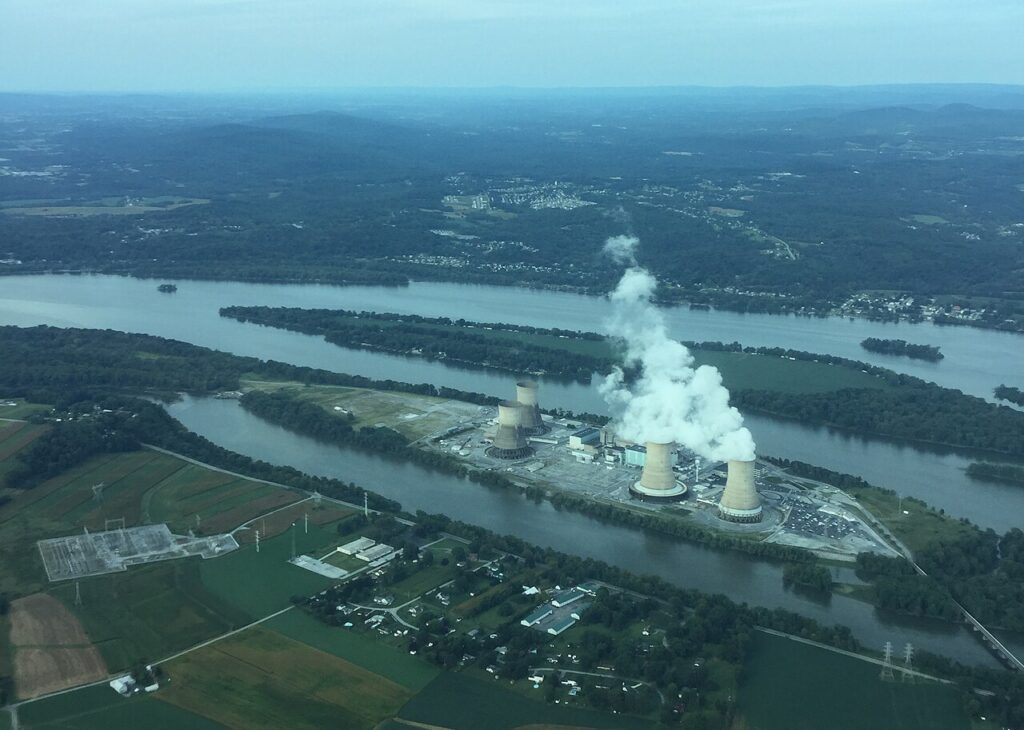
When enough pittances have been multiplied, this happens. In September 2024, Constellation announced the restart of a reactor at Three Mile Island, the name that made the world tremble in 1979. Unit 1, not the accident reactor, had been shut down in 2019 for lack of profitability; it is being refurbished for 1.6 billion dollars under a twenty-year agreement with a single customer, Microsoft, to feed its AI data centres. A piece of the heaviest 20th century has been switched back on to water the machine that guesses the next word. Whatever else artificial intelligence is, it is heavy industry.
What does arithmetic do to the two theologies? To the prophets of limitless intelligence, it says: no exponential in nature survives its environment. Physics even posts the tariff. Erasing a single bit of information costs, at an absolute minimum, about three billionths of a trillionth of a joule at room temperature; that is Landauer’s principle, nature’s non-negotiable price list. Our finest chips still pay millions of times that minimum, and this cuts in both directions: there is no thermodynamic free lunch, and there is no wall nearby either. Between our machines and nature’s floor there are millions left to divide. The interesting question is not whether artificial thought will get cheaper. It is whether we will use that margin to think at the same price, or to think millions of times more.
To the doom camp, and equally to the camp that says it is all hype, arithmetic is just as rude. A restarted nuclear reactor is not a vibe; capital expenditure, water permits and twenty-year grid contracts are the least hallucinated things in this whole story. Meanwhile the theatre of existential risk performs a measurable function: while parliaments debated superintelligence, the mundane dangers, the concentration of compute, data and energy in a handful of hands, advanced without a hearing.
My favourite exhibit for this audience is the dispute over emergent abilities. In 2022, researchers described capabilities that seemed to appear suddenly once models crossed a certain size, absent one day, present the next, cause unknown. Alarming, if true. The following year a Stanford group showed that most of those jumps may be artifacts of measurement: change how you score the task and the cliff becomes a gentle slope. The dispute is not settled; both camps still publish. That is what real science looks like, uncertain, quarrelsome, running behind its own creature, and a long mile from the certainties sold on stage.
In France, where I come from, the skeptic’s toolkit goes by a lovely name, la zetetique, and its working rule fits this subject like a glove: do not ask who is right, ask where the evidence stands, and prefer living with the unfinished to living with the false.
You can even practise it at home, for about £10. Plug your computer into a wattmeter socket and watch the needle while a locally run model generates text: consumption leaps as the sentence forms and falls when it stops. Every sentence heats. Your laptop blowing warm air over a sonnet is the data centre in miniature, and it answers, at kitchen-table scale, the two questions that never wear out. Where does the data come from, and where do the joules go?