




This article originally appeared in The Skeptic, Volume 7, Issue 3, from 1993.
Editor’s note: when this article was first published, the Pons and Fleischmann experiments had not yet been proven to be a hoax, and were therefore still a matter of genuine skeptical debate. A year previous to this article, The Skeptic published another piece on Cold Fusion, which viewed the experiments with some suspicion. The historical debate is preserved here in these articles.
Deliberate scientific fraud is comparatively rare. When it does happen, it is usually in the life sciences, where even the great Pasteur has recently been accused of it. In the physical sciences it is much less common, since experimental results are usually easier to check. Rushed or sloppy work is more common, but the peer review system exists to try to stop such work reaching publication. All the strengths and weaknesses of the process by which science advances are illustrated in the Great Cold Fusion fiasco of 1989. History will have to decide whether – as I believe – Fleischmann and Pons were rushed to publish their findings, believing that they had a real and reasonably reproducible effect
But now the ‘failures to replicate’ by MIT’s Plasma Fusion Centre and Caltech and Harwell have themselves been criticised by well-qualified people, and in particular the work at MIT has been attacked from several quarters for sloppiness and some remarkable examples of ‘data reduction’, where different processes of manipulation were applied to measurements from the heavy water cell and its light water control.
It is true that the effect is very difficult to replicate. To obtain it, it is necessary to load the palladium to a ratio between the deuterons and the palladium atoms of at least 0.83, and even then the metallurgy is crucial. A recent example of this was an experiment where sixteen cathodes were employed from two batches of metal. With one batch, seven of the eight runs gave excess heat, and in the other there were no signs of it at all; there is speculation that micro-cracks seen in the failing batch may have prevented the effect from having occurred.
What is quite clear is that the parameters for inducing excess heat were not at first understood. Even now they are not very well understood. McKubre and his team at SRI in California are now satisfied that their very long and meticulous series of calorimetric experiments have shown them how to induce the effect at will, while Fleischmann and Pons themselves, working in their large well-staffed laboratory in France, were able to show videotape of several cells boiling away their electrolyte, as part of the paper they presented at the third international conference on cold fusion in Nagoya, Japan, late last year. In a commentary, to be published in Fusion Technology, Professor Hagelstein of MIT calculates the energy released in the boiling episodes and shows them to be very greatly in excess of any possible chemical or storage effect Indeed, the heat in the vicinity of the cathodes was sufficient to melt their plastic supports, indicating temperatures of about 300°C.
Replication of the effect is now well-established, two particularly good examples being by Takahashi of Osaka University – who uses pulsed input power – and Storms of Los Alamos National Laboratory in New Mexico.
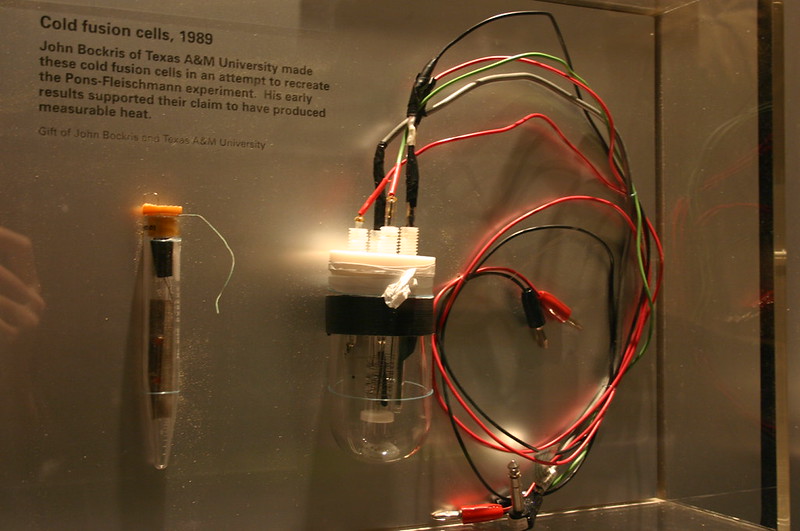
A year ago, I was unconvinced. But there were certain aspects of the matter which I felt needed investigation: the event which perhaps persuaded the Utah duo to continue their work, when a cathode of about a 1cm cube exploded with sufficient force to blow a four-inch deep hole in a concrete floor; the claims by two laboratories that used cathodes fogged photographic film; and that some experiments appeared to generate so much of the unstable isotope of hydrogen (tritium) that opponents were being driven to cry fraud. These sort of accusations were becoming, I thought, a little too frequent, along with words like ‘delusion’, ‘incompetence’, ‘wishful science’, ‘true believer’ and the like.
Could it be that honest skepticism and failure to replicate were causing opponents to overreact to the steady stream of results coming in from around the world (but not from the UK)? And I was not happy that the complaints against the quality of work or the conclusions drawn from the failures to replicate were going unpublished, as they then were. Such news items as did reach the press were, it seemed, always followed by a negative comment from an eminent scientist who seemed not to have reviewed the work in question. The odour of rodent was getting stronger all the time. It was most especially odd to see that the cold fusion ‘community’ in the USA were reacting in much the same way as their own critics to the papers claiming and then confirming very considerable excess heat from the simple electrolysis of a solution of potassium carbonate in light water with a nickel cathode.
The fact that the deuterons trapped in the ‘classical’ palladium lattice were further apart than they are in the deuterium molecule – so that their claimed fusion was absurdly improbable – did not prevent some from claiming that there was no scientific rationale behind this light water work. The fact that the excess heat from light water came in very quickly (suggesting a surface effect) and not in erratic bursts, was actually suggested as indicating experimental error, as was the comparative ease with which the experiment was reproduced. It is instructive to consider whether, had this effect been reported before the heavy water work, it would have been followed up or ignored completely. Should Davy or Faraday have noticed and developed it, the world might have been a very different place today.
It is necessary to consider the complaints of such few opponents of cold fusion – which may well be a misnomer, but we are stuck with it for now – as are knowledgeable about the field. The first complaint is that in hot plasmas deuteron-deuteron fusion has as its usual products either helium-3 and a dangerous high energy neutron, or tritium and a proton. Only once in ten million fusions is helium-4 produced, and even then a high energy gamma ray is emitted. Whatever is happening in cold fusion is nothing like this. To explain the excess heat we would expect to see a storm of lethal radiation from the reactor – the ‘dead graduate student’ problem. But there is no such radiation. A little at the fringes of delectability, but nothing dangerous. The second complaint is the lack of reaction products commensurate with the heat. Generally this is indeed true, though there is tritium and considerable helium; but rarely in the required quantities.
Nevertheless, the heat is there, replicated in published work over and over again. Theories have been advanced to explain it, some by physicists of considerable standing. These range from straight nuclear explanations based on our current understanding of quantum physics, to some quite exotic ideas involving fractional quantum states and the ‘zero point’ energy. The nuclear products have been found, again replicated and published. Perhaps we are trying to understand a submicron silicon microcircuit from the perspective of a thermionic valve expert.
In this context the light water effect is the most intriguing. A recent presentation by the heat transfer specialist company Thermacore at MIT showed their efforts to demonstrate that the steady excess fifty watts coming for months from a light water cell had a trivial explanation. These efforts were exhaustive and eventually fruitless; the fifty watts kept on coming. Thermacore’s reputation is such that replication attempts are underway at several major centres. Dr Reiko Notoya of Hokkaido University actually had such a cell running in Nagoya, along with its control; it was hot to the touch. Following arguments about the equivalence of the cells, she brought them to a lecture at MIT, where they failed, the cathode having been contaminated with oil while being drilled. Nothing daunted, the redoubtable lady came back for another go, this time with more success. When you do not fully understand what you are doing, then, as with Edison, persistence and care are the only weapons available.
Dr Robert Bush of California State Polytechnic University does claim to have discovered the source of the heat, that he has evidence that the potassium is picking up a proton to form calcium, and that if rubidium salts are used strontium is formed in the same way, in the right quantities. As yet no confirmation has been done of this published work, so far as I know, anyway. While this light water work has been virtually unreported outside the specialist press, it has attracted considerable commercial interest in the USA; with claimed gross excess energy ratios of up to 20: this is not surprising. Observers of the field believe that the first large scale (kilowatt) systems will be demonstrated within about six months, and small free-standing self-energising systems perhaps a little later.
There is another different approach to this research, one in which there is no electrolysis. In general this method (most dramatically demonstrated by Yamaguchi of NTT and Kucherov et al of LUCH near Moscow – the latter’s work being the subject of an extraordinary paper in the journal Physics Letters A) involves energising a palladium plate previously saturated with deuterium. These experiments seem to be reproducible with comparative ease, and considerable heat is released, along with nuclear products in profusion, but again not enough to explain the heat. The particular example of the LUCH work is particularly instructive: they used low-energy glow-discharge to trigger the reaction, and when studied under a microscope the plates showed what appeared to be areas of melting, with voids formed in the metal. Should Kucherov’s work be replicated, (and we should not forget that, although all these experiments are slightly different in detail, they do tend to confirm one another) then this must be regarded as one of the most crucial findings of all.
There will now be many problems to solve, but we are presented with a difficult question. Does all this work mean that the world’s energy problems are over? Ridiculous, of course not, I tell myself. But from a purely intellectual view I have to accept the reality of results replicated over and over by competent scientists. The argument ‘it can’t be happening, you can’t explain it, therefore it is not happening’ is an emotional one, and it is wearing a bit thin anyway. We went in less than three years from a reactor in Chicago which gave out minuscule quantities of heat to the death and maiming of thousands in Japan. We have seen two bicycle mechanics derive the basic laws of aerodynamics and realise man’s ancient dream of flight, and almost the commonest element of the earth’s crust become the basis of the electronics revolution. We know that some solid state phenomena lack any agreed theoretical basis. Faraday said that nothing is too wonderful to be true, and Feynman said that science is disbelieving the opinions of experts.
On a logical, intellectual level I must conclude that nuclear physics is incomplete when referring to the solid state – and I do appreciate that it should make no difference to a nucleus what state its atom is in – and that the world’s energy problems are indeed over.
What is absolutely plain is that we must all take great care to maintain intellectual discipline. We must not accept as definitive any scientific results which claim to disprove effects claimed by others, nor assume that the ‘best’ laboratories can be totally relied upon to do perfect work. We must not allow reason to override evidence, as the Academie Francaise did in about 1800 when they declared that the idea of stones falling from the sky was against reason and we lost so many meteorite specimens to the rubbish heaps, or when continental drift was derided in scientific journals as ‘a fairy tale’. Planck ruefully concluded that new theories needed about twenty years before acceptance, and many instances exist of solid evidence being ridiculed by the science community before eventual acceptance. Science needs the careful researchers who validate reasonable theories, and it also should be more sympathetic towards the wild men of science who claim to have evidence which contradicts the current accepted wisdom – however dubious their rationale for trying the experiment.
Misunderstanding of scientific principles and misunderstanding of the mathematics of coincidence, together with sheer fraud, mysticism and attempts to apply science to subjective phenomena, are the causes of much delusion in the minds of many. In any effort to set the record straight in such matters we must avoid the assumption that phenomena that are odd or difficult to reproduce are the result of fraud or self-delusion.