




This article originally appeared in The Skeptic, Volume 6, Issue 6, from 1992.
Skeptical principles are not always applied in science as rigorously as you might think. This is not usually a problem, because a lot of science involves filling in the gaps, checking that the predictions of theory really work. But when a new claim seems barely credible, almost paranormal, then the skeptical approach is exactly right.
Over three years ago, a quick and easy way to cheap power was announced. Since then, the so-called discovery has been checked out, and generally discredited. Despite all the criticism, the original discoverers are still persevering. One of them, Martin Fleischmann, went to the annual meeting of the British Association for the Advancement of Science, the BA, to report on progress. The problem for scientists and skeptics is to know how to keep the door open for unlikely but useful discoveries, but how to close it when the subject has become a waste of time and effort.
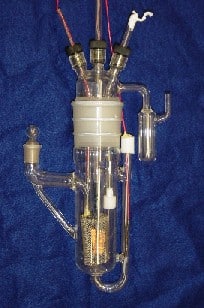
Image: Stevenkrivit at Wikipedia, CC BY-SA 3.0
It was in March 1989 that a British and an American scientist called a press conference to announce the discovery of the century. It had the potential to bring nuclear power without radioactivity. It could run from a gadget the size of a jam jar so that every home (perhaps every car) could have one; and best of all, it could run on water.
This was no hoax. The discoverers were two chemists with valued reputations at risk. Furthermore, they could point to a theoretical basis for their work. The only controversy at that time seemed to be the fact that they had found a cheap and easy chemical way of doing what physicists were spending millions of pounds trying to do, and failing.
Professor Martin Fleischmann came from Southampton University (the host for the BA meeting this year) and before that came as a child refugee from Nazism in Czechoslovakia. Stanley Pons was from North Carolina and then the University of Utah. They both (F&P) knew that nuclear fusion offered the best hope of cheap and clean power for the future. They also knew that a simple route to this involved fusing deuterium atoms together. Deuterium is a heavy form of hydrogen which can be isolated from sea water, given enough power, and they had found a way to get that power.
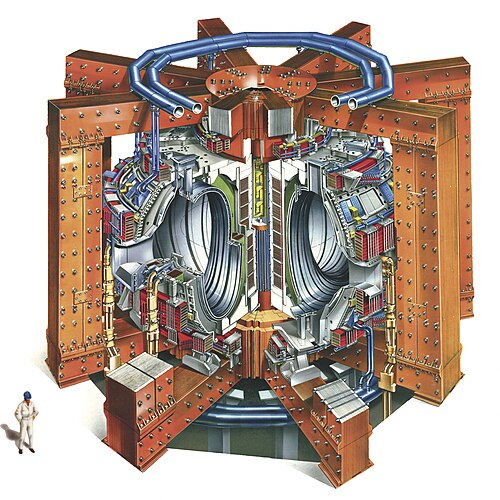
Image: EUROfusion, CC BY-SA 4.0, via Wikimedia Commons.
The conventional physical route to fusion, still being pursued, is to use intense magnets to crush the deuterium atoms together. F&P could see another way. They knew about palladium and its behaviour as a catalyst for reactions involving hydrogen. It seemed to soak up hydrogen, H2. like a sponge, so it should soak up deuterium, D2, too. In fact it could soak up so much that the hydrogen or deuterium atoms must be partially inside the palladium atoms, tangled with their electrons.
With the hydrogen atoms so close together, and their positive nuclei surrounded by a negative soup, F&P reasoned that it might take only a slightly greater push to fuse the two positive nuclei. As electrochemists they could produce the D2 from D2O, heavy water, and the palladium could double up as electrode and medium for the fusion. They also knew that electricity could create the same effect as very high temperatures. It might get the two nuclei to combine, and if those two nuclei were of deuterium then it would only take a few of them to bring about the solution to the world’s energy problems.
At the BA meeting, Professor Fleischmann explained that the chances were low, but the implications of success would be tremendous. For about five years, the two had worked in secret. Then on 23 March 1989 they went public. They had seen their apparatus develop far more energy as heat than they had put in as electricity. On 27 August 1992 at the BA, the story was much the same. There were videos showing heavy water boiling in the tubes. Some showed the recent date of 23.6.92. F&P were still at work at a secret location with little progress to report despite all the publicity and criticism of the last three years.
During that time the excitement has largely died. One outcome of the 1989 press conference was that scientists throughout the world tried to repeat F&P’s experiments. The first results seemed to support the claims. Perhaps only their supporters went public quickly. Those who failed to reproduce their results kept trying. Later came the reports of those who could not substantiate the claims or their implications. There are three important requirements: the production of excess heat, the emission of neutrons and the formation of tritium or helium. Not all experimenters were equipped to deal with all three, and some looked for just one. The more features that they looked for, the less these tied in with each other.
Eventually a consensus view emerged that this was not cold fusion. It might be something unusual, but it was not the answer to the world’s energy problems. Those who had been investing huge sums of money in the development began to cut their losses and F&P disappeared from the news and the scientific stage. The general expectation of most interested scientists was that after a few months or years, one of them would come up with an explanation of where their ‘excess’ energy had really come from (probably stored up in some part of the setting-up process). There might be the odd reference to some accident which produced apparently supporting evidence. Then we could all forget about it.
All of this has been reported in detail in Too Hot to Handle, a readable account by a respected nuclear physicist, Frank Close. It was reviewed by Anthony Garrett in the March/April paperback 1991 issue of The Skeptic. It came out (Penguin, £6.99) on the same day as Fleischmann’s talk to the BA. This edition carries an epilogue to bring us up to August 1991, where we learn more of the personal passions but little more of cold fusion. Dedicated historians can find out more from over a thousand articles, tapes and disks in the Cold Fusion Archive collected by Bruce V. Lewenstein (Olin Library, Cornell University, Ithaca, N.Y.)
The planned talk to the BA might have been Martin Fleischmann’s chance to set the record straight in some way. An estimated audience of 250 people came from a wide variety of scientific backgrounds. They were generally disappointed. Those who were looking for a rich scientific controversy saw little argument, just a few questions of the type ‘Couldn’t your results be explained by…’ (to which the answer was ‘no’). Those looking for the climb-down which would signal the end of the Cold Fusion Era received nothing. Finally, those hoping for the ultimate proof of the discovery of the century heard the same old assertions with just a few repeated experiments. Claims that others had done some of the confirmatory work were not clear, dramatic or numerous enough to carry conviction.
Extraordinary claims demand extraordinary standards of confirmation. These were required three years ago following the original announcement. Now that these claims have largely been disproved, the standards required of any supporting work must be increased. Dramatic demonstrations of that standard were simply not given. There is a problem here for dealing with all extraordinary claims. It is relatively easy to specify general criteria for acceptance. It is more difficult to make them specific for any particular phenomenon, especially when the main supporters of the claim are the ones who do most of the testing. It is virtually impossible to decide who should be the final arbiter.
In one particular respect, the perseverance of F&P gives heart to one form of skepticism. You must have heard some version of the story which I know as ‘the everlasting match’. This involves a minor invention that will make some aspect of life easier, such as one matchstick that can be struck as many times as you need a fire. Before the discovery is fully announced, the story goes, the inventor is bought out, even snuffed out in some versions, by commercial interests. The everlasting match story involves a consortium or conspiracy of match manufacturers, phosphorus producers and lumberjacks.
The cold fusion version would involve uranium miners, car engine makers, coal miners and, biggest of all, the huge oil companies. Clearly this has not happened. F&P are still working. The conspiracy theory fails, or must become much more subtle.
Scientists would like to think that the results of experiments are clear-cut and speak for themselves. With hindsight it can be easy to decide which results to believe, but not at first. It is not experiments but people who ultimately give their verdict. As often happens in claims of the paranormal, the supporters hang around to vote in favour, but the disbelievers drift away, unwilling to waste any more of their time on the issue.