




This article originally appeared in The Skeptic, Volume 7, Issue 4, from 1993.
Over the past few years neural networks have been the subject of an explosion of interest from both the scientific research community and the popular media. It would seem, if the contents of The Skeptic are anything to go by, that neural networks are now making their way into Research Into the Paranormal (R.I.P for short!). In particular the condition of ‘Near Death Experience’ where, to use the popular phrase, ‘my whole life flashed before me’:
Skeptics and believers may disagree over the significance of near-death experiences (NDEs) and in particular whether they reveal anything about the spiritual side of man. But if they do, then some recent findings by an American physicist may serve to widen our current definition of spirituality.
(From The Skeptic, Volume 7, Issue 3 – Hits and Misses, “Near power-down experience”, Steve Donnelly)
According to the Daily Telegraph on 8 May, Dr Stephen Thaler, a physicist working for McDonnell Douglas in Missouri, has witnessed an NDE in a type of computer called a neural network. Neural networks are modelled on the brain by having a large number of processing elements with a high degree of interconnectivity such that they not only have a structure similar to that of the brain but can also be trained to perform tasks.
Dr Thaler devised a way of gradually destroying the neural network by severing individual connections in order to test his theories about the experience of death (computer rights activists please take note). For a partially trained network he found that when he had severed up to 60 percent of the connections the network’s output was gibberish, but when almost 90 percent of connections were disconnected it started to produce particularly interesting results. Its output became ‘whimsical’ because it was reminiscent of but not identical to things that it had been taught. He also discovered that from the network’s point of view, time appeared to slow down.
He relates these occurrences to those similar experiences of the dying brain: ‘it is the unwinding of a brain and the reliving of all its most ingrained experiences.’
Indeed, it is because of the superficial similarity between artificial neural networks and their real counterparts (the human brain, for example) that research has flourished, notably in psychology and neuroscience where artificial neural networks are being used as tools to model psychological and physiological phenomena. Indeed whole new research disciplines such as computational neuroscience and cognitive neuro-psychology have grown at this new interface.
In his article on this subject, Philip Yam admits that there are shortcomings with the network which first appeared to simulate a NDE, in that the model used does not even approach the levels of complexity that one sees in real neural networks. However, the question of whether one needs to incorporate all the features that real neural networks have at either a neuronal or circuit level is the subject of much debate.
Many researchers have found that incorporating features of real neural networks into artificial models does lead to an increase in performance, both in terms of their learning speed and in terms of their usefulness for modelling psychological and physiological processes. This can be seen at the end of Yam’s article where he reports that research is in progress using more complex networks.
Neural networks (both real and artificial) operate according to the same general principles: input from the outside world causes neurons to ‘fire’. This means that they send a signal to those neurons to which they are connected. The extent to which the neuron fires (if it fires at all) is determined by the amount of input it receives from other units. This input can be either excitatory or inhibitory. The former increases the probability of the unit firing, whereas the latter decreases the probability. The network can also modify the strength of the connections between units and it is this ability which enables the network to learn.
The above is, to say the least, a very crude description of the basic processes of neural networks. Readers who wish to look deeper into the subject will find no shortage of introductory texts. The most comprehensive, and in my opinion the best, is Rumelhart and McClelland’s Parallel Distributed Processing (MIT Press).
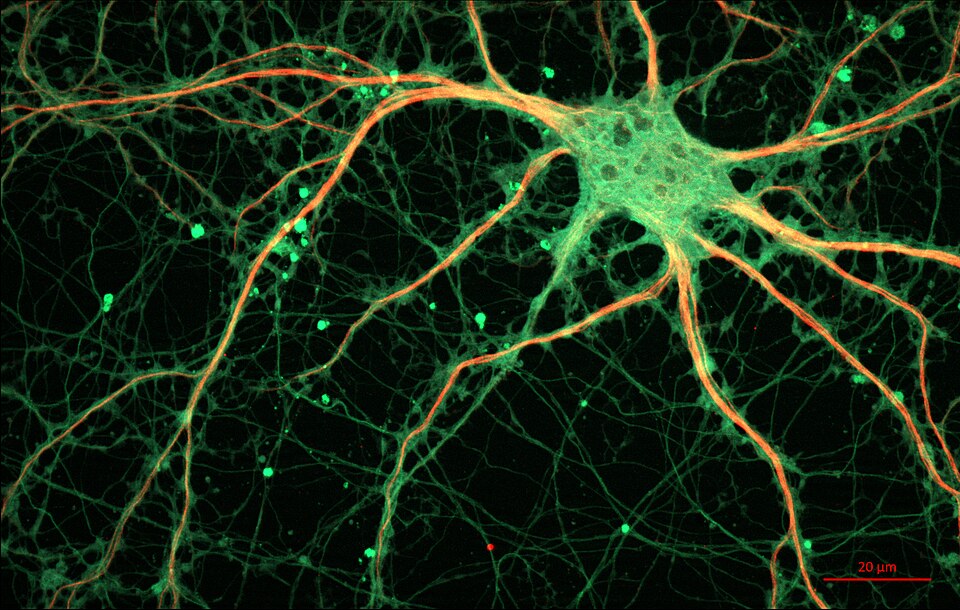
If neural networks are able to offer an account of NDEs then it is necessary to look at the impact of neural networks on the debates on consciousness and human nature. Naturalistic attempts to resolve these debates are often met with the charge of reductionism: that human nature, viewed from the standpoint of the natural sciences, is essentially unchanging (since physical processes follow unchanging laws) and that this is incorrect given the endless variety of human societies that have existed throughout history. On the other hand, if consciousness is solely a product of materialist processes (that is, neuronal firings) then ought an explanation of consciousness be well within the grasp of the natural sciences?
The key point to realise about neural networks in relation to this debate is their extreme plasticity. Even without structural modification, a large amount of variation is available simply by modification of connection strengths that occur as part of the learning process. Of course not all connections will be modified, others (concerned with motor control for example) have little to do with consciousness and the modular construction of neuronal circuits in the brain will limit the possibilities. However, given that a typical human brain consists of something like 100 billion neurons it is easy to see how such a formidable architecture, working in concert with the diverse environments that humans find themselves in, can display such a diverse ‘human Nature’.
If, then, we accept that consciousness is an emergent property of the complex processes that occur as a result of neuronal firings in the brain and that simplified artificial neural networks are a good way to model them, how well do they account for NDEs? If they are simply the result of severing the links between units then we would expect that people would have been unable to relate their experience. Try severing 90% of your neuronal connections and see what happens! So, if this is the cause of NDEs then the severing in artificial models is clearly not what is going on in real brains, where the processes involved are far more complex. However the argument that statistical mechanics could underlie NDEs may still have some validity. As Stephen Thaler is quoted as saying in Yam’s article:
In a fully trained functioning network, all the weighted inputs to a particular unit are about the same in magnitude and opposite in sign… The odds are then that the sum of several weighted inputs to a unit equal zero. Hence when the links are broken, the unit might not feel the loss… The few surviving links will often be sufficient to generate reasonably coherent output.
Furthermore, according to Susan Blackmore’s interview in The Skeptic, Volume 1, issue 3, only 5% of NDErs’ lives flash before them. Clearly the other side of the coin, environmental effects on brain wiring, must have some part to play.
Death, like taxation, happens to us all. So it is not surprising that the question ‘Is there life after death?’ is one which troubles most people, particularly those who are religious or superstitious. Many of the things experienced by NDErs have some religious symbolism. Just imagine, for example, how a Christian undergoing an NDE would interpret what Blackmore describes as ‘the world beyond the tunnel’. Go into any book shop and see how the subject of life after death fills up a fair amount of shelf space one way or another. Given that as skeptics, or religious believers, or whatever, we all think, talk or write about it at some stage of our lives, is it surprising that there is some similarity between NDEs?