





This article originally appeared in The Skeptic, Volume 7, Issue 4, from 1993.
Note: the article reflects the views of the author as published by the magazine at the time. It is preserved here for posterity, but is followed by an update giving contemporary context for some of Galton’s views and his modern legacy.
What does the name Sir Francis Galton mean to you? An eminent Victorian scientist well-known for his contributions to statistics, anthropology and meteorology, perhaps. Apart from his work on eugenics, and I guess everyone is entitled to one major gaffe in his or her lifetime, he happens to be a particular hero of mine. Recently I searched my local library for any of his books and came up with “The Art of Travel“, which he wrote on his return from West Africa, an exploration for which he was awarded the Royal Society’s Founder Medal in 1854. In it we find an interesting anecdote about a pair of 19th century escapologists who claimed paranormal powers. But first, a look at Francis Galton himself.
As a title, The Art of Travel is really a misnomer, because the book, subtitled “Shifts and Contrivances Available in Wild Countries”, is a veritable cornucopia of general science – so much so that it would not be out of place today used as a supplementary school text. The Art of Travel was the handbook for 19th century explorers and intended for a time when travelling was rough, and a person’s life depended on their ingenuity and perseverance. Scholars of the book would make MacGuyver look like the greenest of tenderfoots. Designed to be useful, the book could only have been written by a capable scientist, one accomplished in both theory and experiment. As Dorothy Middleton wrote in her introduction to the 1979 edition:
Galton had an aptitude for gadgetry much in tune with the spirit of the times.
That he was respected for his knowledge of rough country survival is evident from his being asked to deliver a series of lectures on the subject to troops preparing for war in the Crimea. For anyone intending to embark on a long hazardous journey into darker parts of the globe the book is highly recommended. It contains everything you could ever possibly want to know – from how to break in an ox, to lighting a fire in a thunderstorm without matches. The section on medical emergencies alone is worth including on the inside of every first-aid kit. It is important, surely, to know the correct procedures to follow in case of scorpion stings or the effects of rarefied air. A paragraph on drowning anticipates modern techniques in artificial respiration, described as a preferred alternative to “hanging the unfortunate up by his feet to let all the water drain out”. In addition to extensive information on navigation, including 20 things to do if you get lost, Galton described how to use, repair and sometimes even construct scientific instruments; how to silver the glass of sextants, for example, and how to tell the time by sundial, pendulum and hour glass. He also compiled a wide variety of tables, some of standard trigonometry, others less familiar such as two based on human pace lengths, and those of camels and horses, for determining rates of travel.
Animal husbandry was not forgotten. Galton had a wide knowledge of the correct management of elephants, dogs, goats, sheep, cattle, camels and horses including their health and wellbeing. He described all the equipment necessary for using these animals as beasts of burden or food and how to make it from local materials. More unusual activities associated with animals and described by Galton include swimming across rivers with horses and using otters and cormorants to catch fish. Apparently, if a cormorant is disobedient the water near them is struck with the back of an oar, although the reason for this is not given. The book does mention though that it requires caution to train a cormorant as the birds have a habit, when angry, of striking at their instructor’s eye with “an exceedingly rapid and sure stroke”.
Galton was also a builder of some repute and described, in detail, how to construct boats from a variety of materials such as reeds (anticipating Thor Heyerdhal perhaps?), wood, hides, canvas, rubber, bark and sheet tin. A table giving the specific floating powers for a range of different woods provides useful supporting information here. Galton also described how to make horse accoutrements, bivouacs, carriages, bridges and all manner of useful smaller items.
Giving credit where it was due, Galton described “the indefatigable Rumford’s scientific ingenuity in obtaining information on the relative thermal insulation powers of different materials such as twisted silk, beaver’s fur, eiderdown and taffety” (sic). A mercury thermometer was suspended in the axis of a glass tube ending in a globe. The space between the globe and the thermometer bulb was filled with the material being tested. The instrument was then heated in boiling water and afterwards plunged into a mixture of pounded ice and salt. The times of cooling to a specific temperature were then noted. Hare’s fur was found “to offer the greatest impediment to the transmission of heat”.
Galton also anticipated that the traveller would at some stage require to make soap and included a table showing the relative amounts of alkali in the ash of materials such as pine wood and bean stalks. There were also tables on nutrition which gave “real nutriment” as a percentage of the gross weight for a selection of (once) common foodstuffs, although the constitution of this real nutriment was not clearly defined. Whatever it was, apparently 17 ounces were required for a sedentary life and 30 “in severe labour”, a delightfully ambiguous remark.
A section on signalling describes Coulomb and Bolton’s flashing signals, a predecessor of Morse Code, and Galton’s own design for a more efficient hand heliostat. Galton’s attention to detail was such that he included an observation by a Mr Parkyns on the signalling techniques employed by a group of bandits in Abyssinia.
Having amply established his credentials as a scientist, what of his scepticism? In The Art of Travel, Galton describes the activities of the Davenport brothers who, in the 19th century, made money by claiming that they were being assisted by supernatural entities. The brothers were escapologists and realising that little financial gain could be had from traditional approaches to their trade decided to increase their income by implying that they were set free by supernatural beings. Instead of performing on street corners or at country fairs where escapologists usually worked, they held fashionable seances in London and were immensely popular for a while. Apparently, two people were selected from the audience and tied the brothers face-to-face in a cupboard. The cupboard doors were then closed and the room lights dimmed for five or ten minutes until a signal was received from inside the cupboard. The doors were then flung open and, in a blaze of gaslight, the brothers strode free leaving their ropes behind them. They would do this a number of times with different people tying the ropes claiming that they had been freed by spirits.
Unfortunately for them, at one seance two “nautical gentlemen” insisted on tying the brothers with pre-stretched string they had brought themselves from naval supply. Neither the Davenport brothers nor their spirit friends could set them free. Subsequently the nautical gentlemen followed the brothers from seance to seance totally discrediting their performances and exposing the seam. The Davenports soon left the country.
At first Galton was impressed by the Davenports. On one occasion he had the opportunity of tying the knots himself, but the Davenports escaped all the same. Later, Galton realised that knot-tying required a skill that few people possess and that having two people do the tying increased the brothers’ chance of making a quick escape. As Galton put it, “If it be 20 to 1 against any one person having sufficient skill, then it be 400 to 1 against both persons having it”.
Putting Galton into modern context
by Dr Marianne Baker
Readers may (rightly) recoil at the description of eugenics work as a ‘gaffe’, major or otherwise. Or at the BBC’s description of Galton as an “eccentric gentleman-scientist”. While he was undeniably a prodigy and a huge influence across the sciences, having invented multiple methods and items we take for granted today – including the famous-among-skeptics mathematical concept of regression to the mean and… dog whistles – perhaps we do not ‘gotta hand it to him’ without acknowledging the extreme harms that came from his obsession with intellect, human forms and abilities.
Passed over above are his activities in Africa, but Subhadra Das fills in some of the detail in her blogpost for UCL:
During his time surveying the landscape of Damaraland (modern day Namibia)… one [local] in particular – a traditionally built, large buttocked Damara woman – did catch his eye. His primary desire, he tells us, was to measure her. Unwilling to cause (direct) offence, Galton reached for his sextant, took readings of the woman as she stood at a distance under a tree, and used equations and algorithms to calculate the final measurements.
As she notes, his experiences in the region did not challenge his racist biases, but instead amplified them. He carried these views back to London, setting up a huge project to measure thousands of people (physically and in their ability), and eventually winning funding to set up the “Galton Laboratory for National Eugenics”, established in 1907. That same year, he became honorary president of the Eugenics Education Society (EES).
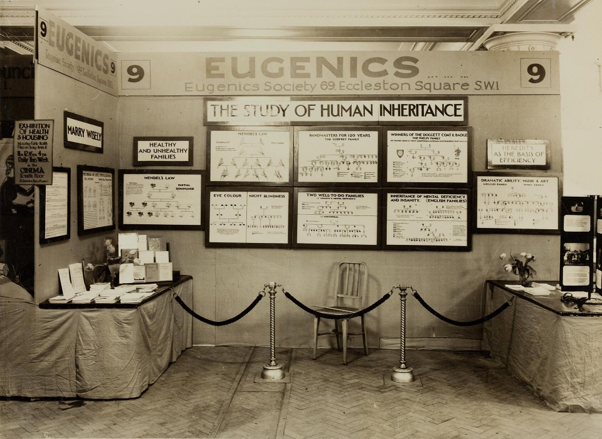
Perhaps we could now celebrate the man and his achievements more if this new field had both started and ended there. But that was not to be. From research programmes and entreaties to “marry wisely” and “better breeding” (see image below from the EES’ 1930s exhibition) – endorsed by Churchill – through to the Holocaust and mass, forced sterilisations across the US, Sweden and elsewhere, eugenics and its proponents have claimed and ruined countless lives.
As we continue to see aspects of the ideology (or outright promotion of it) resurface, through the Christofascist right of the US and around Europe, as well as in ‘great replacement‘ conspiracy theory and white supremacist rhetoric, it is vital we incorporate actively anti-racist challenges to our thinking and not let a veneer of scientific curiosity mask the kind of ‘just asking questions’ about human variation that easily supports such atrocities.
Further reading/listening
- The Unbelievable Truth about Sir Francis Galton, Subhadra Das, 2015
- Bad Blood: The Story Of Eugenics, BBC radio series, 2022
._Image_from_Wellcome_Library.jpg)