




In Christopher Nolan’s upcoming film adaptation of Homer’s Odyssey, Oscar‑winner Lupita Nyong’o has been cast in a dual role as Helen of Troy, and the choice has triggered a wave of online backlash centred explicitly on her being a Black actress playing an iconic figure long imagined as white. Conservative commentators, most prominently Elon Musk, have accused Nolan of historical inaccuracy and of pandering to diversity politics, with Musk calling the casting “racist against Greek people,” claiming Nolan had “lost his integrity,” and suggesting the decision is just an awards‑bait DEI move. This backlash is widely seen as part of a recurring pattern: similar storms erupted when Halle Bailey was cast as Ariel in Disney’s live‑action The Little Mermaid remake.
When dealing with mythological figures like Helen, colourblind casting is especially defensible because these characters are already products of imagination, layered retellings, and shifting visual conventions. There is no “photographic” original of Helen to which we can appeal; she exists as a literary construct whose defining traits are narrative ones (beauty, desirability, the political consequences of her abduction), not empirically fixed phenotypical details. Once we accept that Homer’s hexameters can become English prose, stage plays, comic books, or science‑fiction riffs, it is consistent to accept that visual embodiment will also vary.
Even for historical characters, race is only one dimension among many that constitute identity, and it is not obvious why this single variable should override all others when evaluating “accuracy.” Accent, body type, age, personality, and even language are routinely altered in adaptations without provoking mass outrage: nobody seriously argues that Shakespeare’s Julius Caesar fails because it is written in English rather than Latin, even though a “fully accurate” portrayal of ancient Roman political intrigue would require not only Latin language, but different costumes, social codes, and perhaps a very different dramaturgy altogether. In practice, audiences accept a great deal of abstraction and convention in historical storytelling. If so much flexibility is granted on those fronts, singling out skin colour as uniquely sacrosanct reveals that the fight is less about historical method and more about contemporary politics.
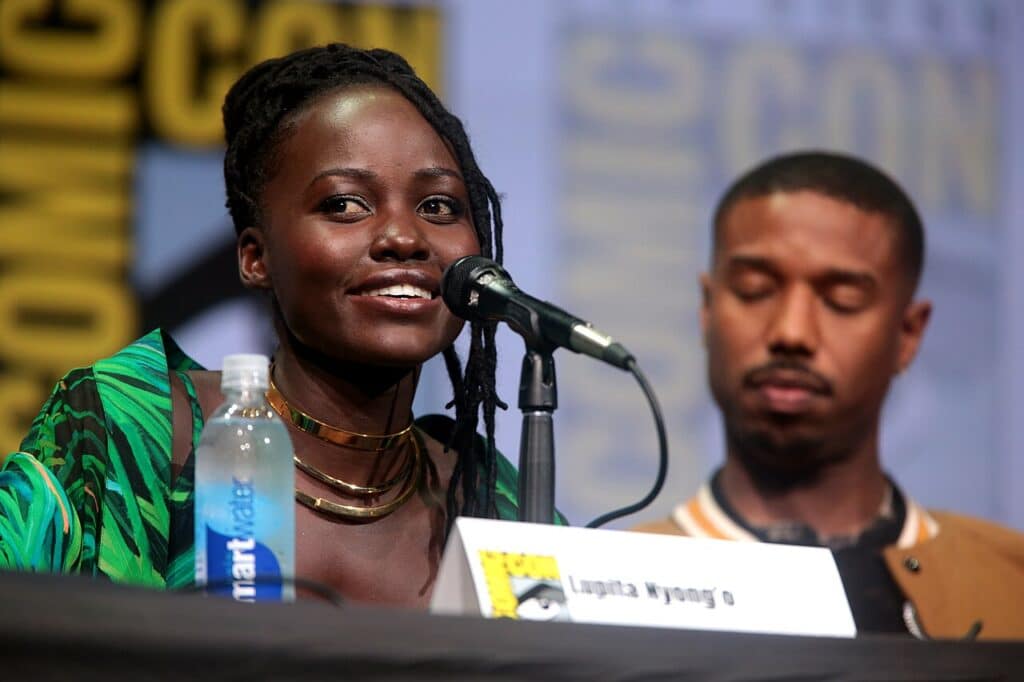
At the same time, one can grant conservatives that there is a real inconsistency in how casting debates have played out, because progressives themselves have often insisted that a close match between an actor’s racial, ethnic, or national background and that of the character really does matter in some cases. Protests over the casting of Crazy Rich Asians included criticism that a mixed‑race actor played a character coded as fully ethnically Chinese, and similar disputes have arisen over non‑trans actors playing trans roles, or white actors voicing characters of colour in animation. These controversies show that the norm has not simply been “anyone can play anyone”, and it is fair to say that if representation arguments are going to be taken seriously, they cannot be a one‑way street in which racial matching is treated as crucial only when it protects minority authenticity, but dismissed as nitpicking when raised by conservatives.
It is also unhelpful when defenders of Nyong’o’s casting lean on discredited Afrocentric narratives to justify a “Black Helen,” rather than on the perfectly adequate grounds of artistic licence and representation. On The View, Sunny Hostin invoked Martin Bernal’s controversial Black Athena to claim that critics “don’t know history,” arguing that Greek culture was “heavily indebted to Afro Asiatic and Near Eastern roots” and telling viewers “people that are saying that Helen of Troy could not possibly be played by a black woman don’t know history.”
Even before getting to the pop‑culture misuse, it is important to note that Black Athena itself has been heavily criticised by classicists, historians, and archaeologists. Bernal’s project leans on speculative etymologies (deriving numerous Greek words from Egyptian or Semitic against the grain of historical linguistics), highly selective readings of ancient texts, and a tendency to treat loose similarities in myth or ritual as evidence of direct, one‑way borrowing rather than the product of a broader, shared eastern Mediterranean milieu. Critics such as Mary Lefkowitz have argued that the linguistic evidence still strongly supports Greek as an Indo‑European language, that Egyptian political and religious institutions differ in fundamental ways from Greek ones, and that the surviving textual and material record points to complex, multidirectional contact rather than the near‑total “Egyptianisation” of early Greece that Bernal sometimes seems to suggest.
Afrocentric writers often get to “Black Greeks” by a simple mental syllogism: Greek civilisation, they say, was fundamentally derived from Egypt; ancient Egypt, they add, was a Black civilisation in something like the modern, sub‑Saharan sense; therefore, the Greeks themselves must have been Black. Each step in that chain is dubious. The first premise – that Greece was essentially an offshoot of Egypt – has already been shown to rest on highly speculative linguistic and cultural claims rather than solid evidence. And even the second premise is overstated: while ancient Egypt certainly formed part of Africa and had a long history of interaction with Nubian and other southern populations, it is far from clear that the Egyptians as a whole can be straightforwardly described as a predominantly “Black” population in the sense that, say, contemporary sub‑Saharan countries are today.
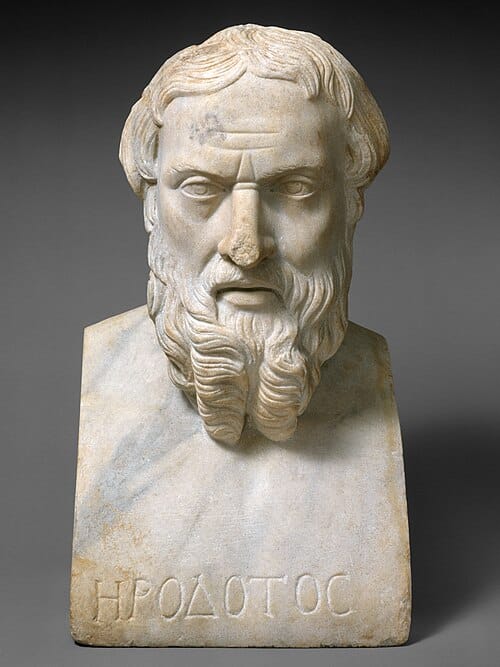
Some of the more confident assertions in this vein lean heavily on a famous passage in Herodotus and stretch it well beyond what it can bear. In his discussion of the Colchians, Herodotus reports:
the Egyptians said that they considered the Colchians part of Sesostris’ army. I myself guessed it, partly because they are dark-skinned and woolly-haired; though that indeed counts for nothing, since other peoples are, too; but my better proof was that the Colchians and Egyptians and Ethiopians are the only nations that have from the first practiced circumcision.
Afrocentrists often treat this as decisive: here, they claim, Herodotus is plainly telling us that Egyptians were dark‑skinned and woolly‑haired, and that this phenotype extended into parts of the wider Greek orbit. On that reading, the passage is taken to clinch the case that the eastern Mediterranean world, including Greece, should be classified as Black.
However, a closer look at Herodotus’ language undercuts that inference. The key adjective he uses is melanchroes, a term that means “dark‑skinned” in a broad, relative sense, not “Black” as a fixed racial category; when Greek authors wanted to refer specifically to populations they associated with what we now call sub‑Saharan Africa, they used Aithiops (“burnt‑face”), the label they apply to Nubians and other peoples further south, and Herodotus does not use that term for Egyptians.
In the very same passage, Herodotus treats Colchians and Egyptians as of the same stock, yet Colchis lies on the eastern shore of the Black Sea, a region that has never been home to sub‑Saharan populations. This makes sense once we see melanchroes as a flexible descriptor that could apply to tanned or olive‑skinned Mediterraneans, Syrians, and even some Greeks themselves, rather than as a code word for “Black” in the modern sense.
The passage tells us that Herodotus noticed variation in complexion and hair texture and used it, alongside customs like circumcision, to speculate about kinship, but it does not license the sweeping conclusion that Egyptians – or Greeks – should be retroactively recast as Black in contemporary racial terms.
A skeptical stance here should cut in both directions in our current culture wars. If the right is too quick to cry “historical vandalism” every time a non‑white actor is cast in a canonical role, segments of the left are too quick to prop up their preferred politics with shaky philology and long‑debunked origin myths. A more intellectually honest approach would separate the empirical questions (What do we actually know about the ancient Mediterranean, its populations, and its cultural exchanges?) from the normative ones (How inclusive do we want our casting practices to be today?), and insist that each be argued on its own merits.
There is nothing unscientific about saying that Lupita Nyong’o can play Helen, because myth is plastic and contemporary art can be colourblind; there is something unscientific about rewriting Greek history to score points in a culture‑war spat. A genuinely skeptical humanism should be able to defend representational pluralism in the present without demanding that the past conveniently remake itself in our image.