




If you’ve been paying attention to UK news recently you may have seen a lot of talk about so-called “two-tier policing”. It was one of the main criticisms of the reaction to the race riots Britain has faced over successive summers, often with social media posts highlighting individual examples of a protester being given what they would claim to be an unduly harsh sentence, juxtaposed with someone they perceive as being from the opposite end of the political spectrum – or racial colour chart – getting a lenient sentence for what they would say is a more severe crime. Usually, the examples are presented with all context conspicuously absent.
This idea of there being a dual-operated, race-based policing system in the UK is an accusation that’s mostly been made by parties on the right of the political spectrum, particularly directed at former Prime Minister Keir Starmer. You could even argue it was one of the primary pieces of misinformation used to discredit Keir Starmer’s position as Prime Minister – such as when Elon Musk amplified accusations of “two-tier Keir”, in an open show of support for Stephen Yaxley-Lennon/Tommy Robinson (whose legal costs Musk has subsequently picked up).
To say that Keir Starmer oversaw a system that judicially favoured one race or minority group over the majority of people in the country is fantasy to the point of being a conspiracy theory, and a racist one at that. But it is a conspiracy theory that many on the political right – and in Reform UK and Restore Britain in particular – were content to perpetuate, regardless of how much division it stoked within the country. For example, Reform’s Runcorn and Helsby MP Sarah Pochin appearance on LBC to discuss a protester who vandalised a traffic camera and was subsequently sentenced to 15 years in jail.
“When I first heard it, I thought that sounds entirely disproportionate. 15 years for effectively, uh, blowing up a ULEZ camera. But like I say, I don’t know how big that actual explosive device was. But it does raise this point of two-tier justice, which is again something that I talk endlessly about. Our whole society should be built on a fair and equal justice system. And the public is seeing example after example now of where they don’t think it sounds proportionate”
Pochin went on to compare this sentence to the response after the Southport riots:
I had two of my constituents go to jail for 31 months each for a tweet associated with the Southport, uh, killings if you remember. Utterly disproportionate. they weren’t calling for violence. They just liked a tweet. Okay. It was irresponsible. But that should have been dealt with in the community… How can we on the one hand be saying our prisons are full and then sending people to prison for clearly offenses that do not warrant a prison sentence?
While Pochin talks about two of her constituents who went to jail simply for “liking a tweet”, there is no evidence that this is the case – not from Runcorn and Helsby, and not from any other constituency. There are no examples in the UK of anybody being imprisoned for any amount of time simply for liking a tweet. That’s not say it definitely didn’t happen, but it is to say that if it did happen it hasn’t happened in any place where anybody could verify or fact check it, and nobody has ever reported it, despite the fact that it would be a uniquely extreme punishment for social media use.
Perhaps not coincidentally, “31 months” is the length of sentence handed out to supposed ‘free speech’ martyr Lucy Connolly… but Connolly wasn’t from Pochin’s constituency, and she wasn’t jailed for ‘liking’ a tweet. Connolly received her sentence for encouraging for rioters to set fire to a hotel filled with people, while those rioters were outside a hotel trying to do just that. She deleted the tweet, but only after she was contacted by her employer. At trial, it transpired she had joked about the message with a friend, before explaining that if anyone saw it she’d just plead a mental health issue to lie her way out of it – which had been the defence she tried to run with in court.
Sarah Pochin was clearly attempting to draw a comparison between the (possibly imaginary) people who were imprisoned for liking tweets, and this particular protester who was imprisoned for vandalising a ULEZ camera. This is obviously an unreasonable comparison; there is nothing analogous between liking a post on a website and doing any amount of criminal damage in the street. Especially as, even Pochin’s telling of this story, the camera was destroyed by “an explosive device”.
The ULEZ scheme
To understand the actions of the protestor in context, we must first understand what the ULEZ cameras are, and why they exists. ULEZ stands for Ultra Low Emission Zone. In London, where there has been a severe issue with pollution and air quality, the public are discouraged from driving older, higher-polluting vehicles. Lower-emission cars can drive in and out of London for free, but vehicles that produces more emissions must pay a £12.50 daily toll to do so.
Four years after its introduction, the ULEZ toll is having a genuine effect on London’s air quality. Pollution in central London has fallen from 17 micrograms of particulate matter per cubic metre to just 8 per cubic metre. This drop in pollution has come with an appreciable improvement on a range of health problems, including a recent study in The Lancet that showed children living in London who previously had impaired lung function had made a full recovery due to the reduction in pollution. The ULEZ toll is unequivocally making children in London healthier, and that health improvement is most keenly felt in London’s most-deprived areas.
Given this success story, it might be surprising that there are so many activists who are staunchly against the enforcement of the anti-pollution zone, and the ULEZ cameras that detect which vehicles are subject to the fee associated with entering the zone.
ULEZ vandalism
One such anti-ULEZ activist was a 63-year-old man called Kevin Rees who in December 2023 used a homemade explosive device to destroy a camera in Sidcup in London. His bomb didn’t just destroy the camera – the blast damaged cars and houses 100 metres away, with some of its shrapnel destroying part of a child’s bedroom at a nearby house. In footage of the bomb going off, the explosion happens only moments after a double-decker bus passes the camera – had the bus been a second slower, it would have been caught in the explosion.
When officers searched Rees’ home, they found chemicals that could be used to make explosives, as well as prohibited weapons in the form of homemade stun guns. That is why he was sentenced under the Terrorism Act and given 15 years in prison.
Is this really an example of two-tier policing, and of white people in the UK getting a harsher sentence than a person of colour would get for the same crime? Imagine what kind of sentence someone would get if they were a racial minority – or especially a Muslim – and they had created a homemade explosive device that they detonated in a built-up area, causing an explosion that sent shrapnel flying 100 metres, damaging nearby cars and endangering nearby children.
In fact, the only reason this case is being discussed by Reform UK as an example of two-tier policing is exactly because Kevin Rees is white. Had Rees been a Muslim, Sarah Pochin may well have been on LBC arguing that a 15-year sentence was too lenient, and this was evidence that Britain was under attack from radical Islamists.
During his trial, Rees told the jury that he strongly opposed the ULEZ scheme, and also that he also strongly opposed the Mayor of London, Sadiq Khan – who happens to be Muslim. A lot of anti-ULEZ activists are extremely anti-Sadiq Khan, and I suspect their issue is the same reason there are so many “London has fallen” online content creators arguing that London has been Islamified and is under “Sharia law“. If there is a double-standard in this country, it certainly doesn’t favour Muslims.
ULEZ opposition and Blade Runners
Rees is not alone in his activism against ULEZ cameras – he was an active member of a number of anti-ULEZ groups on Facebook, where he called himself ‘The Exterminator’. In fact, he even believed his arrest was because of his activity in those online groups – he told the court he thought he was arrested by “the Facebook police”, who came for him because of the things that he was saying online. He said at trial:
People you hear being arrested for making bad or inappropriate comments on Facebook pages – that’s well-known, as it’s been on the news.
It’s probably no surprise in the current climate that someone like this would genuinely believe that you’re more likely to be arrested for your social media posts than caught for setting off an explosion in the middle of a residential area.
Membership of these anti ULEZ groups on Facebook and on Telegram unsurprisingly overlaps very heavily with membership of other conspiracy theory groups on both platforms. These are worlds I know well, having spent much of the early years of the pandemic monitoring the anti-vaccine network on Telegram. Sure enough, many of the groups I monitor on Telegram are filled with people promoting these protests against ULEZ cameras, and arguing against the sentencing that Rees received.
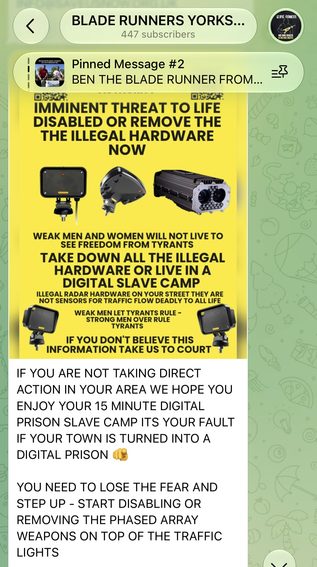
In these Telegram spaces, activists encourage people to remove and destroy ULEZ cameras using whatever means they have at their disposal – rarely improvised explosives, but more often saws, blades, and other cutting tools. It’s for this reason they call themselves “Blade Runners”.
Their stated motivation for doing this is exactly as you’d expect – as one Telegram post explained: “Blade runners bow to no government or authority”, arguing that the cameras are an “imminent threat to life” and that they were “illegal hardware” that people should “Disabled or remove” [sic] immediately. “Weak men and women will not live to see freedom from tyrants”, it warned. “Take down all the illegal hardware or live in a digital slave camp”.
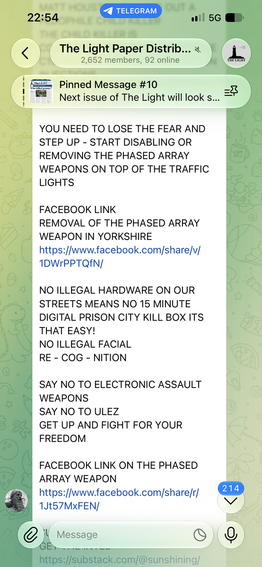
Another post in The Light Paper’s Telegram group warned:
You need to lose the fear and step up-start disabling or removing the phased array weapons on top of the traffic lights. No illegal hardware on our street means no 15 minute digital prison city killbox it’s that easy! No illegal facial re – cog – nition.
They specifically spelled it “re-cog-nition”. It is unclear why.
Their Telegram posts then linked to a Substack, the Substack for a group called “save us now”. The title of the post was: “They are deploying their electronic weapons outside of your young one school-these Epstein satanists hate children unless they are eating them”. The Telegram post was cross-posted from a group called ‘Blade Runners Yorkshire’, and the post immediately before it was a video showing how the Covid vaccine was actually injection of a radio-frequency ID tracking device with a nanomaterial antenna and an RFID chip that rendered your arm slightly magnetic. Again, this was posted in 2026.
What this illustrates is that for a lot of people, the pandemic – whatever their experience of it was – hasn’t ended. When they forged so much of their personal identity and their connections with other people around what they believed was going on during the pandemic, it’s very hard for them to move past that, forget about it, and go back to their lives. Instead, they have to have a reason to keep the train moving and keep the band together.
Thus the pandemic that at one point was a biochemical threat, morphed into being just an excuse to get you vaccinated with something that was going to kill you, which then morphed into a way of microchipping you so that they know where you are at all times to keep you in the 15 minute city that never happened, which then morphed into a way of microchipping you to make sure that they could turn off your bank account at any point with their central bank digital currency that never happened, and is now proof that the vaccine was actually just marking you with an RFID so that the cameras that are mounted on top of traffic lights know which ones to kill.
Of course, not all people who see themselves as Blade Runner activists go as far as to believe this is all part of a global ‘one world order’ conspiracy to kill people using phased laser weapons, but they do think that these cameras are here to track your every movement and to monitor you at all times in order to bring about the 15 minute cities.
ULEZ cameras and mass surveillance
At this point it would be remiss not to compare the paranoia about ULEZ cameras to the very understandable reaction from lots of neighbourhoods at the intrusion of ‘AI-powered’ Flock cameras in America. There have been activists in the US who have taken to vandalising these surveillance cameras, either by spraying them with hardening form, or attacking them with a saw, or otherwise defacing and destroying them. I’m yet to be made aware of anybody who improvised a homemade explosion with 100-metre blast radius.
Is it unfair to criticise the people who are attacking ULEZ cameras while offering more understanding towards those who don’t want Flock cameras in their neighbourhood? I don’t think so, and I think the reason for that lies in what footage is being captured, and how it is being processed.
In London there are around 3,700 ULEZ cameras. Those cameras are static, situated on top of traffic lights, where they’re pointed at the same fixed spot. They’re operated by Transport for London, and they identify a vehicle licence plate, look up whether that vehicle is subject to a ULEZ charge, and if it is they make a recording of that vehicle in the register ready for people to log in and pay their ULEZ payment. That data is then held on a server within the EU, and subject to GDPR regulations.
According to the legal basis for collecting this information, access to the data gathered is limited to a small number of specialist staff, and the enhanced contextual data around the license plate is required by law to be of low resolution, to reduce the likelihood that they allow for the identification of drivers or passengers.
The images taken by the camera aren’t held indefinitely: if your vehicle is exempt from the charge, the images automatically deleted after 21 days; if your vehicle is subject to the toll, the image is deleted 21 days after you’ve paid the toll. There are some people who set up a recurrent account if they happen to be driving in and out of London quite often, in those cases their images will be deleted after 90 days. If you are subject to a fee but you never pay the fee, you’ll be issued a penalty charge notice similar to a parking ticket, and just like with a parking ticket these are held for seven years after payment.
Meanwhile, in the US, Flock cameras don’t just spot license plates – they claim to be able to use “vehicle fingerprint technology” to identify vehicles’ make, model, and colour, as well as other distinguishing attributes such as mismatching colours, bumper stickers, dents, and temporary licence plates. The system does not do that particularly accurately, meaning people find themselves being stopped at gunpoint and made to give their whereabouts for crimes that happened in entirely different states, while driving a vehicle that has little in common with the one being sought. That is obviously additionally dangerous in a system where the police are armed and, as we’ve often seen, can be all too ready to pull the trigger.
Flock cameras aren’t just about enabling the administration of driving tolls – they’re owned by a private company selling cameras to both the public and the police, and they are being used to create a granular map of the movements of Americans, which has then been given to agencies like ICE in order to carry out immigration enforcement, or to track people who are driving to abortion clinics.
Their access is not strictly limited, either – neither in terms of who can put cameras up, and who can access their data. Unlike ULEZ cameras, Flock cameras can be placed by private organisations like homeowners associations, to surveil who is driving through their neighbourhood. And their footage is searchable by whoever has access to the database, where they can input a number plate and receive a detailed report of the vehicle’s movements.
Police also have access to an ‘AI-powered’ searchable database, where they can use natural language to search for specific characteristics, including race, gender, clothing, height, tattoos, and – according to public records obtained by 404 media – even perceived political affiliation. And there have already been at least 28 instances of the police using them to stalk former partners, and even cases where police have used information from the flock database to tip of drug dealers they were colluding with.
Also, 404 Media found that Flock had left at least 60 of its cameras exposed to the open internet, where anyone could watch them, download 30 days’ worth of video archive, change settings, see log files, and run diagnostics – something that, when asked, Flock outright denied, until the data breach was published by an independent security researcher.
All things considered, I am not persuaded that the very real threat presented by the ‘AI-powered’ Flock cameras is analogous to that of the limited use of licence-plate scanning conducted by ULEZ cameras. That is obviously subject to change: if there was a rollout of surveillance cameras with a far broader remit in the UK, I might change my tune on the “Blade Runners”.
Regardless, I still wouldn’t advocate detonating a homemade explosive that damages cars and bedroom windows 100m away – whichever way you look at it, that’s the kind of criminal act that’s going to get you a heavy sentence, regardless of your political affiliation or your skin colour.