

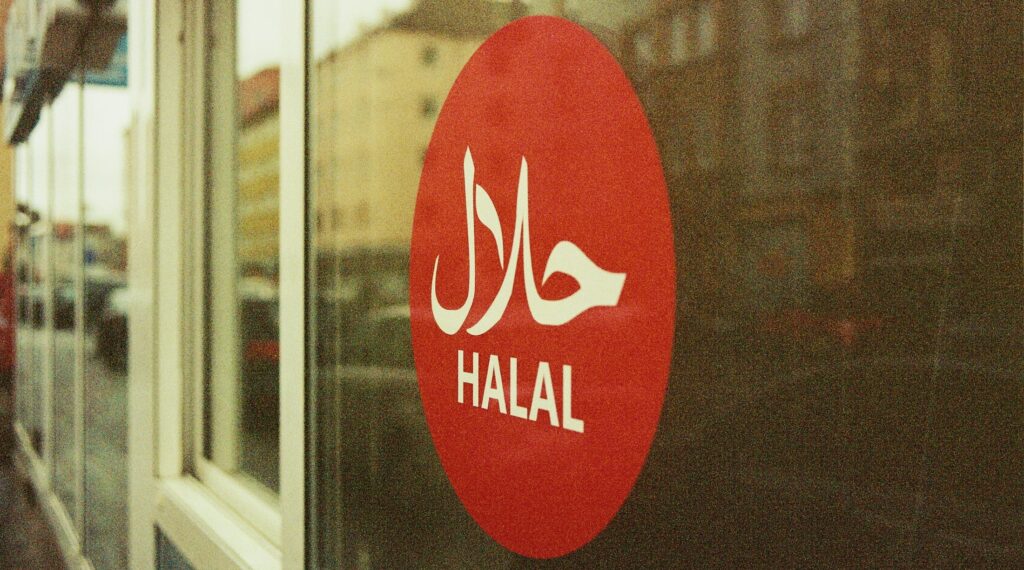
Halal and kosher are distinct religious dietary systems that share some similarities, but differ in important ways. While both require ritual slaughter and prohibit blood consumption, halal permits some foods (such as camel and shellfish) that are not kosher, while kosher has additional rules, including separating meat and dairy. Importantly, kosher food is not automatically halal, and halal certification is generally more uniform worldwide than kosher certification.
Currently in the UK, there is a vociferous online debate around the ethics of halal and kosher meat, with social media algorithms increasingly promoting posts that use extreme language once a user has engaged with similar discussions. In one online group dedicated to rejecting religiously slaughtered meat, a widely available vegan nutritional drink was singled out simply because it carried kosher certification – even though the product contained no animal ingredients at all. Numerous commenters in the group enthusiastically agreed that they had also stopped buying it for the same reason.
One commenter challenged this reasoning, pointing out:
“Well, you’d best avoid fruit, vegetables and water too, as they’re all halal- and kosher-compliant. I think you’ve taken this silly hatred of other religions too far.”
The response was that the group was about “animals, not silly prejudice.” Yet this justification quickly falls apart. The product in question was vegan, meaning no animal slaughter or products were involved. The objection could not have been about animal welfare at all, only about the presence of a religious certification.
This is prejudice masquerading as concern for animal welfare. While this example may seem absurd, it is far from unique. Similar examples of hostility towards religious practices being reframed as welfare advocacy are readily found across social media and online discussions.
This debate is not happening in isolation. In the UK, it has become increasingly difficult to ignore the growing prevalence of anti-Muslim rhetoric and antisemitic abuse, both online and offline.
Across political discourse, traditional media and social media platforms, narratives hostile to Muslims have become more visible and, in many cases, increasingly normalised. These narratives risk dehumanising and stigmatising Muslim communities, often by reducing complex political and social issues to simplistic stereotypes.
The consequences extend beyond online discussion. Reports from organisations monitoring hate crime have documented increasing incidents of anti-Muslim abuse such as vandalism, verbal harassment, and physical assaults, including women having their hijabs forcibly removed. The organisation Tell MAMA, which monitors anti-Muslim incidents in the UK, reported record levels of anti-Muslim hate following the Hamas attacks of October 2023, with incidents more than tripling during the subsequent months.
At the same time, the continued and heightening conflict in Israel and Gaza has profoundly influenced antisemitic attacks across the UK. The United Nations Commission of Inquiry, concluded that Israel had committed acts amounting to genocide in Gaza, and the devastating humanitarian crisis in Gaza, breaches of international law, and intense political debate have fuelled antisemitic behaviour, even despite members of the British Jewish community publicly condemning the humanitarian situation and calling for an end to the violence. In an open letter, representatives of the British Jewish community wrote:
“The inclination to avert our eyes is strong, as what is happening is unbearable, but our Jewish values compel us to stand up and to speak out.”
Meanwhile, academics have warned that misinformation, conspiracy theories and AI-generated content are increasingly being used to reinforce harmful stereotypes and inflame existing tensions.
Against this backdrop, the discussions surrounding halal and kosher meat that have become increasingly prominent across social media take on a more sinister tone. Viral posts frequently (incorrectly) claim that a majority of supermarket meat is halal, that animals are routinely slaughtered without stunning, and that consumers are unknowingly purchasing meat that has been produced using non-stun methods. These claims are often accompanied by emotive language and graphic imagery, but they rarely provide the legislative, scientific or statistical context needed to understand the issue properly.
For those of us who care deeply about animal welfare, this presents a challenge.
There is a legitimate and important discussion to be had about welfare at slaughter. The veterinary profession, and wider population, has debated stunning and slaughter methods for decades. However, when these discussions become intertwined with hostility towards particular religious communities, animal welfare risks becoming a vehicle for prejudice rather than a catalyst for meaningful change.
It is entirely possible to support the highest possible standards of welfare at slaughter while also rejecting Islamophobia, antisemitism and the use of animal welfare as a political weapon. In fact, separating these issues is essential if we want conversations that genuinely improve welfare rather than simply inflame division.
The animal welfare question
For many people – particularly those who are vegetarian or vegan – the debate around stunning vs non-stunning may seem secondary to the broader ethical belief that animals should not be slaughtered for food at all. However, while livestock production remains part of the UK’s food system and millions of animals continue to be slaughtered each year, discussions about welfare at the point of slaughter remain essential. Regardless of individual views on meat consumption, there is a shared responsibility to ensure that animals experience the highest possible standards of welfare throughout their lives, including at the end of life.
The welfare implications of slaughter without prior stunning have been debated by veterinarians, scientists, legislators, the public and religious authorities. Many, including myself, support pre-slaughter stunning on welfare grounds. The UK Government has also repeatedly stated that its preferred position is for all animals to be stunned before slaughter, while recognising the legal right of Jewish and Muslim communities to obtain meat prepared in accordance with their religious beliefs. This is not simply a political compromise – it reflects the complexity of balancing animal welfare with protected religious freedoms.
One of the biggest misconceptions is that religious slaughter automatically means non-stun slaughter. It does not.
The shechita method of slaughter is exclusively non-stun, while Halal slaughter consists of both stun and non-stun methods of slaughter, with the majority being stunned prior to slaughter.
Despite this, even within the Jewish community people are raising this issue. Rabbi Dr Jonathan Romain argues that the debate over pre-stunning is based on concerns genuinely motivated by animal welfare. A working group of rabbis concluded that the majority of scientific evidence suggests pre-stunning is likely to reduce suffering compared with traditional shechita, while acknowledging that no slaughter method is entirely without risk. The report also encourages a broader discussion about animal welfare, arguing that ethical food production should consider not only how animals are slaughtered but also how they are reared throughout their lives. It recognises the tension between traditional religious practice and evolving welfare evidence, suggesting this is an important conversation for Jewish communities to continue having.
As for halal, a substantial proportion of meat produced in the UK comes from animals that are stunned before slaughter. In 2024, the Food Standards Agency slaughter survey found that 98% of cattle, 94% of calves, 89% of goats, and 71% of sheep are stunned before slaughter, with the sheep figure including many animals processed under halal-certified stunned systems. Stunning is even more common in poultry, with approximately 97% of meat chickens, 99% of spent hens, and 99% of turkeys being stunned prior to slaughter.
Overall, around 79% of all animals were slaughtered using standard commercial methods, 21% were slaughtered for the halal market and only a very small proportion were slaughtered using shechita (Jewish kosher) methods.
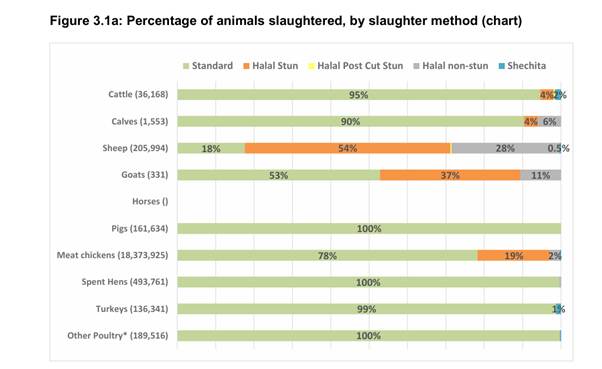
With regards to third-party certification, certification of halal slaughter practices varies across UK slaughterhouses. Among those carrying out non-stun halal slaughter, most (16 of 22) were certified by a recognised halal certification body, while three were self-certified. Of the 51 slaughterhouses carrying out halal slaughter with stunning, 30 held recognised certification and six were self-certified. All 11 slaughterhouses performing shechita (kosher) slaughter were certified by at least one recognised certification body.
When asked, most major UK supermarkets state that their own-brand meat comes from animals that were stunned before slaughter. Lidl, Aldi, Marks & Spencer, Asda, Morrisons and Sainsbury’s all confirmed this policy, although several also stock clearly labelled halal and kosher products to meet the needs of different faith communities. Morrisons noted that even many halal products are produced using pre-stunning, in line with UK industry practice, such as the position of the British Retail Consortium:
UK supermarkets only sell own-brand meat from animals that have been stunned before slaughter. Some might also sell branded halal products, which are clearly labelled and undergo a process that still requires the animal to be stunned.
One important focus should also be on improving transparency for all consumers, rather than targeting particular religious communities. This has been raised in Parliament as a motion “about animal welfare, transparency in meat production and consumer choice”, while making clear that there is no intent to ban halal or kosher meat, merely to ensure they are clearly labelled.
Clear and accurate labelling enables individuals to make informed purchasing decisions that reflect their own ethical, cultural, or personal values. Equally, Muslim and Jewish consumers should be able to trust that products marketed as halal or kosher genuinely meet the relevant religious requirements. Greater transparency benefits all consumers by supporting informed choice, fostering trust, and encouraging an evidence-based discussion rather than one driven by misunderstanding or prejudice.
These figures illustrate why broad claims circulating online rarely reflect the reality of UK slaughter practices, while still recognising that if we want to aim for 100% pre-stun slaughter, there is still room for improvement in some areas.
What does UK law actually say?
UK legislation requires animals to be stunned before slaughter unless they are being slaughtered under a legal religious exemption for halal or kosher production.
The slaughter of animals in the UK is subject to strict legal requirements, including that it must take place only in approved abattoirs by certified, competent slaughter personnel, apart from in distinct circumstances. The process is continuously overseen by Official Veterinarians from the Food Standards Agency, with stringent requirements governing animal restraint, mandatory checks to confirm unconsciousness before further processing, and immediate intervention whenever there is any concern that animal welfare has been compromised. These safeguards exist because animal welfare legislation applies regardless of slaughter method.
For meat to be considered Halal (permissible), the animal must be a permissible species, handled sympathetically prior to and during slaughter, must be alive at the point of slaughter and the person bleeding the animal must have attained the age of discretion.
These safeguards exist because animal welfare legislation applies regardless of slaughter method.
There are signs that a higher focus on animal welfare could be introduced in the future. Perhaps the most interesting development has been the Demonstration of Life (DoL) Protocol.
Developed collaboratively between government, veterinary experts, industry and halal certification bodies, the protocol demonstrates that reversible electrical stunning can be compatible with halal requirements by showing animals remain alive, but unconscious, immediately before slaughter.
A recent report indicated that if a reversible stunning method is successfully applied, the animal will lose consciousness immediatelyand will not feel potential pain during the cut and subsequent bleeding. They also stated that although stunning methods themselves involve risks to animal welfare which have to be managed, stunning prior to neck cutting represents the lowest risk for overall compromise of animal welfare. One researcher in this field is Awal Fuseini, who found in a paper that the majority of scholars (over 95%) said reversible stunning is Halal compliant.
The protocol is supported by DEFRA and the Food Standards Agency and is already helping expand acceptance of stunned halal meat in both UK and international markets.
Rather than framing welfare and religion as opposing forces, the DoL protocol represents an attempt to improve welfare while respecting religious requirements. This is precisely the kind of evidence-led collaboration that deserves greater public attention.
Ethical and responsible discussions
There is nothing inherently wrong with discussing animal welfare at slaughter. Veterinary professionals, scientists, regulators, the public and animal welfare organisations have been examining these issues for decades in an effort to continually improve welfare standards. However, there is an important distinction between asking, “How can welfare at slaughter be improved?” and using slaughter practices as a means of criticising or targeting a particular religious community.
Unfortunately, these two conversations are increasingly conflated on social media. When legitimate welfare concerns become a vehicle for prejudice, meaningful discussion is undermined, public understanding suffers, and opportunities to improve animal welfare are ultimately diminished.
If our objective is genuinely to improve animal welfare, then the conversation must remain grounded in evidence. That means acknowledging uncomfortable facts where they exist, and recognising that many veterinary professionals support universal stunning while also understanding that halal does not automatically mean non-stun slaughter. We should appreciate that the overwhelming majority of animals in UK abattoirs are stunned before slaughter, while still recognising there is room for continued welfare improvements. As such, we should support innovations such as the Demonstration of Life protocol, which seek practical solutions rather than deepening division.
The most productive conversations are those that combine scientific evidence, legislative understanding, respect for religious communities and a shared commitment to continually improving welfare standards.
References
- Vandalism, taunts and hijabs torn off: Muslim leaders in UK say hate crime hitting new levels | Islamophobia | The Guardian
- Anti-Muslim cases surge in UK since Hamas attacks, charity finds – BBC News
- Israel has committed genocide in the Gaza Strip, UN Commission finds | OHCHR
- UK antisemitic hate incidents hit new high in 2023, says charity – BBC News
- British Jewish leaders break silence, condemn Israel’s genocidal war in Gaza – Middle East Monitor
- Media and Islamophobia in Europe: A Literature-Based Analysis of Reports 2015–2023
- How AI-generated images fuel anti-Muslim, anti-migrant sentiment online
- Debate on an e-petition on non-stun slaughter of animals
- Slaughter without stunning – GOV.UK
- Demonstration of Life (DoL) Protocol – Halal Food Information Centre UK
- Animal welfare – GOV.UK
- NSA Policy Position
- Government backs abattoir’s adoption of halal-compliant stunning method – Veterinary Record – Wiley Online Library
- Written questions and answers – Written questions, answers and statements – UK Parliament
- Halal vs Kosher: Differences & Similarities
- 25-02-14 Slaughter Sector Survey 2024 (REVISED)
- It is better for animals to be stunned before slaughter – The Jewish Chronicle
- Kosher vs. Vegan: Where Do These Diets Overlap? | Kosher Eats
- The ethics of Halal meat consumption: preferences of consumers in England according to the method of slaughter – Fuseini – 2020 – Veterinary Record – Wiley Online Library
- Halal Slaughter of Livestock: Animal Welfare Science, History and Politics of Religious Slaughter | Springer Nature Link
- Awal Fuseini | AHDB
- The perception and acceptability of pre-slaughter and post-slaughter stunning for Halal production: The views of UK Islamic scholars and Halal consumers – ScienceDirect
- Report on good and adverse practices – Animal welfare concerns in relation to slaughter practices from the viewpoint of veterinary sciences
- An update on halal slaughtering techniques: current methods and ongoing research on halal meat production techniques and their implication on animal welfare
- Home slaughter of livestock: A guide to the law in England and Wales – GOV.UK