




It has been hot lately, in the UK, as we go into an unprecedented fifth heatwave of the year.
A heatwave is defined as at least three consecutive days with daily maximum temperatures exceeds a defined threshold: above 25ºC in Liverpool, or above 28ºC in London. The UK’s first heatwave of the year lasted from 22–31 May, with temperatures reaching 35ºC in Kew Gardens – a record high for May. The second, from 19–28 June, saw peak temperatures of 37.7ºC in Lingwood. The third stretched from the 4 July through to 26 July, with temperatures hitting 35.5ºC in Wisley. The fourth covered the weekend of 28–30 July, hitting 35ºC in South East England.
These spells of extreme heat have serious consequences. The May heatwave caused an estimated 550 excess deaths in nine days, and the second caused an estimated 2,200 excess deaths, again in nine days. The July heatwave saw wildfires across the country, including a blaze in Conwy, North Wales, that blanketed my home in Liverpool in smoke.
This isn’t normal for the UK.
It is highly unusual for villages in Wales to need to be evacuated due to extreme wildfires. Yet, to hear some talk about it, none of this is particularly extraordinary – after all, didn’t we have a long, hot summer in 1976?
To understand how unprecedented this year has been, it is worth making a comparison to the UK’s history of heatwaves. Wikipedia lists eleven of note:
- 12 to 15 July 1808 – Peak: 36ºC. At the time it was the second-hottest July on record, the hottest since 1783. By 2022, it was only the ninth hottest July on record.
- 31 August to 3 September, 1906 – Peak: 35.6ºC. 2 September 2 in Bawtry remains the hottest September temperature of any day in the UK.
- 17 July to 11 September, 1911 – Peak: 36.7ºC. The record temperature was only broken 79 years later in the 1990 heatwave.
- 11 to 18 July, 1955 – Peak: 32ºC. The heatwave led to catastrophic flooding in Dorset on 18 July, when 11 inches of rain – roughly four months’ worth – fell in just nine hours.
- 23 June to 27 August, 1976 – Peak: 36ºC. A favourite of the tabloids, the 1976 heatwave caused 20% excess deaths, though its peak was 0.8°C below the record at the time of 36.7°C (98.1°F) set on 9 August 1911.
- 1 August to 4 August, 1990 – Peak: 37.1ºC. Again, its peak was hotter than 1976.
- 28 June to 22 August, 1995 – Peak: 35.2ºC.
- 4th July to 23rd July, 2013 – Peak: 33.5C. There were 960 excess deaths in the first nine days.
- 22nd June to 7th August, 2018 – Peak: 35.3 °C. There were 259 excess deaths on 25–26 June alone.
- 15 July to 25 July, 2021 – Peak: 32.2ºC. There were 915 excess deaths over 10 days.
- 15 June to 17 June, 2022 – Peak: 32.7ºC and 17 July to 19 July, 2022 – Peak: 40.3ºC. There were 3,200 excess deaths across the two heatwaves.
I know this isn’t original to say, but it is something we shouldn’t overlook: of the hottest days by maximum temperature in the UK, three of hottest five were since 2020. We’ve just had the warmest June on record in the UK, followed by the driest July.
This is all heading in a clear direction – the UK is getting warmer, we’re getting more frequent and more extreme weather events, and we are not equipped to cope with it. As a result, it is already causing people to die.
The harvesting effect
Some might point out that those excess deaths might be due to what’s known as the ‘harvesting effect’. This was an argument we saw often during the pandemic: imagine someone is at the end of their life, due to age or ill health, and they are almost certainly going to die within the next six months, one way or another. Along comes a particularly hot spell, and it hastens their death. You could argue that, over the course of the year, whether that person dies now or in a few months, it doesn’t make much difference statistically and thus it is unfair to say it was “caused” by the heat. They were already ripe for the reaper, it’s just that the hot spell – or, as was argued a few years ago, the virus – came along and harvested them a little early.
Statistically, at a population level, that might be true. But at an individual level, it’s an incredibly callous way to look at the world, because people are not stalks of wheat, and the point of healthcare and the social safety net is to allow people to live as healthily as possible for as long as possible.

When the harvesting effect, ‘they would have died anyway’, is used to dismiss excess deaths caused by heat, it is likely being deployed as cover for an ulterior motivation, such as to downplay the effects of climate change and to argue that we should take fewer mitigating steps to counter the climate emergency.
The successive heatwaves have brought such arguments out in force, and not just in the chorus of, ‘but what about the time it was hot fifty years ago’ (a song those choristers have, ironically, had to sing more and more often over the past few years in particular, for reasons on which they will absolutely not reflect).
The Daily not-so-Sceptic
The sad reality is that there is still a very well organised and well-funded network of climate denialist organisations in the UK, and the fact that we keep breaking temperature records does nothing to dissuade them. Take, for example, the output of the Daily Sceptic, the far-from-skeptical organisation founded by Lord Toby Young during the pandemic as the ‘Lockdown Sceptics’, which has since morphed into an all-encompassing culture-war and science-denialism platform. They are the sister organisation to the Free Speech Union, which in 2024 partnered with Sense About Science to produce a series of lectures on how to ‘restore public confidence’ in science (spoiler: the FSU’s answer was for scientists to admit that the Covid vaccine was dangerous).
Since the start of July, the Daily Sceptic has published almost-daily articles on climate change and renewable energy, including a 13-part series that they intend to be “collected into a book for Sixth Formers and university students”. One of those, part eight from 1 July, is called “Renewable Energy Will Impoverish Humanity”, written by Dr John Constable who is Director of the UK charity Renewable Energy Foundation – a charity set up in 2004 to argue against wind farms, founded by… Deal or No Deal host and colleague of Mr Blobby, Noel Edmonds.
On 6 July, the Daily Sceptic published Has Climate Change Stolen Scientific Curiosity?, authored by Andrew Sibley, who describes himself as a “semi-retired chartered meteorologist with an MSc in Environmental Decision-Making and an MPhil in Theology”. Previous articles by Sibley for the blog included “Carbon Dioxide is good for the planet” – because, after all, plants need it to survive.
Sibley’s warning about the scientific curiosity gap opens with:
The media’s fear narrative, which is climate change reporting, has gone into overdrive with weather graphics turned to hot red; the contrived alarm reinforces the faith of true believers in the global warming message. With such zealous reporting over supposed connections to global warming, little attempt is made to consider and evaluate other possible factors. Climate change seems to have stolen scientific curiosity.
Note the tone, from an article that accuses scientists of “contrived alarm” (the very scientists who have had their curiosity STOLEN from them, no less!). Let us, for a moment, grant this misnomer of a blog their premise – what overlooked factors do the Daily Sceptic think might be behind our recent record run of heatwaves? They offer several other candidates:
the growth of the urban environment, which also potentially impacts upon the accuracy of temperature readings where new buildings or roads encroach too close to the thermometer screen
So, it’s not that the climate is getting hotter, it’s that we’re building more buildings, and they’re getting too close to the thermometers. We should accept that it is simply an artefact of the increasing urbanisation of… Kew Gardens, where the first heatwave of the year was hottest.
The positive phase of the Atlantic Multi-decadal Oscillation
An argument beloved by climate deniers, it assumes that sea temperature naturally rises and falls over a long cycle, and it is that natural cycle that is contributing to rising temperatures. However, a 2021 study by Michael Mann showed that the cycling of the Atlantic Multi-decadal Oscillation in the last millennium was largely driven by volcanic eruptions and other external sources, and there is no compelling evidence for the AMO being a naturally occurring oscillation or cycle outside of those external forces.
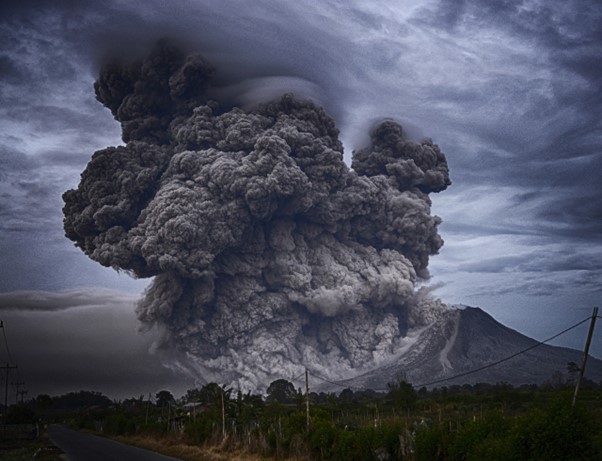
Volcanic eruptions can also play a significant part in global temperature changes.
Ironically, the Daily Sceptic can accept the input of volcanoes on atmospheric changes, but dismiss their contributions to the AMO. While volcanoes do obviously push heat into the atmosphere, the number of significant volcanic eruptions has stayed pretty much level since the 70s, during which time average global temperatures have been rising.
Recent improvements to the cleanliness of fuels used in the Far East, Europe and America, and in global shipping, have also led to a noticeable change to cloud cover in the Northeast Pacific and North Atlantic.
This argument is particularly sneaky, because it suggests that it is actually clean energy that’s a major contributing factor to the earth getting hotter. And while it is true that particulate matter can create cloud cover that can cause sunlight to be reflected back out of the atmosphere (just ask those who are panicking about the proposed ARIA ‘geoengineering’ trials – including the Daily Sceptic), not all emissions are equally reflective. Some particulate matter in the air actively absorb heat, or trap in heat that has been produced rather than let it escape the atmosphere – that’s partly why ash clouds produced by volcanic eruptions can lead to warmer atmospheres (a point that the Daily Sceptic literally just showed us it can grasp in the previous claim).
Fundamentally, whatever contributions cleaner skies are making to the heating of the earth are comprehensively offset by the lower levels of carbon dioxide, methane, and other greenhouse gases. The Daily Sceptic conveniently refuses to engage with that equation, while accusing mainstream science of an absence of curiosity.
The point Sibley and the Daily Sceptic want readers to come away with is that scientists have stopped looking at other factors – which is fundamentally untrue, given the number of scientists who are studying all contributing factors to the current climate crisis. Meanwhile, the Daily Sceptic is deliberately and frequently discounting the primary factor in the current changes to our climate – should we be looking for who stole their curiosity? If so, I propose we start the investigation at number 55, Tufton Street.