




On October 15, 1951, Rio Vista became the first city in California to fluoridate its water supply. Rio Vista was one of the first of perhaps a dozen cities who participated in what is now recognised as one of the most successful public health campaigns of the 20th century. However, by 1956 Rio Vista had removed its fluoridation equipment, and is now one of a handful of cities in the United States which has banned its use completely. As the Rio Vista Municipal Ordinances List states:
198: Unlawful to insert in or aid any person in adding fluorine in water.
Water fluoridation occurs naturally in many parts of the world, as minerals leach from rocks into ground water. In 1908, Dr Frederick McKay, a dentist from Massachusetts, moved to Colorado Springs. Dr McKay became interested in “the Colorado Stain”, a local dental phenomenon. In specific areas, locals developed lines or spots of brown and white as children, which continued into adulthood.
Mr Norman Ainsworth of Essex, England was the first to prove that people with “mottled” teeth had fewer dental carries (we call them “cavities”) than similar populations. In 1931, H.V. Churchill, a chemist with the Aluminium Company of America, analysed the drinking water of a number of towns near Bauxite, Arkansas and determined that mottling was the result of excessive fluoride (13.7mg/L) in drinking water (to the relief of his employer who feared aluminium might be causing the issue).
Studies continued to be conducted which linked high fluoride content and fluorosis (teeth staining) to fewer cavities in young children in the 1930s and 40s. Soon dentists began to suspect lower concentrations, around 1mg/L, would provide strength to teeth without causing staining.
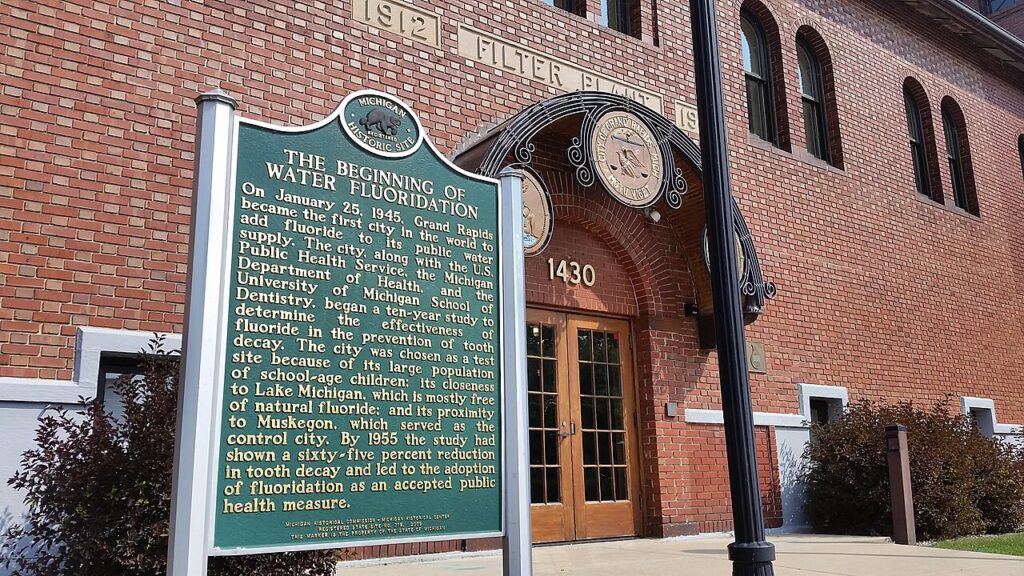
By 1945, the town of Grand Rapids Michigan started to artificially fluoridate their water in an experiment, using a nearby town as a control group. Several more towns worldwide joined in on “community water fluoridation”, or CWF. By 1950, there was ample evidence that exposure to 1mg/L over several years could reduce cavities in children significantly, with no staining or discoloration. That year, the US Public Health Service approved of the process of artificial water fluoridation, and designated it a matter for State and local health authorities.
Seeing an opportunity to join the handful of towns engaged in this new public hearth experiment, in 1951 Dr Tom Green, DDS – a City Council member and local dentist – proposed the idea at a city council meeting. The local paper dutifully records the proposal, the vote, and that someone anonymously sent a Christian Science pamphlet to the City Council which called CWF “forced medicine”. The River News and Banner June issue included a paragraph about fluoridation equipment being ordered by the water department. The permits for fluoridation were granted in September 1951 and the town officially began fluoridation at a rate of 1mg/L on October 25, 1951, when eleven-year-old Ann Chaudy, Mayor Harry Alley, and Dr. Tom Green turned on the system. Rio Vista became the first in California to fluoridate its water in time for Bass Derby, beating Pleasanton by several months.
In November of 1955, Dr. Robert Fischel – whom the Delta Herald dutifully pointed out, was not a doctor of medicine, but of chiropractic – asked the city to remove its fluoridation equipment. The City Council, unconcerned, told him that he was welcome to find signatures for a petition to bring the matter to a vote.
Fischel began firing off articles in the various local papers, writing that fluoride was “protoplasmic and encymaic [sic] poison”, it was “impossible to dose”, that there had been “no longer term studies” on artificial fluoridation, and that people should have a “choice” in the matter. Talks and debates were scheduled: Dr Exner, a famous antifluoride activist at the time, visited the town, drawing a crowd of around 100 people in the high school gym on the ides of March 1956. An editor’s note in the Delta Herald says, perhaps unsurprisingly, during the Q&A session, the anti-fluoride crowd “took over and didn’t stop until the whistle blew”.
The tone of the River News and Banner turned against the concept of fluoridation, and the PTA “recommended” their newly elected president, Lucy Tryon, resign, considering her strong opposition to fluoridation, which the PTA had come to feel was in conflict with the rest of its members view.
A desperate plea from the doctors in town appeared in the Delta Herald reading “Mr. and Mrs. Rio Vistan: Did you know that…: The Russians have nothing whatsoever to do with the fluoridation of municipal water supplies in America?”. While editorials by Charles W. Flodin of the River News and Banner “took no side” but lamented that opponents to fluoridation were being treated as “second class citizens”. Flodin asked “is it not apparent that some of our citizens are so lacking in the principles of Americanism they will copy the tactics of the nazis or communists to win a point?”.
The arguments put forth by residents against fluoridation are simultaneously time-capsules of the second Red Scare, and exactly what you find on message boards and comment sections today. In the case against CWF, people made up fake citations, claiming that President Eisenhower had been told to avoid fluoridated water. The “Stop Fluoridation” advert which ran a week before the vote contained a photostat of a letter addressed to a concerned citizen, alleging that President Eisenhower’s physician had advised the the President and First Lady to “employ conservative methods” about drinking fluoridated water. Critics ignored Howard McCrum Snyder’s later clarifications in support of fluoridation. Other letters from this era both claim Eisenhower had his (then) recent heart attack from drinking fluoridated water, and also that he avoided drinking fluoridated water to avoid the negative health effects.

Meanwhile, antifluoridation residents declared studies of artificial fluoridation too short, and ones on natural fluoridation irrelevant. They conflated various compounds, and accused opponents of misquoting experts. When they were rebuffed by the very experts they quoted, they accused them of going back on their word. They demanded blinded studies on the subject of fluoridation and decried the use of the public as lab rats. People were free to take the poison themselves, but why risk everyone’s lives? Several letters warned of the imminent waves of heart attacks, scoliosis, and death; and, equally important, folks must understand that the effects of artificial fluoridation might not show up for decades.
The folks who saw fluoridation as a public good were baffled. They wrote scientifically accurate debunkings of claims, pointed out the fake or misleading citations (in a pre-computer era), and explained some concerns being raised were understandable but unfounded. They made appeals to their credentials, the savings in tax dollars and importance of early childhood health. This did nothing to stop the Gish-gallop, each concern addressed was simply proof that the conspiracy ran deeper.
In April 1956, the citizens of Rio Vista voted 559 to 307 to remove the fluoridation equipment after four years and five months and end a contentious five months of municipal drama. According to the River News and Banner at the time:
The use of fluoride was initiated one month before it was publicly announced fluoridation of our water would be adopted. The announcement was made in October 1951.
This stands in contrast to the paper’s archives, which reported on the progress of the city’s water fluoridation multiple times in the months leading up to October 1951.
Fourteen years later the issue resurfaced, and Rio Vistans voted to remove the restriction on water fluoridation in 1970. In 1972 however, citizens once again voted nearly 2-1 against fluoridating our water, after a campaign by councilman Asa Brook. While not as contentious, Mr Brooks did get the newspaper to print an article by J. I. Rodale (author of “Happy People Rarely Get Cancer”) which made all the same points as Dr Fischel’s original letter.
Most of the concerns of Dr Fischel and Exner have been found to be totally lacking in merit, yet Rio Vista is still without fluoridation. Eventually, Rio Vista will have to fluoridate its water: in 1997 Assembly Bill 733 updated the California Safe Drinking Water Act to require communities with over 10,000 residential connections to fortify their water (currently, there are slightly fewer than 5,500 more connections to go).
In 2015 the US Public Health Service updated its fluoride recommendations for the first time since 1962. Optimal fluoride levels were set at 0.7 mg/L – previously the level was 0.7 to 1.2 mg/L. Mild dental fluorosis increased between the 1980s and 2020, peaking sometime around 2013. The condition usually isn’t noticeable, let alone harmful.
In 2026, the adoption of community water fluoridation has slowed to a trickle. Few nations outside of the USA, UK, and its former colonies chose to add fluoride to their water. Instead, the majority of nations instead use a combination of school-based dentistry, and fluoridated salt or dairy. Community water fluoridation remains one of the cheapest, effective, and wide-reaching methods of preventing cavities in children.
References
- River News and Banner editions: July 5, 1951; June 21, 1951; November 15, 1951; March 8, 1956; February 16, 1956; and April 5, 1956.
- Delta Herald, February 8, 1956.
- River News Herald and Isleton Journal, editions June 3, 1970 (495 to 390); April 12, 1972 (575 to 298); August 11, 1971.
- “Something in the Water”, Paul Nelson, the Minnesota Historical Society
This would not have been possible without:
- The Rio Vista Museum and Peter Hamilton, The Rio Vista Library.
- Articles by Ernest Newbrun, DMD, PhD; Catherine Carstairs, PhD; and Paul Nelson.
- The efforts of Dr Tom Green, DDS, Harry Alley and Grace Anderson.