





This article originally appeared in The Skeptic, Volume 7, Issue 2, from 1993.
Sightings of the Madonna, usually in bucolic areas of impoverished countries that profess a rabid faith in Catholicism, used to be popular, providing a shot in the arm for the local tourist trade, and eventual beatification for the illiterate urchins benefiting from such an audience. Observations of this nature are inevitably followed by the proclamation of miracles, particularly from those eager to boost the authenticity of such shrines.
Lourdes is perhaps the best known of such locations, Fatima in Portugal and Knock in Ireland also support a healthy traffic in pilgrims, but readers of The Skeptic will be familiar with Medjogorje in Yugoslavia, where the Mother of God allegedly appeared to, the now obligatory, peasant children in the 1970s.
Medjogore, when not playing host to civil strife, has been slowly building a reputation for miraculous events, with a concomitant increase in tourism. Not least of these is the apparent transformation of the links in rosary bead chains from silver to gold when brought into the shrine.
Several sets of such ‘transmuted’ rosary bead chains were presented to our laboratory for verification of this ‘miracle’. The investigation involved placing links of the chains into a scanning electron microscope (SEM). This instrument uses a beam of electrons to image the specimen, just as light is used in an ordinary optical microscope.
In addition, the electron beam generates X-rays when it hits the specimen. The energy of the emitted X-rays is highly dependent on the specimen composition. Each chemical element present in the specimen will emit X-rays of a characteristic energy, which act like a fingerprint, enabling the chemical composition to be determined very accurately. The analytical technique which relies on this effect is called energy dispersive spectroscopy (EDS), and was used here to establish whether or not the chain links contained any gold.
Optical examination of the links from these chains did indeed suggest a gold colouration in parts, while other regions were silver. However, the owners of the beads did not notice any dramatic increase in the chain’s weight. If the chain were to spontaneously change from silver to gold, it would be expected to almost double in weight, owing to the high density of gold compared with that of silver.
Images obtained of the silver regions showed the surface to be quite spongy, and made up of many small metallic crystals (grains). This layer was not very uniform, as holes penetrating to a smoother region beneath were evident (Figure 1).
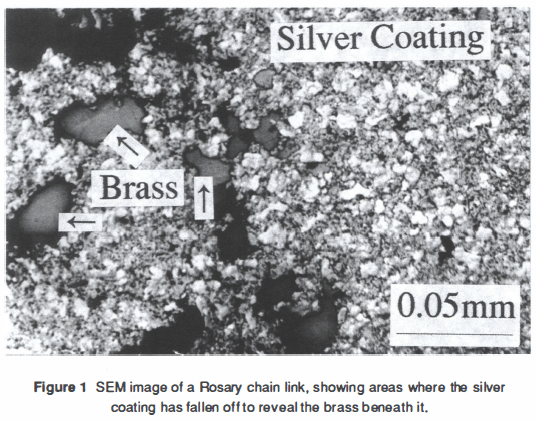
Analysis of the X-rays generated in the spongy surface layer revealed the presence of one element only, silver (Figure 2a), but analysis of the smoother regions at the base of the holes indicated the presence of two elements, copper and zinc (Figure 2b). These two elements are the constituents of the alloy brass.
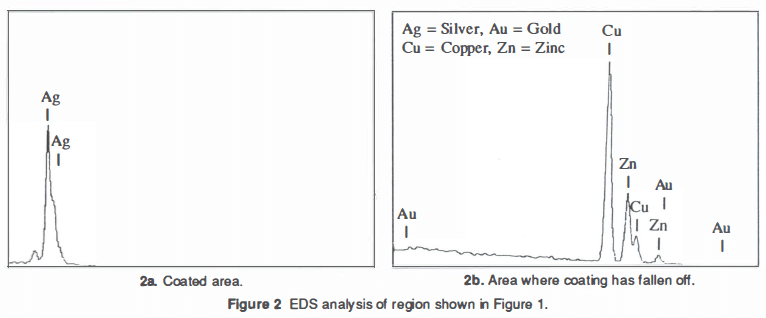
Figure 2b shows where peaks due to gold would be expected. However, this element was not detected on any of the specimens provided. Examination of the gold coloured regions on the chain links revealed the absence of the spongy layer, and only copper and zinc were detected using EDS.
The examination showed that the chain links were made from brass, plated with a thin layer of silver. In the light of this, it is reasonable to suppose that the gold colouration assumed by the chain is associated not with deity-induced alchemy, but merely with detachment of the silver plate, to reveal the brass beneath. The remaining mystery therefore, is to explain why the alleged sanctity of Medjogorje induces thin layers of silver to detach from religious artifacts.
When two metals with different chemical properties, such as silver and brass, are placed in contact, the more chemically reactive metal can undergo much more rapid corrosion than when it is in isolation. This phenomenon is termed ‘dissimilar metal corrosion’. In the case of a thin metal plating on top of another metal, this will occur most rapidly where the metals touch, causing the coating to slough off.
The question then, is why should this occur within the shrine? The answer is most likely that exposure to cool damp conditions provides the ideal corrosion environment, particularly when augmented by salt and abrasion from devout and perspiring palms. Therefore it seems most likely that dissimilar metal corrosion in the hands of pilgrims, rather than the hand of God, plays a leading role in this particular miracle.