




This article originally appeared in The Skeptic, Volume 7, Issue 3, from 1993.
In the late 1970s several of my friends suddenly found themselves a guru. In the wake of the Beatles and the counterculture this was hardly novel. Mystics, gurus and oriental cults were then the fashion – as they still are – and the Hare Krishna tribe still chanted and sang up and down Charing Cross Road. But the guru my friends embraced was not like any other. For the Bhagwan, as he was called, explicitly described himself as god (or, at other times, the Buddha) and advocated sex as a way of salvation. He offered, I was informed, real ‘freedom’ and the key to salvation was ‘letting go’ of the ego, of one’s own individuality – by paradoxically offering oneself in total submission to the authority of the guru.
Prompted by my friends I read one of his books, The Psychology of the Esoteric. It was, I discovered, a strange mixture of pop psychology and religion, with a touch of existentialism thrown in, and pretended to enact a synthesis of all religions. The thoughts of the theosophists and the mystic Gurdjieff lurked in the background. The book was written in a very persuasive, readable style, and indicated both wide erudition and a rather naive understanding of the material world.
Philosophically the book was hardly original, simply propounding a form of religious idealism that had been advocated by Vedantist scholars like Sankara more than a thousand years ago. I was hardly convinced, and only bemused at Bhagwan Shree Rajneesh’s love of paradox. Here was a man suggesting that we must all be seekers after truth, not the disciple of any guru: ‘Do not seek a guru’, he wrote; ‘because gurus are crippling’. At the same time however he was demanding that his followers ‘surrender’ themselves to him, and he proclaimed ‘I will transform you’. And my friends more than surrendered themselves to this ‘Enlightened Master’. Here was a man suggesting like the Quakers that god was within each of us, yet at the same time announcing that anyone who believed in god was not only mentally retarded but utterly mediocre. He was a man who wrote that we should only observe and experience life: ‘do not verbalise’ he argued. Yet practically everything he said in his numerous public discourses was dutifully taped by his disciples and published. It was reckoned that around twenty-five new books by the Bhagwan were published each year. His books (talks) are still being published: they made him into a very wealthy man.
In reading his books I always had the feeling he was something of a religious con-man. This, in fact, was almost how he described himself. ‘I am the best showman in the whole history of mankind’ he declared. The Bhagwan was not renowned for his modesty. He was also an intellectual fake, often quoting such figures as Jesus, Marx, and the Buddha with words which were either spurious or complete fabrications.
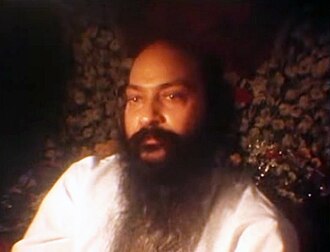
Mohan Chandra Rajneesh was born in 1931 in a small village near Jabalpur in India, the son of a cloth merchant. He came from a Jain background, and studied philosophy at Saugar University, taking his MA in 1957. Until 1966 he taught philosophy at the University. He then became a freelance lecturer and erstwhile guru, and in 1970 he moved to Bombay where he found support from some wealthy people. He made a name for himself by his outspoken criticisms of Gandhi and orthodox Hinduism, and he seems to have bowled many people over by his charisma and personal charm. Abandoning the role of ‘acharya’ (teacher), he took the title of ‘Bhagwan’, which means ‘god’ or ‘the blessed one’.
Rajneesh was by all accounts a strange and eccentric guru. He lived in sumptuous luxury, and in his heyday owned a fleet of Rolls Royces. He advocated free sex, and had promiscuous sexual encounters with a host of admiring female devotees who, like one of my friends, swooned around him. He said he had loved more women than any man in history. ‘In the beginning’, he recalled, ‘I used to keep count, but I’ve lost track’. He thus emphasised ‘spiritual sexuality’ as a way of salvation, and stressed the physical release of inhibitions through ‘dynamic meditation’ – all as a way of enlightenment. Sex, for the Bhagwan, was divine, and must not be repressed. It was all part of ‘letting go’, ‘surrendering the ego’, ‘losing the mind’ – all bound up in submitting oneself to the authority of the ‘Enlightened Master” – the Bhagwan himself. His disciples wore orange robes and decked themselves in a beaded necklace that held a medallion containing his portrait. Most of the teachings and the life style of this “sex guru” flew in the face of orthodox Hinduism, which is highly puritanical, and it is not surprising that he attracted young people from Europe and America. Most of his Indian followers were wealthy, professional people.
In 1974 the Bhagwan moved to Poona, and there established his famous ashram; but again, it was quite unlike any other ashram. What people in Poona told me about the place is fully confirmed – and detailed – in Hugh Milne’s book Bhagwan: The God that Failed (Sphere, 1986). For not only was there “free-for-all-sex”, but “there was a conscious indulgence in wine, music, song, feasting and sensual massage”. A former bodyguard of the Bhagwan, Milne, like his guru, had numerous love affairs and sexual liaisons. The ashram was seen by Rajneesh as a kind of experiment, combining a range of Western therapies – bio-energetics, primal therapy, gestalt, encounter groups – with meditative practices drawn from all the major religious traditions, but especially the Sufi and Tantric traditions. It is significant that nowhere in his voluminous writings on religion does Rajneesh mention Africa. It was this “diverse package” that was known as “dynamic meditation”, and its aim evidently was spiritual transformation, expressed as the awakening of a “higher consciousness”, as the “experience of Buddhahood”, or as the explosion of the “life-force” or “Kundalini energy” within the person.
As many of the devotees of Bhagwan were involved (it was alleged) in drugs and prostitution, and the ashram itself, as a profit-making religious charity, was being harassed for tax evasion, Rajneesh’s whole enterprise soon came under the scrutiny of the Indian authorities. Although not mentioned by Milne, I was told in Poona that the Indian authorities also suspected CIA activities in the ashram. Inevitably, facing arrest and having generated a lot of ill-feeling among the people of Poona, the Rajneesh decided to shift his ashram to the United States. It was all done rather abruptly: only a few disciples knew about the move. There was then about six thousand sannyasins (disciples) living in or around the ashram in Poona. Thus it was that in June 1981 the guru Rajneesh moved with his devotees to Oregon, having bought the Big Muddy Ranch for $5.75 million. Like Aurobindo before him, the new city was to be built by his devotees and named after him, Rajneeshpuram.
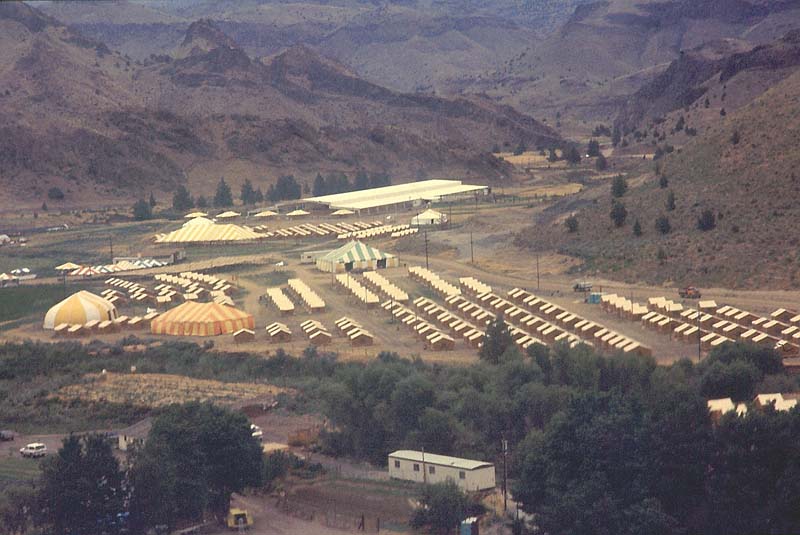
The events surrounding the activities of the Rajneesh foundation in America are even more involved and bizarre than those in Poona. Corruption, intrigue, conspiracy charges, arson, racketeering, and attempted murder were all associated with the new “commune” which suddenly fell apart in 1985. Under the leadership of the Bhagwan and his secretary and confidante Ma Anand Sheela – described by one recent journalist as a “foul-mouthed harpy” – the ranch initially flourished. Gurdjieff Dam, a $1.5 million earthen dam, was constructed, along with the Krishnamurti Lake holding 350 million gallons of water. Free labour provided by the sannyasins soon had about 2700 acres of land under cultivation, and a sophisticated sewage system was established. The Oregon commune soon had its own shopping mall, restaurants, stores, clinic, and offices, as well as its own airport and university – The Rajneesh International Meditation University. The whole undertaking – the “communal Buddhafield” as it was called – was organised as a capitalist enterprise, and around $200 million were spent in less than four years developing Rajneeshpuram into a new-age, futuristic commune. It was quite unlike the sprawling, untidy, hippie communes of an earlier decade! Most members of the commune were white, middle-class professionals. Around two-thirds of them had university degrees, and almost all were in their thirties or early forties. There were no nurseries or schools, however, for children were positively discouraged. As Judith Thompson and Paul Heelas write in The Way of the Heart: the Rajneesh Movement (Aquarian, 1986), their sympathetic account of the Rajneesh movement, women were asked “to give up the distraction of having babies so that they [could] focus their attention on Bhagwan’s vision”. But women played a central role in the administration of the commune, under the direction, it appears, of Ma Anand Sheela.
By 1983 “Rajneeshism” was being propagated as a new religion, the Bhagwan had taken a vow of silence, and between four and five thousand devotees were living on the ranch. Then things started to go awry. Relations between the commune and their Oregon neighbours, which had never been amicable, began to seriously deteriorate. Devious methods were employed by the followers of the Bhagwan to rig the local elections. The devotees were encouraged to build up an arsenal of handguns and semi-automatic weapons in order to protect the guru; and Ma Sheela regularly appeared in public or on national television, brandishing a magnum, and denouncing the local people of Oregon as ‘bigots’, or ‘hicks’ or ‘monkeys’. Such antipathy towards outsiders was coupled with growing control and intolerance within the commune. A siege mentality developed. Visitors to Rajneeshpuram were strictly monitored, activities in the commune and contacts with outsiders strictly controlled, and an electronic surveillance system was installed – every telephone tapped and every room in the commune bugged. In 1984, it appears, an attempt was made by Ma Sheela and her acolytes to poison, with salmonella, a nearby town of nine hundred people. On top of this the Bhagwan was accused of conspiring to violate U.S. immigration laws.
In the autumn of 1985 the commune suddenly fell apart amid acrimony, confusion and paranoia. The community the ‘Buddhafield’ – was dramatically split asunder, the schism largely focussing around what had all the signs of a lover’s quarrel between Rajneesh and Ma Anand Sheela. In September Sheela abruptly left the commune for West Germany, along with a small group of leaders. She announced that she had grown tired of pandering to the whims and needs and irrationalities of a guru whom she dubbed a liar and a crook. This seems to have caused the Bhagwan to break his vow of silence, and the following month he accused Sheela of establishing her own ‘fascist regime’ within the commune, and fleecing the Rajneesh corporation to the tune of some $55 million. He likened his secretary to Adolf Hitler, as someone who lusted for power and was wracked with jealousy. As in Poona four years earlier, the Bhagwan made another abrupt departure from his commune, this time destined for Bermuda. But he was arrested while fleeing the country, at Charlotte, North Carolina, where he was fined $400,000, and given a suspended sentence of ten years. Around the same time Sheela was arrested in Germany, and after extradition and plea-bargaining with the U.S. authorities, was eventually sentenced to four and a half years imprisonment for immigration fraud, arson and attempted murder.
After travelling the world for a while seeking a safe haven – many countries, including Sweden, Germany and Britain refused to grant him a visa – the Bhagwan eventually returned to India. He died at Poona in January 1990, aged only 58.
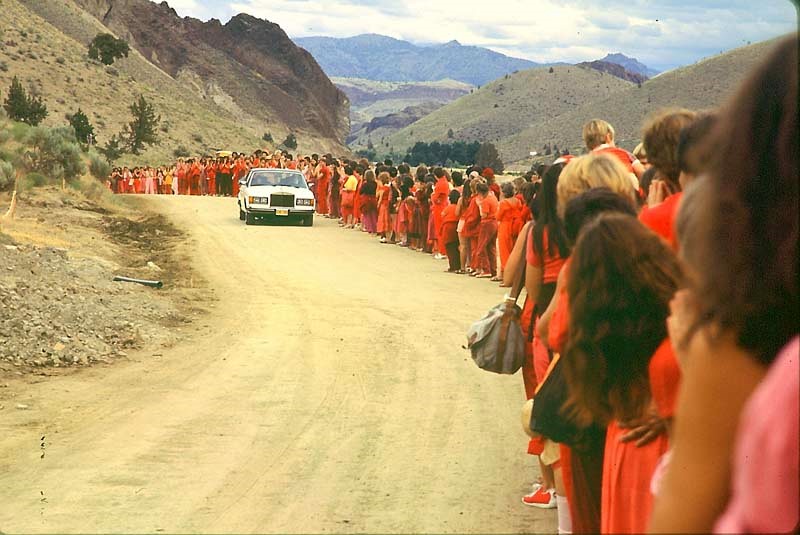
‘Jesus saves, Moses invests, Bhagwan spends’ was a favourite bumper sticker at the Oregon commune, displayed as Rajneesh drove silently among his admiring devotees in one of his 93 Rolls Royces. At Poona many people were appalled at the Bhagwan’s somewhat arrogant display of wealth, when he totally ignored the poverty of Indian people just outside the ashram. But unlike Gandhi, Rajneesh was never really concerned with the material well-being of ordinary people – only with the spiritual salvation of the affluent. He described himself as a ‘materialist spiritualist’ and remarked ‘blessed are the rich because they are already inheriting the kingdom of god’. He stridently supported and advocated the capitalist system and the work-ethic, and held very anthropocentric views, considering humans as ‘nature’s highest peak’. In many ways Rajneesh updated the Protestant ethic, shifting the emphasis from production to consumption. His eclectic hedonistic mysticism is the religious counterpart to much postmodernist philosophy – simply a reflection of the culture of consumerism.
The biography of Bhagwan Shree Rajneesh is a strange story. It recounts the sudden rise of a shrewd, intelligent, charismatic figure from obscurity to world fame – for at the peak of his popularity the Bhagwan had thousands of devotees, and assets well in excess of $100 million, and he was hailed as another messiah. His demise as a guru was equally sudden, and he now stands discredited, although as ‘Osho’ his remaining devotees at Poona still attempt to keep his memory green. He is alleged to have never lived and to have never died. But perhaps Lord Acton was right: power tends to corrupt, and absolute power, even religious power, corrupts absolutely.