




In 1941’s ‘The Lungfish and the Unicorn: An Excursion into Romantic Zoology’, German-born science writer Willy Ley described a mysterious and terrifying inhabitant of the Timor Sea, a relatively shallow body of water to Australia’s north:
This sea, the natives claim, is inhabited by a large, ferocious man-eating shark. It is larger they say, than the well-known man-eating shark.
Despite its preference for temperate or colder waters, most interpret the ‘well-known’ man-eater to be the great white, Carcharodon carcharias. However, Ley may well be referring to the tiger shark, Galeocerdo cuvier, the blunt-nosed apex predator of tropical seas worldwide. Ley continues with a curious description of the unknown creature:
It does not possess the typical triangular fin on its back; yet it is definitely a shark…It is said not to swim on the surface of the sea but to lie in wait on the bottom. Consequently, the natives call it the ‘ground-shark’.
The term has a long history in ichthyological circles. To Newfoundland fishermen, it described the Greenland shark, a deep-sea ambush predator of the frigid North Atlantic and Arctic Oceans. Meanwhile, a 1922 article from Adelaide’s Observer applied it to the ‘much-feared’ sevengill shark, a relative lightweight of up to one hundred kilos.
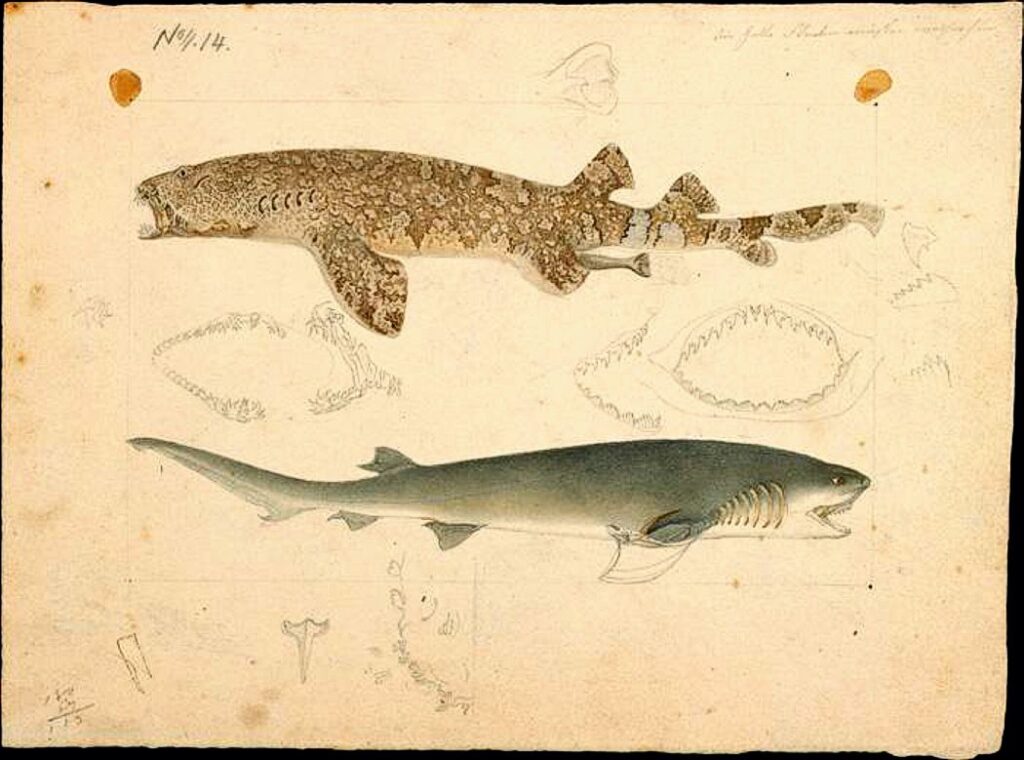
Nowadays ‘ground shark’ refers to a member of the Carcharhiniformes, the largest order of sharks with some 270 species. Members of this order are characterised by the presence of a transparent third membrane over the eye, two dorsal fins, an anal fin, and five gill slits.
The Timor Sea’s ground shark’s great size and lack of a central dorsal fin appears to rule out all members of this group of which the tiger shark, at potentially over five metres with its rows of distinctive notched teeth, is the largest.
What is clear is that while the creature’s identity remains shrouded in mystery, its pool of potential victims continues to grow.
Today, approximately sixty five thousand years after Australia’s first inhabitants crossed the Timor Sea from what is now Indonesia, divers using simple compressors and air hoses comb the floor of the continental shelf in a perilous quest to harvest trepang or sea cucumber, prized throughout Asia for their culinary and medicinal properties.
Many trepangers have failed to resurface over the years, some simply disappearing without a trace. In fact during a 2021 interview with a fishing boat captain from Rote, Indonesia’s southernmost island and the East Lesser Sundas’ gateway to the Timor Sea, the hardened seafarer revealed that four from his village had been lost to the sea in that year alone.
Could the ground shark be a deadly new species currently unknown to science? Ever since the accidental discovery of the bizarre megamouth shark off Hawaii in 1976, the notion can’t be dismissed outright.
Renowned author and zoologist, Dr Karl Shuker, in his 1991 article, ‘The Search for Monster Sharks’, suggested a yet-to-be-discovered species of giant wobbegong as the potential culprit. While certainly an intriguing possibility given the fish’s sluggish nature and low-lying dorsal fins, the largest known wobbegong, Orectolobus maculatus, rarely exceeds three metres in length and is generally considered harmless to humans.
But just when the mystery of the ground shark’s identity appeared destined to remain unsolved, the bluntnose sixgill shark, Hexanchus griseus, emerges from the depths. These long-lived deep-sea fish, inhabiting tropical and temperate waters worldwide, get their name for being one of only a handful of sharks without the five gill slits of more modern species.
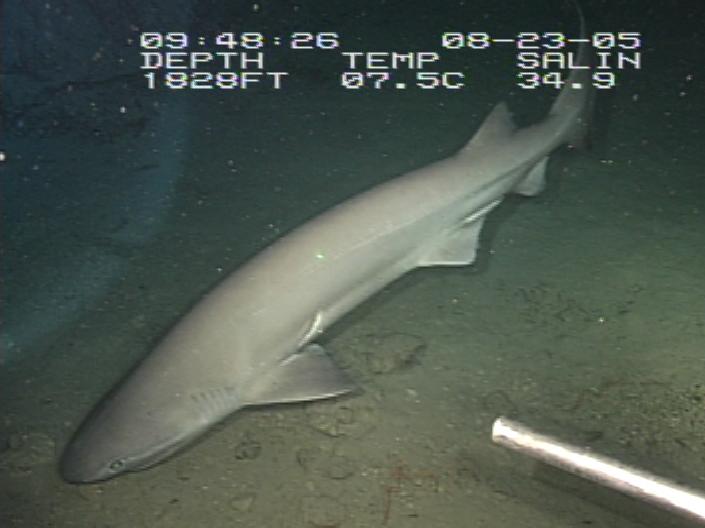
They are sometimes referred to as the ‘mud shark’ due to their habit of hunting along the sea floor for crabs, rays, and fish, and according to the book, ‘Economically Important Sharks and Rays of Indonesia’, sixgills are known as the ‘hiu tahu putih’ (tofu shark) in the Lesser Sundas due to their soft white flesh.
But perhaps most pertinent to the topic at hand, they completely lack a central dorsal fin, instead having a single small dorsal fin located far back near their elongated caudal fin. With an estimated maximum length of up to five metres, the powerful bottom-dwelling sixgill certainly looks the part of the feared man-eater.
The sixgill’s ambush tactics are also closely aligned with those attributed to the Timor Sea’s mystery fish. A 2015 study by researchers from The University of Tokyo and the Hawaii University at Manoa demonstrated that this remarkable giant, virtually unchanged for over two hundred million years, is one of only a few species of shark to be positively buoyant.
After prowling the floor of the continental shelf during the heat of the day, the sixgill rises through the murky depths at night, in a behaviour known as diel vertical migration, appearing suddenly and without warning beneath its prey with rows of saw-like teeth glistening within a gaping, cavernous maw.
The Timor Sea’s relatively shallow depth, an average of less than two hundred metres in most places, could bring this usually shy predator into close proximity to human divers, and into legend.