

The start of the year is, for many, an opportunity to reflect on their diet and fitness, with New Year’s resolutions around committing to exercise more, join a gym, and watch what they eat. Mant even decide to go vegan, as part of Veganuary – the annual public awareness campaign designed to encourage people to ditch animal-derived produce.
Personally, I think Veganuary is a terrible idea, but not because I’m against reducing our meat and dairy intake – far from it. We know the environmental impact of eating meat and consuming milk-based produce is high, so anything we can do to reduce our intake even by a little is going to have an appreciable effect on the carbon emissions associated with our food. But January is a terrible month to take on a large-scale adjustment to your diet. January is cold and dark and miserable, and the last thing you should be doing is finding ways to make it even more cold and dark and miserable by limiting one of the few things you can control in January that can bring you some joy: what you eat and what you drink.
Nevertheless, for a lot of people January is the month when they make ambitious changes to their diet, including switching out their milk for non-dairy alternatives. However, according to recent studies, that might be very bad for them. The Telegraph proclaimed on 5 January: “Vegans are more likely to be depressed, study suggests”, while Women’sHealth went with “New research says drinking plant-based milk ‘increases risk of depression’”, and the Daily Mail coverage was headlined: “Experts issue warning over oat milk – dairy alternative linked to health harm while semi-skimmed cow’s milk boasts surprising benefit”. Here’s a flavour of what the Mail had to say:
If you splash almond milk over your porridge or opt for oat milk flat whites, then you might want to think again. Opting for plant-based diary alternatives could harm your mental health, if new research is to be believed.
Scientists, who tracked more than 350,000 Brits, discovered plant-based milk drinkers were more likely to suffer from depression than those who drank semi-skimmed cow’s milk.
These headlines reported on a study published in Frontiers in Nutrition, in which, as the Daily Mail explained, scientists at Southern Medical University in Guangzhou in southern China tracked the diets and mental health of 350,000 British people, collected as part of the UK Biobank study. The UK Biobank is a long-term study in which half a million people aged 40–69 were recruited between 2006 and 2010, consenting to have their anonymised biological samples, health-related data and lifestyle questionnaire data made available to researchers. Since then, these records have been periodically updated with cognitive tests and follow-up questionnaires, some of which track changes in mental health, and it’s that long-term comparative data that these Chinese researchers were interrogating.
According to the paper, the researchers examined the reported milk consumption habits of 502,402 UK BioBank participants. In the initial intake questionnaire, participants were asked “What type of milk do you mainly use?”, and were provided with a list of options: full cream, semi-skimmed, skimmed, soya, other types of milk, never/rarely consume milk, do not know, and prefer not to answer.
The researchers omitted from the study those who didn’t know or didn’t answer, and then lumped the soya milk respondents in with ‘other milk’.
They then looked at the reported mental health scores for these participants, which were assessed on initial intake using a questionnaire that consisted of four questions – two regarding depression, two for anxiety. Participants rated their thoughts and feelings over the past two weeks on a scale of 0 (not at all) to 3 (nearly every day), and if they scored full marks on both relevant questions, they were judged to have depression or anxiety, or both.
The researchers omitted the 52,306 participants who didn’t answer the mental health questions on intake, and the 1,149 who never responded during the later follow-ups. Finally, they omitted any participant whose results indicated they had depression or anxiety on initial intake – 89,852 people.
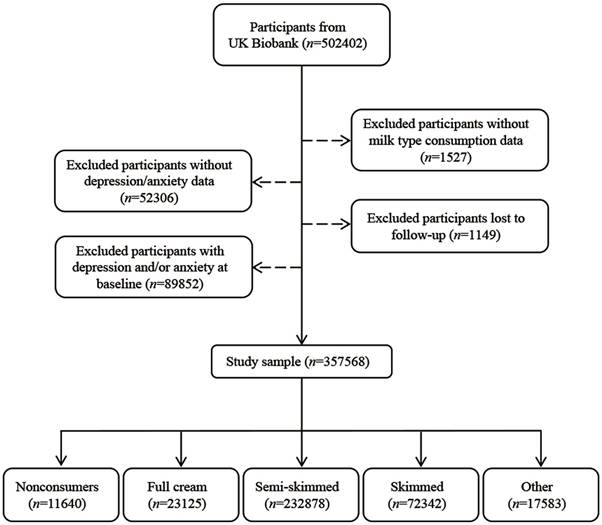
This left them with 357,568 participants, of which around 23,125 were full-cream drinkers, 232,878 were semi-skimmed drinkers, 72,342 drank skimmed milk, 17,583 drank ‘other’ milk (including the soya drinkers), and 11,640 did not consume milk. Then they looked at the follow-up depression and anxiety scores across the various types of milk consumption, comparing them to the non-consumers as a baseline. What they found was summarised in the Mail as:
semi-skimmed cow’s milk drinkers were 12 per cent less likely to be depressed and 10 per cent less likely to have anxiety. Those who consumed plant-based milks, such as soya and almond, had a 14 per cent increased chance of depression.
The Daily Mail included some of the researchers hypothesised reasons for these findings:
semi-skimmed contains more good fats than skimmed milk but fewer bad fats than full-fat. Previous research has found ‘good fats’ may increase the production of serotonin — a hormone that can alter mood. This, they theorised, means the milk could sit in a sweet spot where it improves mental health. It also shatters the myth that milk alternatives are always the healthier option, they argued.
Except, that’s not true, because “shattering the myth of milk alternatives” is not something that is argued in the paper. This paper says nothing at all about the dangers of drinking non-dairy alternatives to milk – and there is zero mention of oat or almond milk in the entire paper. It seems that the Mail made that bit up (or, perhaps, cribbed it from a press release that invented it), and then added “they argued” to the end in order to put these thoughts into the mouths of the researchers. In reality, all of the findings in the study focus on the positive health benefits of semi-skimmed milk over all other types of milk in the study:
‘Milk is a rich source of nutrients such as lactose, lipids, protein and minerals, which are essential for maintaining human health…
Among the three milk types, full cream milk contains higher levels of saturated fatty acids, while semi-skimmed milk offers a moderately reduced amount. Excessive intake of saturated fats is associated with elevated levels of circulating saturated long-chain fatty acids, such as palmitate, which are positively correlated with the severity of depression…
The fatty acid profile of semi-skimmed milk might provide greater cerebral protection compared to full cream milk and skimmed milk, thereby potentially reducing the risk of both depression and anxiety…
These findings suggest that semi-skimmed milk may have a protective effect against these mental health conditions, presenting new prospects for dietary interventions.
What can we make of all of this? Firstly, it’s worth noting a minor point: the researchers from the Southern Medical University in Guangzhou were from, specifically, the School of Traditional Chinese Medicine at that university. That’s not to say that makes them bad researchers, or that we should ignore their results, but it is context that would be remiss to leave out. If they were from the homeopathy department of a British university, we’d expect that to be made clear. Traditional Chinese Medicine is a little different to homeopathy at least politically, in that there are departments of TCM at major Chinese universities and it receives more legitimacy and funding than it ought to, so likely attracts researchers who are drawn more by the resources than the ideology, but nevertheless it is worth noting.
Now let’s turn to those headlines. Neither The Telegraph’s “Vegans are more likely to be depressed, study suggests”, nor Women’sHealth’s “New research says drinking plant-based milk ‘increases risk of depression’” accurately reflect this study, as researchers were looking to compare semi-skimmed milk to other types of milk – they weren’t looking at vegan alternatives to milk. Worse still is the Daily Mail’s headline, “Experts issue warning over oat milk” – we can confidently dismiss that, because this study at no point mentions oat milk, not even once. That shouldn’t be a surprise, because the dataset it interrogates did not ask people how much oat milk they drank. They provided the options ‘soya milk’, and ’other types of milk’.
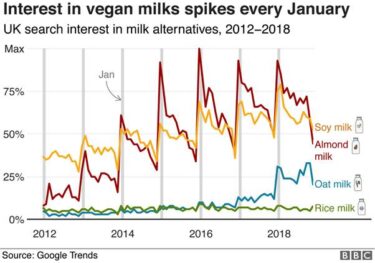
This makes sense, because back in 2006 when the UK BioBank started recruiting people aged 40-69, oat milk wasn’t a particularly common or readily available alternative to milk. Statistics on this are hard to find, but I was able to track down a February 2019 BBC article on the comparative popularities of vegan milks, which showed oat milk made up less than 5% of searches for vegan milk alternatives as far back as 2012, according to Google Trends, with soya milk and almond milk leading the market since. That 2019 article even notes that oat milk companies only recently entered the UK market. That aligns with Mintel market research reports from the time, surveying consumers’ milk choices – soya milk made the list of options, but oat milk wasn’t even included. By 2014, oat milk made up less than 1% of purchases. Suffice to say, oat milk wasn’t common when these people were asked which milk they were drinking in 2006 to 2010. And it’s the only time any of these people were asked what they were drinking – they were not asked again in 2022 when asked for their updated depression and anxiety scores.
Even the initial milk intake of the participants is less than reliable – it was self-reported data, which is prone to messiness. Take me, for example: currently, I mostly drink soya milk, unless when I’m at someone else’s house or I’m out, in which case I drink semi-skimmed. But also, if I’m looking for something to buy and drink as I’m on the go, I’m more likely to buy a pint of milk to drink than a bottle of coke, and if I do that it’d be semi-skimmed or possibly even whole milk. What would I respond to “do you drink milk?”.
Given that the data was self-reported, we don’t even know how much milk each participant consumed. That is a significant issue, if the working theory is that fats in semi-skimmed milk offer some protection against mental health issues. Several people in my life are regular semi-skimmed drinkers, but their milk consumption amounts to half a teaspoon of milk in a cup of tea several times a day – perhaps half a pint of milk per week. Meanwhile, I eat cereal every morning, and have a generous glug of soya milk in each cup tea I drink. Comparing type of milk without noting quantity is comparing apples to oranges, from a nutritional perspective.
Additionally, in 2006-10 during the initial UK BioBank questionnaires, it isn’t just that there was less oat milk around for people to self-report drinking – there were fewer non-dairy alternatives in general. The category of ‘non-dairy’ milk or ‘milk alternative’ was so uncommon that many people wouldn’t have been able to explain what it meant. That’s actually not a problem for the study, because the UK BioBank didn’t ask what ‘non-dairy’ milks people drank – they only asked whether they drank full-cream, semi-skimmed, skimmed, soya, or ‘other’. Anything that wasn’t one of the four stated categories was bundled into the ‘other’ category – yet it’s that ‘other’ that has been translated to ‘non-dairy alternative’ (or even just ‘oat milk’ in the reporting).
Significantly, ‘other’ is not a synonym for ‘non-dairy’: it would include, for example, gold top – a high-fat premium milk that was readily available from milk delivery services (certainly more so than soya milk or oat milk). It might mean reduced-fat milk that’s not quite semi-skimmed. It might mean lactose-free milk. It might mean organic milk, goat milk, or sheep milk. ‘Other’ might include people who didn’t realise ‘whole milk’ was a synonym for ‘full-cream milk’. It might include people who drink UHT milk but thought it was it’s own category. There’re lots of reasons why that ‘other milk’ category may include a large number of dairy-milk drinkers and it isn’t as synonymous with milk alternatives as it is portrayed in the reporting.
All of that is just an issue with the reporting, because the paper itself doesn’t look at how bad vegan milk is: it looks at whether semi-skimmed is superior to everything else. That focus might well explain why the researchers took the one piece of non-dairy information they did have – the soya milk data – and rolled it into the ‘other’ category. Cow’s milk gets broken down by three different levels of fat content, but the researchers pollute the only unambiguously non-dairy data they have, because they weren’t comparing non-dairy to dairy, they were looking at which level of fat content in milk was best.
That’s not to say that the researchers did nothing unusual in their analysis. They omitted the nearly 90,000 participants with depression or anxiety in the original baseline measurements, which is not ideal, given they were looking at levels of anxiety and depression in the population. By removing the people who had depression to begin with, they may argue they were left with only the participants who developed depression during the course of the study, but the omission effectively skewed their baseline, leaving them with a cohort of participants who were now artificially above the background level of depression and anxiety in the population.
What the study does not have, because it was removed from the dataset before any analysis, is how many people at baseline had depression, and what types of milk they typically consumed. What if that data found an existing depression or anxiety skew towards one particular type of milk? That might have indicated that people who have depression or anxiety have characteristics that also influence their consumption choices.
The demographics of the various milk consumption options are also distinct in a way that does not appear to be random. For example: women made up 50% of semi-skimmed drinkers, 61% of skimmed and 67% of the ‘other milk’ category, but just 37% of full-cream. Smoking rates are just as stark: just 5.9% of ‘other milk’ drinkers were smokers on initial intake – the lowest of any group, followed by 6.2% of skimmed milk… but a full 18% of full cream drinkers were smokers at the time of the initial data collection.
‘Other milk’ drinkers were more likely to exercise (61% compared to 55%-56% for the remaining categories). ‘Other milk’ drinkers ate more vegetables and fruit than all but the milk non-consumers – not by a lot, but consistently. 37% of ‘other milk’ consumers did not drink alcohol, compared to 31.5% full, 25.6% semi, 28.6% skimmed, and 27.2% milk non-consumers. ‘Other milk’ drinkers had the lowest rates of diabetes – 3.6%, compared to 3.9% full, 4.9% semi, 5.1% skim and 4.8% non-consumers.
Clearly, from the demographic breakdown, people who were more health conscious – who smoked less, drank less, and ate more fruit and vegetables – were more likely to drink this ‘other’ category of milk. This feels significant: perhaps the same factors that lead someone to be more conscious of their health are the factors that might lead them to experience depression or anxiety 15 years down the line.
The fact that those second measurements of anxiety and depression took place almost 15 years after the initial readings is also important. First, it means that the intake who were 40-69 at the time of first reading were 55-84 at the second measurement of their anxiety and depression. Obviously, along the way, 1,149 patients were ‘lost to follow up’ – given the upper end of that age bracket, we can imagine what ‘lost’ might mean for a lot of them. That itself might also introduce a bias into the data: how many of the hard-drinking, hard-smoking, non-exercising, whole-milk-drinking participants didn’t make it to their 80-somethingth birthday to tell us about their depression?

The paper does specify that they performed subgroup analyses on these demographic variances, and that they showed no statistical significance. Though obviously they were focused on semi-skimmed milk, as that’s what the study was really about – it wasn’t about other milk or oat milk at all.
The 15-year gap to follow-up introduces another confounding issue: how many of the participants had, at some point during the intervening 15 years, changed their milk preferences – either from dairy to other, or even just from full-cream milk to semi-skimmed milk? We don’t know, because the data doesn’t include that, despite the huge boom in awareness of and interest in dairy alternatives since 2010. There’s no way of measuring whether any of the people in one category of milk consumption are even still in that category now.
A further thing that is hard to rule out is that many people would argue that world events include some clear causes of anxiety and depression, even in 2022 when the follow-up measures took place. It may well be the case that that people whose demographic data put them in the more health conscious, non-smoking, low-drinking categories, might also be the kind of people who pay more attention to anxiety-inducing global events. Or, perhaps, that people who made climate-conscious choices about their diets in 2010 had feelings of anxiety and depression in 2022… as the world continues to do too little about the climate crisis. There is no distinction in the paper between clinical anxiety and reasonable concern about the catastrophic nature of current events. It could be that this study filters for awareness.
Ultimately, despite the headlines, this study never had anything to say about oat milk, nor any non-dairy milk. It suggests that consuming semi-skimmed milk is associated with lower levels of depression and anxiety than ‘other’ types of milk, but it does that observationally, where it can only point out associations and not causes. It speculates as to a nutritional reason for this, but that’s all it is: speculation, because even the milk consumption was self-reported. The study even notes that it doesn’t have access to dietary information or total energy intake, which could be confounding factors.
All in all, it is probably fine to stick with your vegan alternatives to milk – there’s no good evidence that they’ll cause you anxiety, and they’re certainly better for the environment. Just take my advice and don’t go making any major dietary changes in the darkness of January and February, because winter is already depressing enough.