




This article originally appeared in The Skeptic, Volume 6, Issue 4, from 1992.
In his article ‘Reason, Science and the New Demonology’ (The Skeptic 4.6) Andrew Belsey noted that ‘Nature is simply whatever exists and the task of science is to discover what it is like, at a fundamental level… To put the point simply: we cannot lay down or even predict what science will be like in the future in either its methods or its results.’ Belsey’s eminently sane observations about Demonology set me upon the task of considering miracles in a somewhat like manner.
The skeptic is often confronted by what the believer thinks is a trump card – miracles. A miracle is usually defined as ‘an event contrary to the laws of nature’; it can also be considered that a miracle is ‘an event that creates faith’ (if it were the first, it would also be the second).
It is quite foolish to be sidetracked into debating the authenticity of alleged miraculous events. To be fair, the Roman Church (which sets great store by the supposed reality of miracles in general) can be ruthlessly skeptical about alleged instances. The Vatican can be very hard-nosed when confronted by any old tall story from the back of beyond on the sole say-so of some obscure crackpot. The secularist should be equally careful and avoid trying to prove a negative on the dubious ground that whatever it was ‘did not happen because it is impossible’.
Many things happen that might, at some stage, have seemed impossible. Imagine a man who has been cut off, by chance circumstance of war, from the modem world (perhaps he has been living rough in some obscure Far Eastern jungle and has only just been rescued, decades after the end of World War 2). Such a man could well accept that I have typed this article. If I told him that I had a special kind of typewriter that enabled me to correct errors before they were printed, that enabled me to move whole paragraphs from one part of the article to another before printing, that could, by telephone, be used to type my words on a paper hundreds of miles away from where I am sitting… he would react in various possible ways: number one, he might call me a tease or a liar or a madman saying that ‘such things are not possible’; or, perhaps, number two, he might say it was all a miracle – using the word as defined above. My back is broad: I don’t object to number one. Perhaps he is inclined to go for number two as the truth of the matter. We must examine this possibility carefully.
‘Such things are not possible’ is false in this instance. On what basis might he think otherwise? His reason would be ‘these things are impossible because if, hypothetically, they were possible, I would not be able to understand them.’ The easy assumption, that possibility is limited to what we can currently comprehend, is one that we all tend to make and never should make. Columbus did not fall off the edge of the earth even though people could not comprehend how that could be avoided.
It is not good enough for you to say that these words cannot now fade from the paper and be replaced by my voice reading them to you merely because that would be impossible for you to understand. Perhaps it is impossible anyway but not simply because it would exceed your powers of comprehension were it to happen.
With such thoughts in mind, the catch in the ‘miracle’ idea is not necessarily in the events cited being deceptions, or in their being readily explicable within the limits of existing knowledge and comprehension. The catch is in the concealed assumption that we know the laws of nature as final truth. We do not need to claim that those laws are the whole truth but, only if we know them to be ‘the truth and nothing but the truth’ could we say that any supposed event would be contrary to them.
People who are not scientists, and some who are, have very exaggerated ideas about the validity of the ‘laws of nature’; they are not what they are cracked up to be. These laws fall into two extreme categories and in many instances they are a bit in both.
An example of one extreme is the law that when you halve the volume available to a given quantity of gas, it responds by exerting double the pressure on the walls of the vessel containing it. This – Boyle’s Law – is the summary of many observations but is dependable only in the circumstances in which those observations have been made. If you work at very low temperatures, or at very high pressures, gases do not behave like this. A hypothetical race of beings living on the deep-sea bed would not have discovered Boyle’s Law as he did, not because of lack of his ability and skill, but because the ‘law’ is not ‘true’ – it is not there to be discovered – in the conditions of high pressure and low temperature prevailing in the ocean depths. ‘Laws’ of nature are often like that – usable generalisations from experience that are not dependable beyond the scope of that experience. The old certainty that ‘what goes up must come down’ is now known to be a grossly limited generalisation. If you throw something up hard enough, it goes round (in orbit); if you throw it up harder still it does not even go round – it goes away into ‘outer space’ never to return (so far as we can tell).
The other extreme case of ‘laws of nature’ is exemplified by the Laws of Thermodynamics. These laws describe the sorts of transformations that energy can undergo. They cannot be proved directly by experiment. They are, in reality and in the strict sense of the word, ‘dogma’. People expert in thermodynamics accept these laws because they form a framework within which a vast and varied range of observed facts can be fitted logically. The whole edifice is so satisfying to those who can comprehend it that they have no hesitation in stating as fact anything that is needed to keep the structure intact. If anybody thinks that’s rather like theology – it is!
So the laws of nature, as ‘known’ to us are, partly, limited generalisation from observation, and partly wide-ranging doctrines that ‘feel’ right – if that’s the way you feel about them (and informed people do). The great idea of evolution is both: it is a consistent summary of many facts and it is a grand scheme that appeals to people who feel that ‘it must be true’. But, whatever the place of any law of nature in the spectrum that runs from summarised fact to irresistible dogma, we do not know those laws well enough to state categorically that any event that may be authenticated is certainly contrary to them. The whole basis of the accepted definition of ‘miracle’ is flawed – and that without any disputing the authenticity of alleged instances. A surprising event, given that it has been authenticated, does nothing to contravene the ‘laws of nature’, whatever they may, or may not, be – it merely reveals that we do not know them as well as we may have thought we did. The surprise does not necessarily reveal that ‘God has countermanded the laws of nature’, perhaps to fortify Faith. It can as easily mean, simply that we are not as smart as we thought we were.
The idea that God, supposing such to exist, would create a law-regulated universe and then proceed to mess about with it just to show He can, seems to be a sort of mild blasphemy, a suggestion that God is one who ‘buys a dog and barks himself’. I prefer to explain surprise as following from our ignorance rather than from divine caprice or cosmic conjuring tricks for our delectation.
One basic humanist dogma we need to identify (and of course we have dogma – which, if we are honest, we question) is that possibilities that are beyond our immediate or foreseeable comprehension are not the less possible on that account, and that all real possibilities are part of nature – the single sole totality of what exists, has existed and will exist. We assert that the remedy for our ignorance, of anything, is to extend our experience of it, not to resort, much less revert, to the supernatural as an evasion of that ignorance.
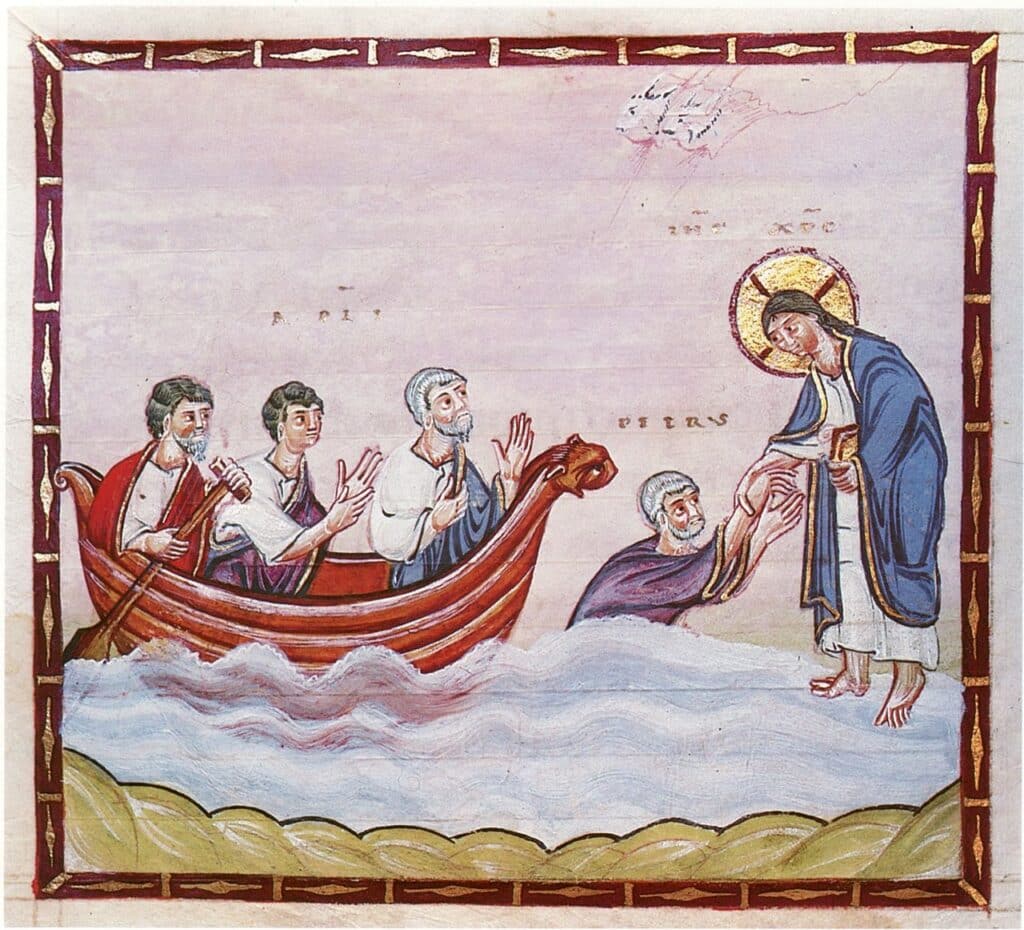
Finally, a basic theistic dogma is that there is a need for belief in a god as a basis for moral standards and that a belief in miracles, as defined above, is necessary to generate faith in god. Humanists assert that we do not require to accept tall stories about ‘feeding the five thousand’ or ‘walking on the water’ as a basis for relating satisfactorily to our fellows and to the society wherein we live. It would not even make any difference to us if the stories (most improbably) were proved to be historical facts. Such proof would only tell us – what we ought to admit anyway – that nature is more many-sided than we currently think.