




This article originally appeared in The Skeptic, Volume 6, Issue 5, from 1992.
Imagine that you are roused from sleep one night, to see, staring through the window of your first or second storey bedroom, a corpse-white face with large, hollow, red eyes. Long-nailed fingers scrabble feverishly on the window. A red-lipped mouth exposes long, pointed teeth as it implores or demands entry. You are either terrified, bravely defiant or simply indifferent because you saw the same thing last night, on video. Whatever your reaction, you realise that you are confronted by a vampire.
But, of course, we all know that vampires do not exist. They are just an old folk-myth, exploited by Bram Stoker and others for the future benefit of film-stars, producers and special-effects men. Or are they? The Vampire Research Center (VRC) of New York does not think so. It claims to have documentary evidence of 810 vampires around the world. Their most favoured area is not Transylvania, but California. In Britain there are between twenty and thirty.
There is no suggestion either by the VRC or by Fortean Times, which has featured a number of newspaper reports of vampirism world-wide, that these are in any way supernatural. Dr Stephen Kaplan, ‘the world’s leading authority on vampires’, and director of the VRC, says they are ‘mainly nice people’, who drink only a few ounces of blood at a time, presumably not directly from source, avoid strong sunlight, and occasionally sleep in coffins. There’s no accounting for taste.
But, do Dracula-type vampires exist, with insatiable blood-lust, propagating by turning the corpses of their victims into vampires, immortal unless killed by one of the prescribed methods? Captain Edward Rowe Fisher of Thorncombe, near Guildford, evidently thought so. He sounds an impeccable witness: a retired army officer, active throughout the Crimean War, as a cornet, later lieutenant, in the 4th Dragoons. One of those to whom in June 1874 he told his story was Augustus Hare, who recorded it in his diary, and later published it in his autobiography. Incidentally, Fisher told the story of the Croglin Grange Vampire twenty-three years before Dracula was published.
Thomas Fisher, Captain Edward’s father, migrated from Cumberland in about the middle of the last century. Their home there, Croglin Grange, was some centuries old. By a curious tradition, it had never been more than one storey high. Today, you can find the village of Croglin on the B6413, about twenty miles south-east of Carlisle. The Grange was let to a family of two brothers and a sister, and the young people settled down happily in their new home. One night, after they had all retired to bed, the sister lay enjoying the view through her window of the moonlit countryside, and the little church nearby. Presently, she noticed two lights, flickering in the trees between the house and the churchyard. To her horror she saw that they were the eyes of a monstrous figure which glided inexorably nearer and nearer until it stopped outside her window.
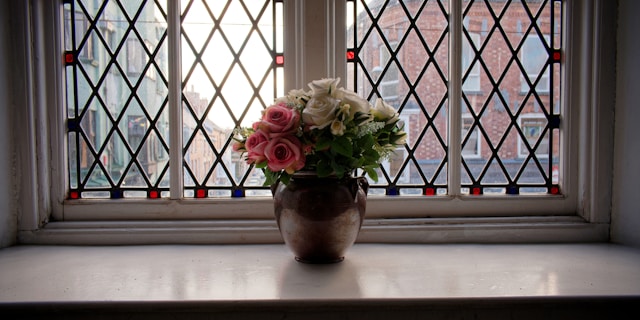
Her bedroom door was next to the window. To unlock it, she would have to stand near the thing. She stayed in her bed, too terrified even to scream. Red eyes glared from a brown, withered face, as the creature scratched on the glass. The scratching was followed by a pecking noise as it unpicked the lead holding a diamond pane of glass. As the section fell out, a bony hand reached in and turned the catch. The figure entered the room, seized the woman by the hair, and bit her throat. At last she found her voice and screamed. Her brothers rushed in, to find her bleeding and unconscious. The intruder fled from the room, climbed over the wall, and disappeared into the churchyard.
The young lady evidently did not have a morbid imagination. When she recovered, she suggested that her attacker was an ‘escaped lunatic’ rather than something supernatural. However, the doctor insisted that her brothers take her abroad to get over the shock.
The next year, they returned to the Grange. This time, the brothers slept in the room next to hers, keeping loaded pistols by their beds. One night in March, she was awakened by the familiar scratching at her window, to see the same wizened face peering in at her. She screamed for help. Her brothers rushed out into the garden, to confront the creature. One of them fired his pistol, and hit the thing in the leg. It limped away, scrambled over the wall, and slipped into the vault of a long-extinct family.
Next morning, the brothers, with their servants and neighbours, broke open the vault. Inside, they found the coffins burst open, their contents hideously mangled and strewn over the floor. Only one remained intact. When they opened it, inside lay the brown, shrivelled creature that had twice attacked their sister, with a fresh bullet wound in its leg. They burnt the body, and nothing more was ever heard of the ghoulish assailant of Croglin Grange.
This story has fascinated students of the occult. Anthony Masters simply repeats Fisher’s account, as set down by Hare, without comment. Peter Haining credits the story on the grounds that it was told more than twenty years before Dracula was published.
The famous occultist Montague Summers was the principal champion of the Croglin Grange Vampire. One objection to the story is that there is no Croglin Grange in Croglin. There is or was, however, a Croglin Low Hall which, according to Summers, sufficiently answered the description. Hare might have recorded the name wrongly. Furthermore, the church does not contain a family vault, nor any record of one. No doubt the local people destroyed it along with the vampire, since they would not wish to publicise such a story.
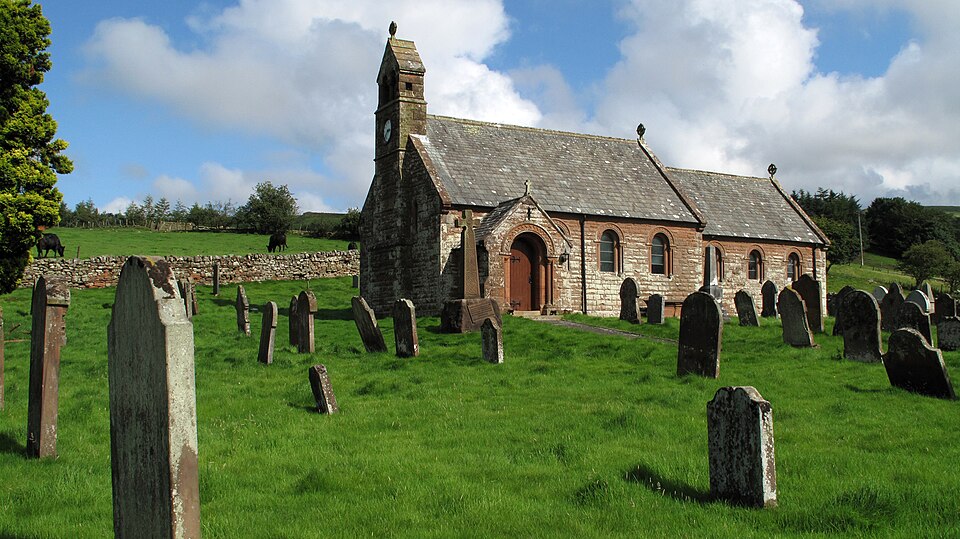
So, what are we to make of this rather ineffective vampire? Not a lot. The identification of Croglin Grange with Croglin Low Hall is a triumph of faith over reason. The Grange was evidently a gentleman’s residence, near the church. Croglin Low Hall was a farmhouse, situated a mile from the churchyard. A sketch of it by Charles G Harper clearly shows it as being two storeys high. Incidentally, Harper himself discounted the story.
The Fisher family did indeed come from Cumberland. The first mention of them was ‘Joseph Fisher of Scarrowhill, parish of Cumwhitton, later of Ruckcroft, parish of Ainstable’. Both places are within a few miles of Croglin (Captain Fisher never actually said that Croglin Grange was in Croglin, but it is a natural assumption to make). Early directories of Cumberland mention Fishers at Coathill and Moorthwaite, Cumwhitton and at Dale, Ainstable. None are mentioned at Croglin whose name would be perfect for anyone inventing a creepy story. The name actually means ‘Rock (by the) water’.
But why should a manifestly honest man like Fisher invent such a story? Presumably, the answer lies in the character of Augustus Hare. This distinguished writer was also rather a comic figure, a humourless snob with an insatiable appetite for scandal and tall stories (I am bound to say that he sounds rather likable, nevertheless). He tells of several supernatural events, including the famous discredited story of Lord Dufferin’s escape from a fatal lift-accident, thanks to a premonitory dream.
Another concerns the death of ‘Mr (or Colonel) McPherson of Glen Truim’. Colonel Lachlan McPherson, who was the first member of the McPherson family to live at Glentrium House, Invernes-shire, outlived Hare by a year. He served in the Crimea, as a lieutenant in the 30th (Cambridgeshire) Regiment, where Lieutenant Fisher may have met or heard of him. It was he who told Hare this palpably false story. ‘The captain wasn’t a liar. He merely had a sense of humour. Unfortunately, Hare took him seriously.’
The fact that this story was told years before Dracula appeared is a blood-red herring. There were several fictional vampires before 1874, such as J S Le Fanu’s Carmilla, published in 1872. Another was T P Prest’s lengthy Varney the Vampire, whose first chapter has the vampire entering his victim’s bedroom by unpicking the lead from a diamond window-pane. Fancy!
As I say, we all know that vampires do not exist.