

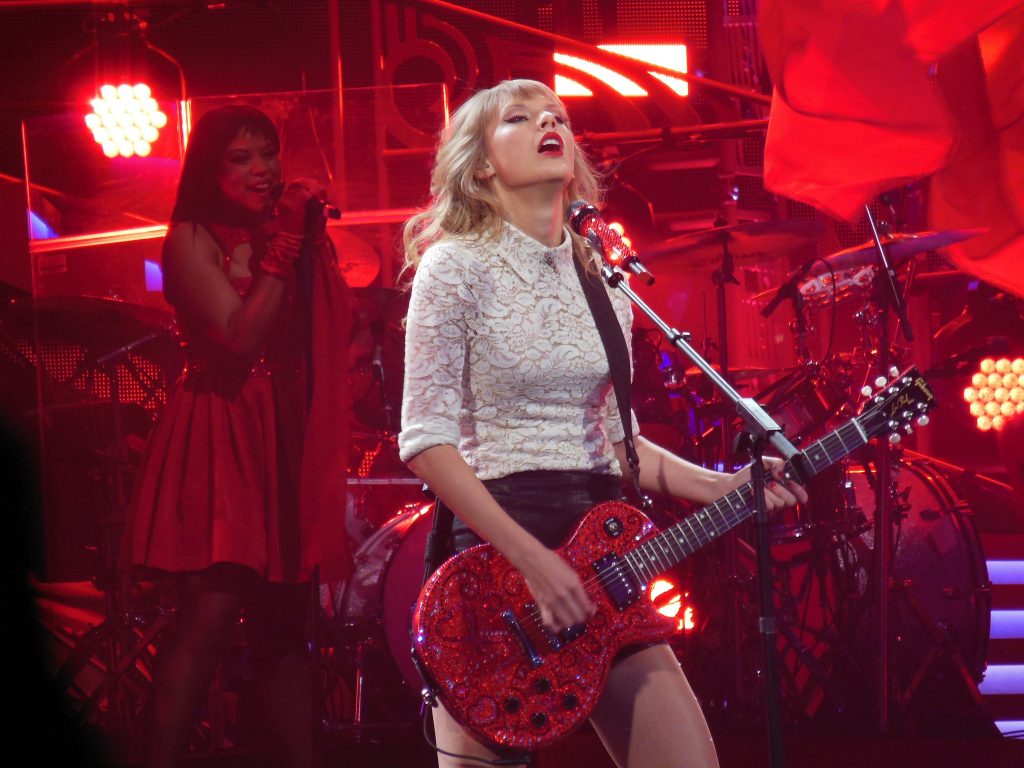
I won’t lie and say that Taylor Swift is the last thing that I want to write about but she isn’t the first either. I’m not really a big music person and I’m certainly not prone to celebrity gossip. I make a concerted effort to learn as little as possible about the personal lives and beliefs of actors, authors, and musicians that I am a fan of. That being said, I have written two book chapters about her, two articles for this magazine, and another article in a print magazine (which was an expansion of the first one I did here). When Swift pops up in the skeptical world, I feel that it is something I can probably cover.
This isn’t even an article about Taylor Swift the person or the musician. As I pointed out in my first article about her – it’s not about her so much as the attention that she brings. At the time of writing that first article, she was the most famous person in music and was conducting what would become the largest world tour in music. Famous people attract conspiracy theories simply because of their fame. As another writer for this site pointed out, as a woman she is going to be the subject of even more conspiracy theorising than her male counterparts.
October saw the release of Swift’s latest album: “The Life of a Showgirl.” It had a mixed reception. The “Swifties” loved it, her haters hated it, the overall critical consensus was that it was fine but didn’t meet the bar that she had set for herself. It was far from a cultural achievement but it was also not the civilisation destroying abomination that some celebrated the album as. Ultimately, musical taste is subjective and what one person likes is personal to them in a way that is impossible to quantify (except the band with a real-life bird as the lead singer – that’s just objectively awesome).
On top of the album there was news of a mini-documentary series about the end of “The Eras” tour on Disney+ and something about her getting engaged to her boyfriend. With her in the news again the conspiracy theories that I wrote about previously began to pop up again but then quickly died off. They didn’t gain traction because two important factors were missing: the most important being that there was no upcoming election to couple the conspiracy theory with. The initial batch of conspiracy theories only ever sort of worked because the American right wing dreaded the possibility that her endorsement of the current president’s opponent would sway a close election.
The second factor is that no one really bought those conspiracy theories to begin with. The point of the theories was to reassure conservative supporters that the most popular musician in the world didn’t openly agree with right wing politics, not because those politics are wrong, but because “they” won’t let her be real.
Secretly she has to be an American conservative. She fits a certain stereotype. Swift is blonde, blue-eyed, engaged to an all-star American football player. Of course she’s one of them – provided you ignore her public statements, song lyrics, and personal success – because she fits the mould.
In November, I found myself doomscrolling through Facebook’s AI slop wondering why we just tacitly accept that everything needs an advertisement attached to it, when I came across an actual post from a group I’m in. It was a seeming miracle that the algorithm directed me to somewhere I was actually connected to. The post was from the group page for the “Cognitive Dissonance” podcast. The post had the unfortunate effect of providing me with a shot of endorphins to reinforce the doom scrolling but that is what led to this article.
The poster, who I will not name, asked whether the group believed that Taylor Swift was “MAGA coded.” The initial post, then others like it, offered a few pieces of evidence that Taylor Swift was secretly a Trump supporter. The first was that her official store sold merchandise with “88” on it. If you are a stranger to the conspiracy sphere of skepticism you might shrug. Those of us who are cursed with unfortunate knowledge know that “88” is used by uncreative neo-Nazis as a greeting, because it references the eighth letter in the English and German alphabets, “H.” So 88 = HH, or ‘Heil Hitler.’ I’m wanting to apologise to everyone reading this, because it’s going to take a few days before you stop coincidentally noticing it.
I don’t know if the original poster saw “88”, or if they read that she was selling it… but she never was. The closest number is “89” a reference to the year Swift was born and the album “1989” – her first album solidly in the pop genre.
The second major “clue” was a necklace in her merchandise store with a lightning bolt on it. Even if you don’t see the world through a conspiratorial lens you know that a lightning bolt can be a reference to the Nazi SS… or, of course, it can just be a lightning bolt. Especially when it’s a reference to the new album’s song, “Opalite.” I feel it necessary to point out that the glam-rock band KISS has lightning bolts in the place of both “S”s and was accused of a similar reference.

Those were the strongest pieces of supporting evidence for the theory; the rest of the theory requires even more from the audience. The first being that they were primed to already believe the worst about Swift. The second was coincidentally the type of cognitive dissonance necessary to ignore the few political statements that the singer has made. It would be out of character for the singer to turn heel like this. I say that not as a fan, but as someone who understands that a legitimate criticism of the musician – and many others as well – is staying silent on large cultural and political issues. I think, as a philosophy instructor, that this is a debate we can have – do people with large platforms and followings have an obligation to speak on such matters? I can see a legitimate argument on both sides, but that topic is outside the scope of this article.
The conspiracy theory was subjected to a debunking by a research firm. An article first published in Rolling Stone attempted to make the case that this conspiracy accusation was artificial. The actual white paper leaves a bit to be desired from a research point of view. The evidence is rough, and the claim that there was overlap between the “Taylor Swift is a Nazi” and the “Amber Heard is terrible” conspiracy sites doesn’t mean that there aren’t people at the bottom of the well. It does mean that there are the same accounts doing the work, and the conclusion that it was only a small fraction of accounts which caused the larger conversation seems borne out. The issue here is that the conversation was abandoned after only a few weeks.
For skeptics though I see a larger problem.
The spy show “Burn Notice” explained that a good trap doesn’t scare people, it makes them curious. If the theory claimed that Swift was a member of Stormfront or a supporter of current right wing darling Nick Fuentes, we would dismiss it out of hand. They would be too obviously false. Instead, the theory claimed that she was secretly MAGA with subtle clues from her latest album and merchandise store. There is nothing Swift has said publicly to indicate her heel turn, but – the theory tells us – there are clues for people who know how to find them. It’s “interesting”. The clues are subtle and hidden, so you must expend energy to find them and engage in the sunken cost mentality. A trap of this nature sucks people in, because it feels wrong enough that I read the post, and so did many others.
I want to stress that I found this not on Reddit’s r/conspiracy, but on the fan page for one of the longer running skeptical podcasts – “Cognitive Dissonance” co-hosted by Cecil Cicirello of the “Know Rogan Experience” podcast. The audience of “Cognitive Dissonance” are reliable skeptics, yet there was still debate on the post. I’m not attacking fans of the show; I’m using it as an example that we are not immune to conspiracy theorising.
The attachment to conspiracy theories is not rational, it’s emotional and the reasons people are drawn to conspiracy theorising are various; but we have to be aware that we have the capacity to fall into a trap like this. Perhaps you are sick of seeing this person in the news, maybe you’re disappointed at the new album, or you think that Tay-Tay should use her platform to speak up for various causes, but she doesn’t… so maybe, you think, it’s because she supports them.
Any of those can form the emotional lever. As skeptics we’re also prone to a bit of iconoclasm, and this theory feeds right into that. Skepticism is hard because we’re often the cold water that gets thrown onto people’s theories: we didn’t panic about the drones, or the clowns, and we probably aren’t concerned about 3I Atlas either. Skepticism is more difficult when we have to police ourselves. The hardest thing is to keep in mind that our emotional reactions are not rational. We need to especially take a step back on our own views.