




Walking is accessible, free, easy, and does not require specific equipment. Numerous studies have consistently shown that it is a low-impact exercise correlated with significant health improvements, including better cardiovascular health and lower mortality rates. Yet, ask anyone about the recommended or ideal number of steps to walk per day, and the answer will most likely be 10,000. Many of us have wholeheartedly accepted this number as a science-based fitness benchmark against which daily activity is measured. This figure has become a fitness gospel but, in reality, it is a marketing invention.
In 1963, amid a fitness boom leading up to the 1964 Tokyo Olympics, there was a lot of attention on exercise among the Japanese population. Local companies were trying to profit from the hype and in 1965 the Yamasa Tokei Keiki company released the Manpo-Kei pedometer. They named it “Manpo-kei,” which literally translates to “10,000-step meter”. Far from being an evidence-based number originating from years of rigorous scientific research, the 10,000 figure was chosen arbitrarily to reflect an active lifestyle.
An advertisement campaign for the pedometer was created, spreading awareness of the 10,000 step concept, which has since become a ubiquitous phenomenon. The programme became popular and the number caught on, even though there is no data to back it up. Sixty years later, the fitness industry still promotes it as a universal benchmark. So, why did this number stick so well?
Appeal to round numbers
People are naturally drawn to round numbers like 10,000: it is easy to remember, track, communicate, and market, so it has become the gold standard recommended by fitness trackers and health apps. Its roundness strongly evokes a perception of completeness or totality. People are motivated to reach this specific round number because it signifies a ‘full’ or ‘complete’ daily activity goal. The desire to achieve ‘completeness’ drives the effort towards this round figure, which acts as a psychological threshold, even if a non-round number like 9,876 steps might have similar health benefits. When we reach or surpass a round number, it feels like we have truly accomplished something, which is psychologically rewarding.
Mere exposure effect
The mere exposure effect is the psychological phenomenon of repeated exposure to something increasing our preference for it. Because round numbers are more common in language, media, and culture, we become more comfortable and familiar with them, which boosts their appeal. The proliferation of step-counting devices, fitness wearables, and the well-intentioned advice from health professionals over the past 20 years has treated the 10,000 steps goal as a default target, and social sharing has helped sustain its appeal.
Anchoring bias
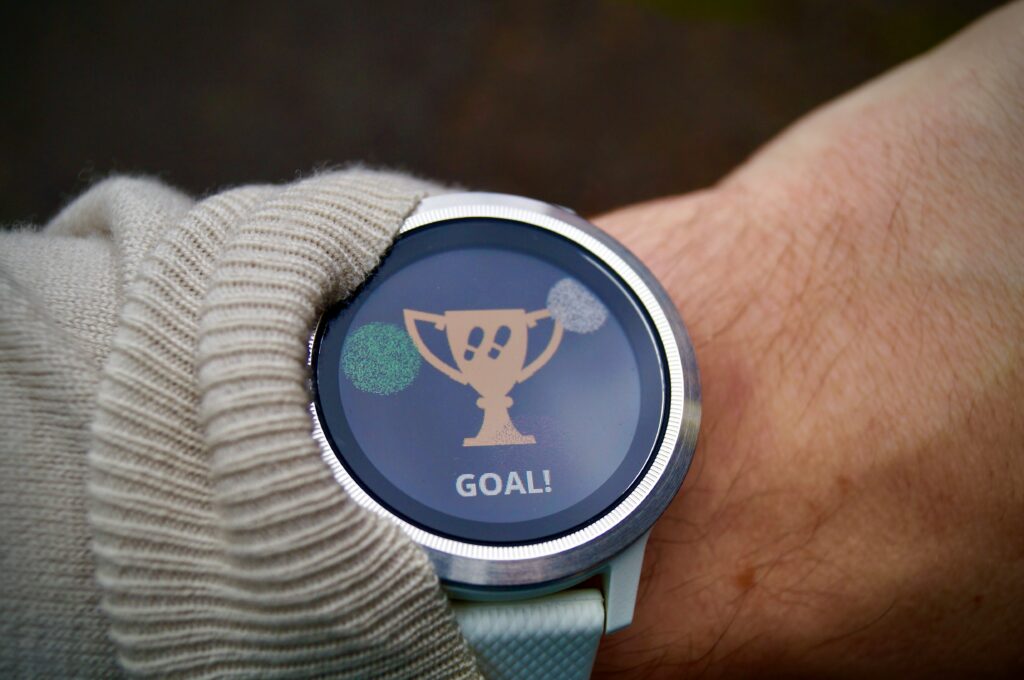
Even though studies show health benefits start at lower step counts (e.g. 4,000–7,500 steps/day), the round number dominates the public narrative because it serves as a salient reference point for effort and achievement. The 10,000-step benchmark became a psychological anchor, shaping perceptions of what constitutes ‘enough’ activity. Even health apps celebrate this milestone with virtual fireworks.
Heuristics
Our brain prefers simplicity. Round numbers are easier to process, reducing the cognitive load. When faced with the complex question, ‘How much daily activity is healthy?’, people substitute it with the simpler, heuristic-driven question: ‘Did I hit 10,000 steps?’ Such numbers become rules of thumb that are easy for the public to adopt and adhere to. In this case, the 10,000 steps a day goal serves as a heuristic that simplifies decision-making and goal-setting. For people who are trying to become less sedentary but are not sure how to start, this number may serve as a starting point for a more active lifestyle.
The science: should we disregard this target?
Given that the 10,000-step number is entirely arbitrary and not evidence-based, we might be tempted to disregard it as worthless. However, despite its weak foundation, walking 10,000 steps is a reasonable daily target for an average person as a minimum requirement for physical activity, though the benefit gained by reaching this milestone depends on the person’s fitness level.
The strict 10,000 steps recommendation is not an optimal daily goal for everyone and is not tailored to individual differences and health conditions. For some, it might be very easy to achieve this goal throughout the day; for others, 10,000 steps might be a demanding activity. It might not be an attainable goal for the elderly or those who are new to exercise. Moreover, depending on your age, physical health, stride, and pace, walking 10,000 steps would approximately take one and a half hours. Such a coveted target might be hard to achieve, given the other daily commitments besides walking.
For many, walking 10,000 steps a day can be a kind of challenge to help shift from a sedentary lifestyle and adopt a more active lifestyle. Tracking steps can be a useful method to monitor daily activity levels, but it is not the most significant factor in achieving a healthy lifestyle and it is not the ultimate benchmark for good health. The NHS recommends at least 150 minutes of physical activity for adults over the period of one week, through various activities including walking.
A more accurate estimate
Although scientists and health experts have historically lacked sufficient data to endorse a precise target for the general population, allowing 10,000 steps to persist as an informal benchmark, recent evidence offers clearer guidance. A 2025 meta-analysis of 57 studies, encompassing over 160,000 adults, revealed that 7,000 steps per day is associated with substantial health benefits, including a 47% reduction in the risk of all-cause mortality as well as lower chances of cardiovascular disease, dementia, depression, and other conditions.
While 10,000 steps remains a solid aim for active individuals, 7,000 steps emerges as a more practical and effective goal for most, with diminishing returns beyond that threshold. The analysis further indicates that even 4,000-5,000 steps daily yield notable benefits over a sedentary baseline of 2,000 steps, emphasising that any increase in movement matters.
Despite its marketing origins, the 10,000-step target has proven remarkably effective at motivating behavior change, acting as an ‘invisible ceiling’ that encourages people to move more. The goal’s simplicity is key to its effectiveness. Step counting is relatively simple to monitor and easy to understand. However, the challenge lies in long-term sustainability.
The key question for public health messaging remains: is it an effective goal for everyone? This is where the ceiling becomes problematic. The 10,000 steps recommendation is not based on rigorous research, peer-reviewed studies, or medical consensus. Its origin is rooted in marketing rather than science, but the underlying concept, that more movement is beneficial, is supported by research.
While science does not provide us with a magic number of steps, it is definitive on a key point: as with most fitness goals, there is no one-size-fits-all. What is important is the consistency of staying active and embracing incremental improvements rather than the number itself.