




This article originally appeared in The Skeptic, Volume 6, Issue 3, from 1992.
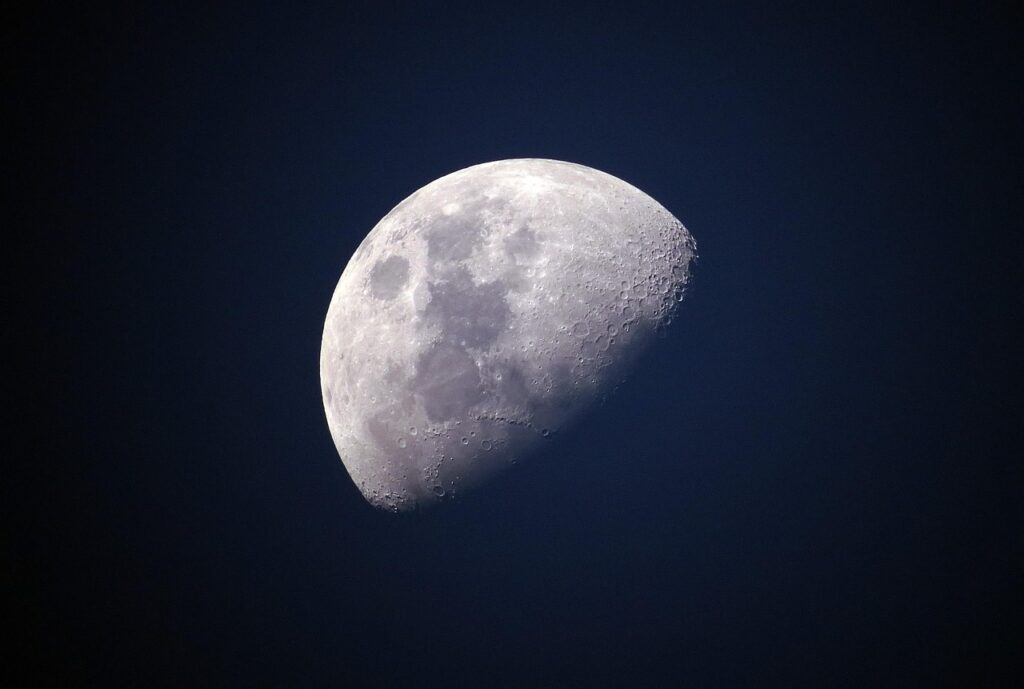
This is the story of a remarkable cosmology concocted by an Austrian mining engineer, Hans Hörbiger. Hörbiger was not only a mining engineer, he was also an amateur astronomer. Often, he would use a small telescope to look at assorted celestial bodies, especially the Moon. According to his account, early in this century, as he was looking at the Moon, he was struck by the apparent brightness of its surface. He had his first ‘recognition’, that what he was seeing was ice, piled up in blocks, producing the brightness and roughness he saw.
Some nights later, he had a dream and his second ‘recognition’. He dreamt that he was suspended in space, watching the swinging of a silvery pendulum, which grew longer and longer until it broke. ‘I knew that Newton was wrong and that the force of gravity stops at three times the distance to Neptune’, he concluded. This was the starting point for his Cosmic Ice Theory.
He worked out this theory, in collaboration with a schoolteacher named Philipp Fauth, in a giant book called Glazial-Kosmogonie. Here is what it said: Once upon a time, there was a supergiant star in the direction of the constellation Columba. A smaller star, dead, water-soaked to the core, fell into it. It was heated up, vaporising the water, and causing a great explosion. The fragments of this smaller star were spewed out of the supergiant into interstellar space. The water condensed out into ice, forming giant ice blocks. A ring of this ice formed, as well as a small number of solar systems. This ring is known to us all as the Milky Way. Among the solar systems that formed was our own, with many more planets than exist today.
The Solar System has had a long history of evolution. Interplanetary space is filled with traces of hydrogen gas, which cause the planets to slowly spiral in. Also spiralling in are ice blocks which approach closer than three times the distance to Neptune. The outer planets are large because they have swallowed a large number of ice blocks, but the inner planets have not swallowed nearly as many. One can see ice blocks on the move in the form of meteors, and when one collides with the Earth, it produces hailstorms over an area of many square kilometres. When an ice block falls into the Sun, it produces a sunspot. It gets vaporised, making ‘fine ice’, which covers the innermost planets.
The Earth has had several satellites before it acquired its current one. They were once planets, in orbits of their own slightly beyond Earth’s, but they were captured one by one over the eons. Once captured, a satellite would slowly spiral in, as the planets are doing toward the Sun, until it disintegrates and becomes part of the Earth’s structure. One can identify the rock strata of several geological eras with these satellites.
The last such episode, the infall of the Cenozoic Moon and the capture of our present-day Moon, Luna, is remembered in the form of countless myths and legends. This was worked out in some detail by Hörbiger’s English follower Hans Schindler Bellamy, though some of it was originally due to Hörbiger himself. Bellamy tells us that, as a child, he would often dream about a large moon that would spiral closer and closer in until it burst, making the ground beneath roll and pitch, awakening him and giving him a very sick feeling. When he looked at the Moon’s surface through a telescope, he found its surface looking troublingly familiar. When, in 1921, he learned of Hörbiger’s theory, he found it practically a description of his dream. He explained the mythological support he found in such books as Moons, Myths, and Man, In the Beginning God, and The Book of Revelation is History.
Mythology, Bellamy tells us, forms a ‘science of pre-Lunar culture’. As the Cenozoic Moon spiralled in, it pulled up the Earth’s oceans into a ‘girdle tide’, while the rest of the Earth sank into an ice age. The people were forced into mountainous highlands in such places as Tibet and the Andes. The gigantic Moon, pitted and scaly, soon revolved around the Earth six times a day, causing an equal number of eclipses of the Sun and itself. It inspired legends of dragons, battles of gods in the sky, and the Devil. These final days are recorded in the Book of Revelation in the Bible and inspired the idea of Götterdämmerung, the twilight of the gods.
Eventually, this moon broke up, and its pieces fell onto the Earth, causing rains of hailstones. As the Earth went back to its old shape, there were gigantic earthquakes and volcanic eruptions. The girdle tide flowed back over the rest of the Earth, inspiring countless flood legends, including Noah’s Flood. Bellamy tells us that he had always wistfully hoped that there is some historical basis for the story of Noah’s Flood. What followed was a time of peace and tranquillity, remembered in a variety of legends, including that of the Garden of Eden.
The first chapters of the Book of Genesis tell of the re-creation after that catastrophe. The story of Adam and Eve is, in fact, the story of a Caesarean birth undergone by a heroine of the flood. Somehow, the myth got the sex wrong! Naturally, there was a serpent in this paradise, and it was the capture of the Earth ‘s present-day moon, Luna. When it was captured, it caused more earthquakes and disasters, and sank the continent of Atlantis. It is slowly spiraling in and will one day share the fate of the earlier moons.
Hörbiger had some interesting responses to the criticism that he inevitably received. When anyone pointed out to him that this or that assertion of his did not work mathematically, he responded: ‘Calculation can only lead you astray’. One recalls that he was an engineer. When anyone pointed out to him that there existed pictures that show that the Milky Way consists of billions of stars, he answered straightforwardly that the pictures had been faked by ‘reactionary’ astronomers.
He had a similar response to accounts of measurements of the surface temperature of the Moon, which exceeds 100 degrees Centigrade in the daytime. To one critic, he wrote back: ‘Either you believe in me and learn, or you will be treated as the enemy’. Astronomers generally dismissed his views and the following he acquired as a ‘carnival’, though it took some very non-carnival-ish overtones later on. Although Hörbiger’s theories have a lot in common with Immanuel Velikovsky’s theorising about the recent history of the Solar System, the scientific community had a much calmer reaction to Hörbiger’s theories than to Velikovsky’s, and his publisher was – as far as I could learn – never boycotted.
His book came out in 1917, during the First World War, and did not attract much attention. But afterward, a mass movement based on the theory appeared. Its members exerted considerable public pressure to get the theory accepted. The ‘movement’ published posters, pamphlets, and books, and even a newspaper, The Key to World Events. One company would only hire those who declared themselves convinced of the truth of the theory. One astronomer at Treptow Observatory spent half his time answering questions on the theory. Some followers even heckled astronomical meetings, crying ‘Out with astronomical orthodoxy! Give us Hörbiger!’ Along the way, the name was changed from the Graeco-Latin Glazial-Kosmogonie to the Germanic Welteislehre – ‘Cosmic Ice Theory’ – WEL for short.
In the 1930’s, the ‘movement’ became more and more pro-Nazi. Hörbiger died in 1931, so we cannot tell what his opinion would have been. Supporters of the WEL said things like: ‘Our Nordic ancestors grew strong in ice and snow; belief in the Cosmic Ice is consequently the natural heritage of Nordic Man’, ‘Just as it needed a child of Austrian culture – Hitler! – to put the Jewish politicians in their place, so it needed an Austrian to cleanse the world of Jewish science’, and ‘the Führer, by his very life, has proved how much a so-called ‘amateur’ can be superior to self-styled professionals; it needed another ‘amateur ‘ to give us a complete understanding of the Universe’. Alas, Hitler himself was not enthusiastic about the idea, and the Propaganda Ministry felt obliged to state that ‘one can be a good National Socialist without believing in the WEL’ .
After World War Two, the WEL cult dropped out of sight. But it revived sometime afterwards, and, according to my information, continues to have members in both Germany and England. In the 1950’s, a pamphlet supporting the WEL stated that ‘proof of the theory awaits the conclusion of the first successful interplanetary flight, a matter in which the Institute is greatly interested’. But more recently, some of its supporters have dropped the idea of an icy lunar surface, though they continue to support the view that it was captured and that its capture destroyed Atlantis.
Further reading
The following books also discuss Hörbiger’s Cosmic Ice Theory:
- Hans Schindler Bellamy, Moons, Myths and Man, Faber & Faber, 1931.
- Martin Gardner, Fads and Fallacies in the Name of Science, Dover, 1957.
- Willy Ley, Watchers of the Skies
- Patrick Moore, Can You Speak Venusian?, David & Charles, 1972.