




This article originally appeared in The Skeptic, Volume 6, Issue 6, from 1992.
I define ball lightning (if it exists) as an electrical discharge phenomenon. I question the existence of corona discharges in mid-air and not necessarily the existence of other luminous phenomena.
The existence of ball lightning is not certain. Scientists have to be careful not to claim certainty. Truth cannot be discovered and nothing is certain. In practice of course many things are believed to be very nearly true, or approximately true. In effect one may say that the degree of certainty is proportional to the quantity of confirmatory data available. But there are dangers in the interpretation of data. Before the acceptance of continental drift, the data were seen to confirm the view that continents do not move. After the paradigm shift, the data were seen to confirm drift and plate tectonics.
In other words, data can be interpreted in various ways, depending on the beliefs of the interpreters. In the words of modern philosophers of science, ‘perception is theory-laden’ and even scientists can fall victim to their beliefs. Where hypotheses can be tested, erroneous beliefs can be exposed. However, belief in ball lightning is an example of a hypothesis that is hard to test. The data are sparse and inevitably open to various interpretations. In such a case it is most important to question the existence of the alleged phenomenon (see article by Frank Chambers in The Skeptic 6.4).
It is important to point out that the existence of ball lightning is an assumption! This is not emphasised often enough (or at all). Consequently the fundamental question about ball lightning concerns not its nature but its existence. Scientists often ignore the null hypothesis, the hypothesis which states that what they seek does not exist. They especially ignore it if it is unwelcome. Someone who has spent his life looking for something will not willingly accept that it does not exist.
However it is instructive to recall an earlier belief in the existence of an ether through which electromagnetic radiation could be propagated. In the 1880s, Michelson and Morley conducted an experiment which, although it ought to have detected the ether if it existed, found no evidence of it. Then in 1905 Einstein concluded that the ether did not exist and his view has been accepted.
Scepticism regarding the existence of ball lightning goes back at least to Faraday and Arago in the nineteenth century. In 1839, Faraday, while allowing that balls of fire might appear in the atmosphere, doubted that they had anything to do with lightning or atmospheric electricity. More recently (in 1973), K Berger reported that, in over 20 years’ study as a meteorologist and lightning investigator, he had never observed ball lightning. He concluded that it did not exist. Other scientists have reached the same conclusion. Even James Barry allows that unbiased examination of reports leads to the conclusion that a great percentage are highly questionable and could be interpreted in several ways.
Among those ways is the persistence of vision theory proposed by Lord Kelvin in 1888. He claimed that the uniform size reported in many cases was ascribed to an illusion associated with the blind spot in the eye. Until a few years ago, most scientists agreed. Other sources of deception proposed have been will-o’-the-wisp and owls with luminous wings. Unfortunately, the existence of will-o’-the-wisp is as uncertain as that of ball lightning! I do not comment on owls.
This raises all sorts of other questions relating to the reliability of reports and the nature of the objects reported (if they are not ball lightning).
Reports of ball lightning (which do exist) suffer from defects inherent in the human perceptual and memory systems. Seeing takes place not, as many believe, in the eye, but in the brain. Because the brain (or rather the mind, the brain’s operating system) processes the sensory input, what we perceive is not necessarily what the sense organs receive. In the case of vision, the mind does a lot of guessing. This can be demonstrated by various well-known optical illusions. Not all need a laboratory: one can be seen on any moonlit night If there are clouds moving across the moon, it will be the moon that appears to be moving, not the clouds. This is because the mind guesses that backgrounds are usually stationary and it takes the moon to be an object moving in front of stationary clouds. It is difficult to overcome this particular illusion, even when you know that it is happening.
Distant stationary lights are subject to several movement illusions, all of which attribute movement to the light. The most famous is the autokinetic illusion (in which a stationary light will appear to move about at random).
The size and distance of a luminous object cannot be established by observers without additional information. Its maximum distance can be determined if it is seen in front of an object, the distance of which is known. However, where observers (mistakenly) place an object nearer than it really is, they may claim to have seen it in front of something when this was not the case.
Usually observers make a guess about either the size or the distance of an object and then determine the other parameter from their guess. In fact both can be wrong. Objects seen near the horizon can be subject to the moon illusion (in which an object appears larger than it really is). This illusion is commonly seen in the moon.
In general, observers cannot distinguish between change in size of an object and change in its distance from them. They are prone to interpret a change in size as a change in distance. A phenomenon called size constancy can interfere with size perception when either the size or the distance of an unidentified object is unknown. Estimates of altitude are similarly suspect; observers tend to exaggerate the altitude of objects near the horizon.
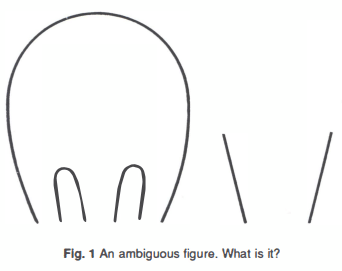
Even estimates of time-span can be unreliable. An observer who is fascinated tends to underestimate the duration of the observation. Estimates of brightness are meaningless since brightness is a relative term; it is the result of contrast differences. Observers may also make false associations, drawing unwarranted conclusions from what they perceive. They may associate effects with the wrong cause. In short, human perception can be faulty and seeing is not necessarily believing. Take a look at Fig. 1. What do you see? An alien being peeping over a wall? Or perhaps a kneeling woman washing a floor, with her bucket beside her!
In the case of anomalous luminous phenomena, observers will try to identify them by reference to the models they carry in their minds. They can only identify such a phenomenon as ball lightning if they have heard of it. Conversely, they are likely to identify a phenomenon as ball lightning simply because they have heard of it, and for no other reason. We all tend to see what we want to see!
Nor is memory much more reliable than perception. Because memory is a process of reconstruction, it can be faulty. People who report ball lightning and who have heard of other reports may (inadvertently) draw on those previous reports for their own report. Tests show that reliability decreases with time, and it is strongly suspected that observers attempt to make facts fit theory. Consequently, anecdotal reports of ball lightning (supposing that they are genuine) must be regarded with suspicion. Observers are mostly unaware of the defects inherent in their perception and memory.
Worse still, asking people if they have seen ball lightning begs the question of its existence and ignores their inability to distinguish it (if it exists) from other phenomena. The question plants a concept in the mind, a concept which will distort memory of any genuine perception (itself of doubtful reliability). Consequently such a question should not be asked and surveys based on it are valueless.
Proper identification of an aerial object (reported or recorded) depends on how many explanations the investigator knows. An investigator who knows many explanations will be able to explain the report or recording more satisfactorily than an investigator who knows only a few explanations. An investigator who believes in the existence of ball lightning is likely to overlook alternative explanations and believers are prone to ignore Occam’s Razor.
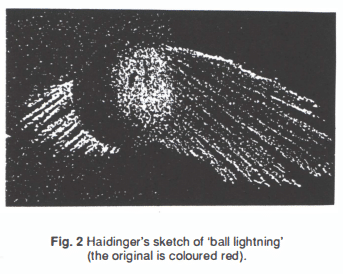
Let me illustrate some reporting errors by example. Fig. 2 shows a drawing published by M W Haidinger in 1868. Indeed it was the first sketch of ball lightning to appear in a scientific journal. He claimed that it shows an ‘electric meteor’ which he saw during a thunderstorm in Vienna at about 5:15 pm on 20 October that year [1]. The sketch is well known and is often used to illustrate ball lightning; Singer reproduced it in colour and his publisher used it on the book’s dust jacket [2].
Of course one should be cautious in accepting a sketch, which may owe as much to the imagination of the reporter as to what he saw. However, there are other reasons for doubting that this shows ball lightning:
- Haidinger admitted that he wanted to see such a ‘meteor’ ever since he heard about them in 1845. Consequently he was prone to misinterpret other phenomena for the one he sought.
- It was seen for only 23 seconds and it did not move.
- It was not associated with a lightning stroke.
- Because he reported that he saw the moon in the same position (although later in the evening), it is clear that the object must have been seen in or against the sky, not in front of the house opposite.
- As a result of an announcement in a local newspaper, Haidinger discovered that he was not the only observer. At least two other people reported seeing a similar object in the same direction, but from different parts of Vienna. One saw a dazzling object in the south-west before the storm broke.
All this points to the object being astronomical, even though it was observed during daylight and during a storm (a gap in the clouds could have given a brief glimpse of the sky). As a student of astronomical mirages (these are images of astronomical objects enlarged and/or distorted by lens effects in the atmosphere), I can tell you that it has all the necessary characteristics, especially the two slanting beams. Because Haidinger gave estimates of altitude and azimuth (which agree with his claim to have seen the moon in the same position) we can look for the source. At approximately the azimuth he gives (although a little lower in the sky) I found the first magnitude star Antares, a red star! I know of many reports of similar objects, some evidently of stars seen in daylight. The stars (sometimes planets) are only visible because of the magnification involved. However this is not the place to discuss another unusual phenomenon. I conclude that the object is very likely to have been a mirage of Antares. In any case, it is not safe to conclude that it was ball lightning.
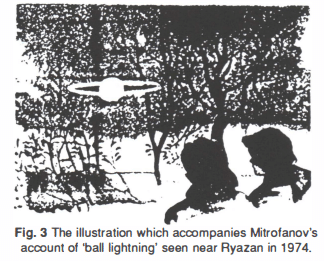
Many other reports of ball lightning may have a similar explanation. Indeed, I have explained one Russian report in this way. A Russian scientist reported that he and some friends from the Soviet Academy of Science saw the object shown in Fig. 3 early one morning from the bank of the River Oka near Ryazan. Since it appeared to be 70 metres away along the riverbank, they thought it was a torch. As they all stood up, it also rose up and appeared to come towards them, increasing in size. Then it slowly ‘swam’ horizontally and disappeared after 4 minutes. At its largest, a ring detached itself and vanished as it expanded. There had been no sound and there was no storm. Nevertheless, Mitrofanov reported the object as ball lightning, probably because he and his group had been testing Kapitsa’s ball lightning hypothesis [3].
Because Mitrofanov gave his exact position, the exact time and the approximate azimuth of the object, I was able to test for an astronomical explanation. Venus was just rising on the horizon in the direction in which they had been looking. It appears that what they saw may have been a mirage of Venus. The fact that the object rose up as they did tends to confirm this hypothesis. Only a very distant object would appear to move in that way. Astronomical mirages are fairly rare, but then so are reports of ball lightning. Perhaps some reports of ball lightning are actually reports of another rare phenomenon.
Nor is mechanical damage reliable evidence for the existence of ball lightning.
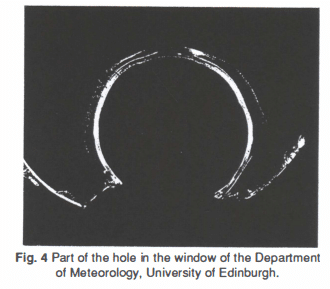
In 1973, damage to a window in the University of Edinburgh (see Fig. 4) was reported (by the head of the Department of Meteorology) to have been caused by ball lightning, although he did not see the damage occur. He was misled by an illustration in a book published in 1921 which showed such a hole and attributed it to the effect of lightning (although not to ball lightning). He was also misled by having heard of ball lightning [4]. Detailed investigation showed that the hole was caused by mechanical damage. In this case the window was probably struck by a glass marble thrown by children. Indeed, I found a marble below the window!
I found many similar examples, some where the hole was the only damage. In all cases the missing disc of glass was found lying where it fell, usually inside the window. What many took to be glass fused by the heat of a lightning stroke (or the heat of ball lightning) was in fact a nearly circular crack propagating around a weak spot in the sheet. I have never seen any evidence that such holes in glass have been caused by lightning and I do not believe reports that ball lightning passed through closed windows [5].
Reports of extensive damage such as fires or explosions may just as easily, if not more easily, be explained as the result of ordinary lightning strikes. Such reports are not clarified by the popular conception that lightning strikes are the result of something called a thunderbolt. Some may believe that what we call ball lightning is in fact what they call a thunderbolt.
I have defined ball lightning as an essentially electrical phenomenon. Consequently I allow the existence of chemical phenomena that have a spherical shape. In this way I can accept that a Smethwick housewife did encounter a luminous ball in her kitchen in August 1975 [6]. It was only described as ball lightning because it occurred during a thunderstorm. However, that appears to have been coincidental; there was no evidence of a nearby lightning strike.
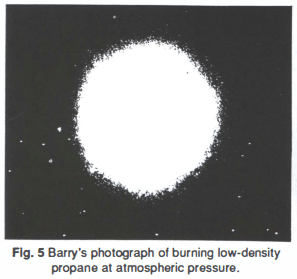
More relevant was the fact that she had been attempting to light a gas ring and that the ‘ball’ appeared directly over the ring. Barry published a photograph of a long-lived illuminated ball phenomenon produced by the spark-initiated combustion of low-density hydrocarbon gas at atmospheric pressure (see Fig. 5) [7]. In the Smethwick case, the gas was methane. My guess is that the housewife had used a spark-type gas igniter and that she had operated it above the ring where some methane had escaped [8].
In 1979 I investigated a report from Crail in Fife that ball lightning had appeared on a crowded beach 11 years earlier. There were many witnesses; I had reports from five, all in different parts of the beach area, one in a house in the town. All agreed that there was a loud noise like an explosion. The main witnesses were in their beach cafe, where (so they alleged) the ball passed over a gas cooker; this was later found to be cracked [9]. In fact the ball may have emerged from the cooker and may have been a low-density gas combustion ball. Research should be conducted to establish whether or not such gas balls can exist in the open. It may explain some reports of ball lightning.
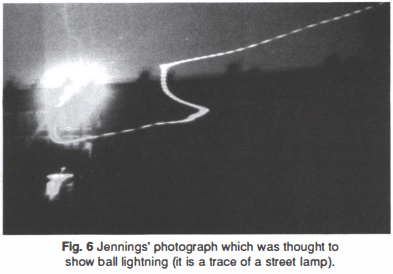
Photographs alleged to show ball lightning are as suspect as anecdotal reports and sketches. The camera cannot lie, but what it shows can be misinterpreted and the photographer can lie. Until the early 1970s, Fig. 6, a photograph taken in 1961 at Castleford in Yorkshire, had been interpreted as showing the path of ball lightning. Indeed New Scientist described it as the ‘Path of a Thunderbolt’ (without even adding a question mark). Like Haidinger’s sketch, the picture was commonly used to illustrate ball lightning. In 1972 Davies and Standler claimed that it might show the pulsed trace from the street light visible in the picture [10].
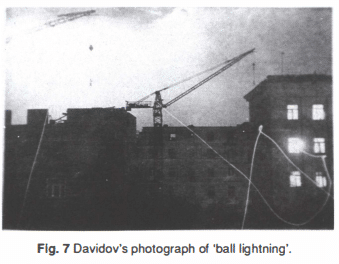
In 1981 I demonstrated that Davies and Standler were correct. Furthermore, I showed how the picture came to be taken. The pulses were due to the periodic discharges of the lamp (100 times a second) and the shape of the track was caused by movement of the camera. The camera shutter was slow to close on release of the operating button [11]. It is quite easy to obtain such a trace and I have seen many other examples. A Russian photograph has the same explanation. Fig. 7 shows a picture taken by B V Davidov in Kharkov in 1957, allegedly during a thunderstorm. It was published the following year with an endorsement by Professor I S Stekolnikov of the Soviet Academy of Science [12]. His conclusion (that it showed ball lightning) was based on having seen similar pictures in a 1939 US journal [13].
The traces in the picture can be shown to have been caused by the light from stationary lamps tracking across the film. The two traces are identical; they have the same shape and orientation. One light source was in a room in the building opposite (here). The second source must have been some distance away on the right at a lower level. The lack of pulses shows that both lamps were incandescent. Evidently these traces were caught (again) because of slow shutter closure. The photographer moves the camera believing (mistakenly) that the shutter is closed. Considering that he drew attention to the constant width of the trace, it is surprising that Professor Stekolnikov did not see the simplest and obvious explanation – that the sources were at a constant distance from the camera. Misled by his photograph, Davidov went in search of evidence for ball lightning, and thought he had found it on a window of the block opposite. He found charring and soot which were more likely caused by a painter’s blowlamp. Misled by the American article, Stekolnikov drew the wrong conclusion. In fact, all the pictures in the article he saw appear to be traces of various lamps, some caused by movement of the camera, one by movement of a torch in front of a stationary camera! [14].
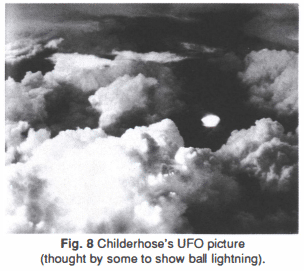
Some ball lightning photographs are deliberate fakes. Indeed, some of those identified as showing lamp tracks may be fakes. But a more subtle fake was produced in 1966 by a former Canadian Air Force pilot. Fig. 8 was alleged to show a UFO, but since it was taken over a thunderstorm, an American editor of Aviation Week and Space Technology (who also writes sceptically about UFOs) suggested that the bright object was a giant plasma or ball lightning about 15 to 30 metres in diameter. He described it as ‘a phenomenon not yet catalogued by science’ and his publisher used the picture on the dust jacket of one of his books [15].
I discovered many inconsistencies regarding the circumstances in which the picture was alleged to have been taken and that the pilot involved had a reputation for pranks. His former flight commander admitted that he had let him ‘have his fun’. It appeared that the pilot (R J Childerhose) had constructed the picture (perhaps by double exposure) to illustrate an article on flying saucers which he wrote for the Montreal Star [16]. Many other pictures are probably faked.
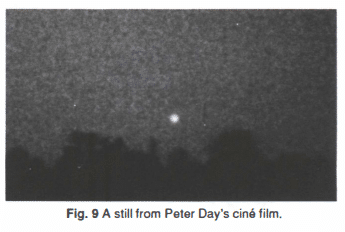
Although it is fairly easy to take a photograph (or to fake one) which many mistakenly interpret as showing ball lightning, it should be less easy to produce a film or video sequence that could fool anyone. Moving image sequences contain so much more information. However, Fig. 9 is a still from a film sequence taken in 1973 by Peter Day near Aylesbury in Buckinghamshire. A bright ball of light moves steadily across the horizon for 23 seconds until it suddenly vanishes. Because it was reported as a UFO, the film has been shown many times at UFO conferences and has featured in the BBC programme about UFOs called Out of This World. However, it was also thought that it might show ball lightning and the film was shown to a group of interested scientists. All agreed that it did not show ball lightning. However they did not know what it did show.
I have been able to demonstrate that the object is a mass of burning fuel from a damaged F-111 fighter-bomber. The jet was dumping fuel after taking off from Upper Heyford Airbase and the fuel was ignited by the jet’s exhaust. This is a permitted procedure, although it is not often used. The aircraft (invisible in the film, and unheard by Peter Day) was at least 6 kilometres away from him. It later crashed near Bedford [17].
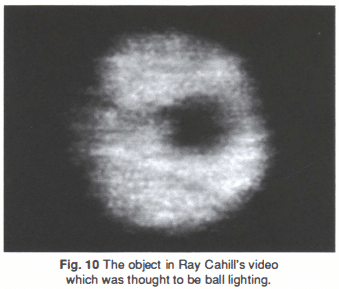
So much for cine films. Videos fare no better. Bergstrom and I have recently explained a video recording taken by Ray Cahill in Kent in 1989. He videoed lightning seen during a thunderstorm and, although he did not see ball lightning, he later noticed the object shown in Fig. 10 on the recording. It moves across the screen from left to right in about 1.5 seconds. Apparently Cahill had heard about ball lightning and thought he had caught it accidentally. Some scientists (including Professor Roger Jennison of the University of Kent) agreed, and for a time it was accepted that the video did (uniquely) show ball lightning. It was shown on television in the south-east of England.
I was not convinced, and attempted to locate a light or lamp that could have been caught accidentally as Cahill swung the camera across the scene. I found that the only lamps bright enough to show on the video were those of a motorway junction some 300 metres away and that one of these had been caught. Crucial to finding the right explanation was an understanding of the operation of the video camera, especially its autofocus mechanism. This defocussed the lens during the critical moments when the anomalous image was caught.
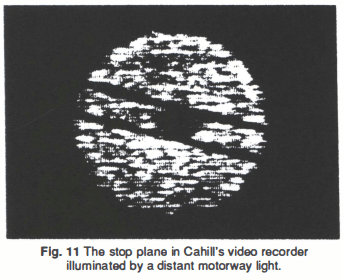
However it was not just a matter of videoing a lamp out of focus. In video cameras, there is an extreme out-of-focus situation where a distant object evenly illuminates the stop plane, the latter being focused sharply on the picture plane. Because the stop plane usually contains a small shield that is not usually seen because it is completely out-of-focus, an image of this shield can be recorded. Fig. 11 shows an image of the shield and its support wires in Cahill’s video recorder. It is illuminated by one of the motorway lamps. Clearly this is the object which Cahill and others thought was ball lightning. The more complex the equipment used to record alleged ball lightning, the more careful we need to be in analysis of the results [18].
If we ignore anecdotal evidence because of the perceptual and memory problems involved, we have to rely on instrumental evidence for the existence of ball lightning. After all, if it really exists, some instrumental evidence must be available. In fact there is none! There is no photograph, film, or video recording which can be accepted unreservedly as showing ball lightning. This in itself points to the null hypothesis. We then observe that no theory exists which can explain all the reported characteristics of ball lightning and that no-one has been able to create ball lightning in laboratory conditions which simulate those in the open. These facts can be explained most simply by proposing that ball lightning does not exist!
Perhaps I am influenced by the fact that all the cases which I have investigated have (or could have) a prosaic explanation. However there is no reason to suppose that my own experience is untypical or that I have not examined a representative sample.
I do not claim that ball lightning does not exist; I merely propose the null hypothesis. Someone ought to advocate it, if only to keep a check on the believers. If you like, regard me as a Devil’s Advocate. I may be proved wrong, but the onus of proof is on those who advocate ball lightning’s existence.
References
- MW Haidinger (1868): ‘Elekstrische Meteore am 20. October 1 868 in Wien beobachtet.’ Sitzber. Math. Naturwiss. Kgl. Akad. Weiss. 58:II:761.
- Stanley Singer (1971): The Nature of Ball Lightning (Plenum, London).
- Aleksandr Mitrofanov (1982): ‘Vnimaniye: sharovayamolniya! [Attention: ball lightning] Zapozdalaya vstrecha [A delayed encounter]’ Tekhnika Molodezhi 7, p. 46.
- D H Mclntosh (1973): ‘Lightning Damage’, Weather 28:4:160
- S. Campbell (1981): ‘Not lightning damage’, Weather 36:3:66.
- Mark Stenhoff (1988): ‘Ball Lightning’, letter to New Scientist (Feb 11) p.69.
- lames Dale Barry (1980): Ball Lightning and Bead Lightning (Plenum, London), p. 172.
- Steuart Campbell (1988): ‘The Smethwick Ball Lightning Report’,The Journal of Meteorology, 13:134:391
- Steuart Campbell (1982): ‘Ball lightning at Crail – 1968 ‘, Weather, 37:3:75.
- D W Davies and R B Standler (1972): ‘Ball lightning’, Nature, 240 (Nov 17), p. 144.
- Steuart Campbell (1981): ‘How not to photograph ball lightning’, The British Journal of Photography, 128:43:1096.
- B V Dovidov (1958); ‘… [Rare Photograph of Ball Lightning]’, Priroda, 47:1, between pp. 96/97.
- RE Holzer and E I Workman (1939): ‘Photographs of Unusual Discharges Occurring During Thunderstorms’, Journal of Applied Physics, 10 (Sep), p. 659.
- Steuart Campbell (1987): ‘Ball lightning exposed! Another picture puzzle…’, The British Journal of Photography, 134:6645:1537.
- Philip I Klass (1968): UFOs – Identified (Random House, New York)
- Steuart Campbell (1988): ‘The Childerhose UFO: fact or fiction?’, The British Journal of Photography (Sep 29), p. 72.
- Steuart Campbell (1991): ‘Fireball by Day’, The British Journal of Photography (Apr 4), p. 22.
- Ame Bergstrom and Steuart Campbell (1991): ‘The Ashford ‘ball lightning’ video explained’, The Journal of Meteorology, 16:1 60:1 85.