



Potentially, for something to be considered the greatest ghost sighting of all time, it would need to be the one most corroborated in terms of the number of witnesses present at the same event.
In my book Ghosts (2021), I included two first-hand accounts of alleged ghostly experiences, each involving eight people: one in the Crosby/Seaforth district of Liverpool in 1944, and the other at Guisborough Priory in North Yorkshire in 1967. However, the prize – if indeed there was a prize – for the greatest alleged ghost sighting must go to the one discussed by Alan Murdie in his article ‘Spectres of the Stage’ in the magazine Fortean Times.
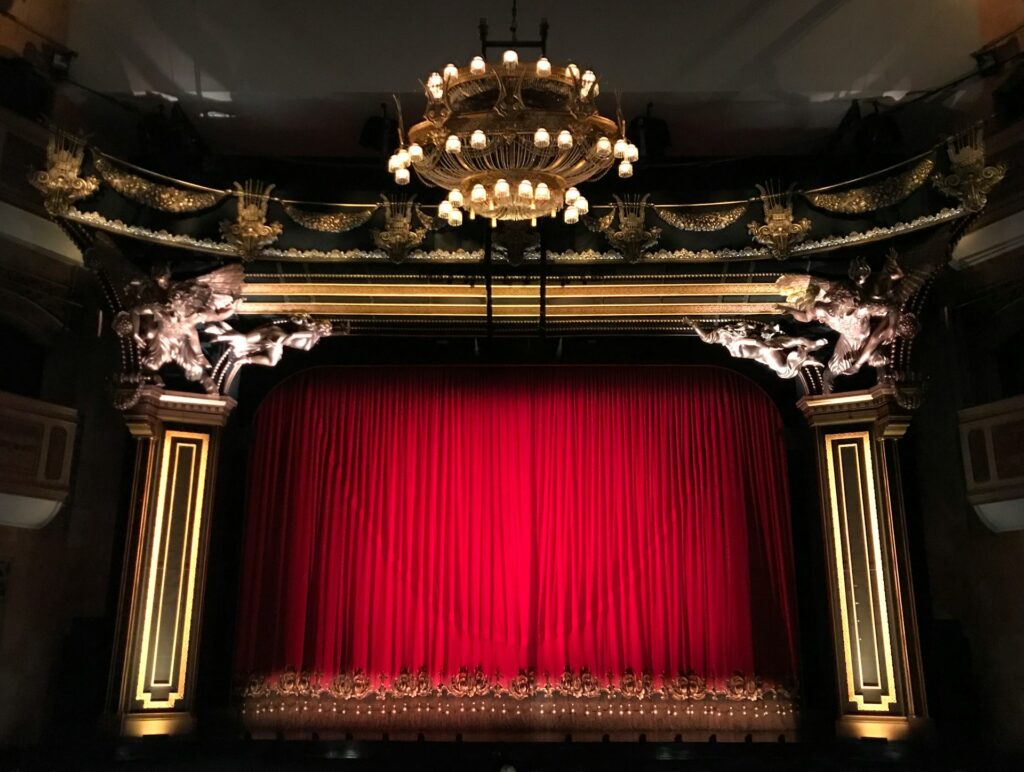
Alan discusses Nick Bromley’s book Stage Ghosts and Haunted Theatres (LDP Books, 2021), which features a report of the Grey Lady of the Theatre Royal, Bath, who apparently appeared on stage in the middle of the play The Dame of Sark on 23rd August 1975. According to the reports, the ghost appeared next to the actress Anna Neagle and four other cast members, and was witnessed by over 850 people, including the audience.
Alan comments: “The experience was apparently a collective one, though one might wish for more corroboration on this claimed aspect.” I couldn’t agree more.
So, I lost no time in ordering Nick Bromley’s book direct from his website, very reasonably priced at £9.99 plus postage. While I waited for the book to arrive I googled this apparent mass ghost sighting, wondering why I had never heard of it before, and thinking that a collective experience such as this must have been repeated on many websites.
Well, it wasn’t.
I found two very brief accounts of the mass sighting on the websites Reddit and Tolino. The latter contains a PDF version of the book Supernatural England (Countryside Books, 2002) edited by Betty Puttick, which includes the line: “…and Dame Anna Neagle and the cast of The Dame of Sark, saw her in August 1975″, though it contains no further details, nor does it mention the 850 alleged witnesses in the audience.
There was another online mention of Dame Anna Neagle’s sighting, which was detailed in a book about the paranormal experiences of actors, written by Michael Munn. I ordered a copy of that and several more books which may help me in my research.
When I received Nick Bromley’s book, I quickly turned to the two-page section detailing the mass eyewitness ghost sighting. It stated that two Canadian girls in the audience saw the ghostly figure in the box in the dress circle during the interval, which then faded away as the curtain came up for Act Two, then re-appeared on stage. At which point Dame Anna stood stock still and the other four actors ran off the stage. One of the Canadian girls in the audience is said to have screamed and fainted, and people in the auditorium were scrambling over their seats to escape. The author concluded the account by saying that “…the indomitable Dame (Anna Neagle) completed the week’s run (of the show) but was never to play Bath again.”
I also bought Malcolm Cadey’s book Paranormal Bath (Amberley Publishing, 2010) which I found to be an odd book. As one of the online reviewers had noted, the book is billed as being about the ghosts of Bath, but after a lengthy introduction, preface and prologue, pages 19 to 93 are exclusively about the ghosts of the Theatre Royal, with short accounts from other haunted locations in the city compressed into pages 93 to 97.
That suited me just fine. If the book was mainly about the Theatre Royal, then surely an account of the mass sighting would be included in the book – which it was, and in greater detail. It states that an unnamed actor delivered his last line in Act One, then exited the stage, complaining to the stage manager about how a member of the audience had put him off his performance by standing up in the dress circle box and walking off, while being dressed rather oddly, with a noticeable feather plume in her hat.
The stage manager made enquiries, but no one was found of that description. He noticed two girls in the audience – the ‘Canadian girls’ as described in Nick Bromley’s book – who were signalling something to him, but he didn’t understand what they wanted, so he hurried backstage again in time for the start of Act Two.
Malcolm Cadey further recounts the appearance of the Grey Lady onstage, much as Nick Bromley describes it, but adds that one of the Canadian girls screamed and fainted, and had to be carried out on a stretcher by members of St John’s Ambulance. He also added that four of the actors ran offstage, and refused to set foot in the theatre again, later sending someone to pick up their belongings. To replace the actors who walked out, Cadey writes:
Understudies were hurriedly instated and Anna Neagle, being the trouper that she was, stuck it out for the rest of the week. However, she swore that she would never set foot in the Theatre again. She kept to her word; if she came back on circuit she stayed in the hotel and understudies played her part.
The author concludes: “The Grey Lady (appeared) in view of 857 witnesses. How many witnesses do you need to prove a sighting?”
The website Theatricalia details the whole cast and crew of the production of The Dame of Sark at the Theatre Royal in Bath, stating that the play was on tour in theatres around the country, and it ran at this location between 18th to 30th August 1975. As far as I can see, there were no cast changes when the play transferred in the following week to the Theatre Royal in Brighton, which ran from 1st September to 6th September 1975.
I thought it strange that both books had included so much detail, but not the names of the actors who fled the stage and refused to appear there again. The same website included the names of the four actors: Alan Gifford, Ian Liston, Alister Cameron and Nicholas Loukes. I searched their online career biographies and added the term ‘ghost’ next to their names, but found nothing.
In fact, I searched online for the whole of the cast and crew detailed on the Theatricalia website and found that the vast majority are now either deceased or untraceable. The exception, however, was the producer of the play, Ray Cooney – a celebrated playwright himself – who was detailed in the programme for the night’s performance with the words ‘Presented by Ray Cooney.’
When I contacted ‘Ray Cooney Plays’, the general manager, Michael Barfoot, replied:
Ray has asked me to reply to you that he knows nothing about this alleged appearance of a ghost on stage at the Theatre Royal Bath during a performance of The Dame of Sark in 1975.
Elsewhere in his book, Nick Bromley states that at the end of each performance of a play, the stage manager compiles a report about how the performance progressed, including any problems or mishaps, and sends it to the producer. Therefore, if a ghost had appeared on stage, in the middle of the play, with the performance having to be halted and four members of the cast refusing to return to the theatre, resulting in understudies stepping in to complete the evening’s performance, and the hurried recasting of the four characters, Mr Cooney as the producer, would certainly have got to hear about it.
In Paranormal Bath, Malcolm Cadey says that he used to work at the Theatre Royal Bath, and therefore many of the first-hand accounts are from colleagues, past and present, and his account of the alleged mass sighting appears to have come from someone he refers to as ‘Molly, the manager of the Upper Dress Circle Bar.’ She was approached by one of the Canadian girls, after her friend had fainted and had been carried out of the auditorium on a stretcher. So, no surname, and even the first name might be an alias.
Cadey also names two other people who were present on the night: the stage manager Norman Wootton, and Sid Payne, who – with his pet dog – was tasked with checking security after the eventful evening’s performance.
Curiously, on the Theatricalia website, the name of the stage manager is not mentioned – only the assistant stage manager: Jackie Garrett, and the deputy stage manager: Tania MacDonald. Norman Wootton is not included anywhere.
I emailed the Theatre Royal, Bath about the incident and didn’t get a reply, and Nick Bromley advised me that while researching for his book and contacting theatres around the country, he got the impression that theatres tend to be reticent about releasing details to the media about any ghostly reports. On 27th June 2025, I received an email from the press officer acknowledging my letter enquiring about ‘ghost stories at the Theatre Royal, Bath’, promising he would make enquiries on my behalf and get back to me. I sent a reminder in early August 2025, and I still haven’t received a reply.
So where did the information about the mass ghost sighting come from? As with so many books on fortean subjects, the books by Nick Bromley and Malcolm Cadey don’t include any list of sources, bibliography, or an index. Unfortunately, I discovered that Malcolm Cadey is now deceased, so I can’t contact him about his sources.
I wrote to Nick Bromley to ask if he had got his account of the mass witness ghost sighting from Malcolm Cadey’s book. When Nick phoned me soon after, he explained that although he had a copy of Paranormal Bath, which we discussed in our phone call, he had heard about the event from a stage carpenter when he visited the theatre in May 1976, less than a year after the alleged event.
Nick also told me that he seemed to remember the sighting had been reported in the actor’s periodical The Stage which, back in 1975, was titled The Stage and Television Today, but he has been unable to locate it. Back issues are available online at the British Newspaper Archive website, and I also tried – and failed – to locate the issue.
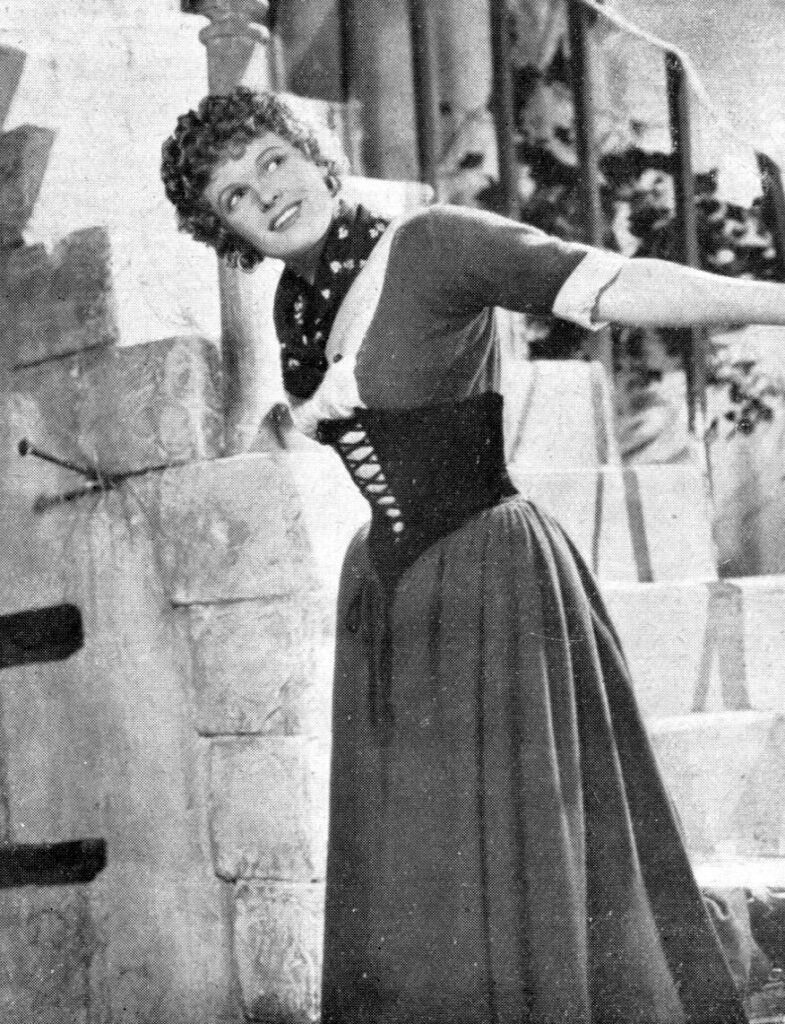
I also bought the book Anna Neagle: An Autobiography (Futura Publications, 1979) published four years after the alleged incident. However, I discovered that the book was largely a reprint of her original 1974 autobiography, published one year before the alleged sighting, and although there was a chapter added on to the new edition about what had happened to her in the years since it was first published, there was, again, no mention of the incident. In fact, The Dame of Sark and the Theatre Royal Bath were not even mentioned, let alone anything about her alleged ghost sighting.
When I received Michael Munn’s book X-Rated: The Paranormal Experiences of the Movie Star Greats (Robson Books, 1996), I found the mass eyewitness sighting was not included. Instead, there is the following quote allegedly from the actress:
…I saw (The Grey Lady), in that box, on the opening night of The Dame of Sark (on 23 August 1975). The curtain went up, I walked on, and I saw her in the box. I had been told I might see her, so it wasn’t a surprise, but it still sent the shivers down my back.
Page 22
What are the chances that Dame Anna Neagle told Michael Munn about her sighting of the Grey Lady at the beginning of Act One, of which she presumably had no corroborating witnesses, and yet decided not to mention her sighting of the Grey Lady appearing on stage at the beginning of Act Two on the same date, in which she had over 850 corroborating witnesses?
I also bought the book of the script The Dame of Sark written by William Douglas-Home (Samuel French, 1976), as I wanted to discover which characters/actors were on stage at the time when the alleged sightings took place, as stated in the books by Bromley, Cadey and Munn.
According to the text, the play’s six scenes were not formally divided into acts. However, as over twelve months have passed between the action in Scene Three and Scene Four, and the gap between them is roughly halfway through the play, I think we can safely assume that the interval would have occurred at the end of Scene Three.
I started with Malcolm Cadey’s account of the actor who was put off his lines by a strangely attired figure in the audience – presumed to be the Grey Lady – and who then delivered his last line of the scene and exited the stage, complaining to the stage manager about it. According to the printed text of the play, there is a character, Colonel von Schmettau, who leaves the stage just before the end of Scene Three – or Act One, as it was originally described – so this detail appears to be correct.
Concerning the mass ghost sighting, both Nick Bromley and Malcolm Cadey state that at the beginning of Act Two – which I now assume to be Scene Four – there are five characters on stage. Nick Bromley writes that:
…the curtain rose, and the stage lighting came up. Dame Anna was standing with four other members of the cast in their opening places on stage. She was astonished to see a column of whirling smoke appearing next to her.
Likewise, Malcolm Cadey writes:
It was time, the curtain lifted and the opening scene of Act Two was about to start when…On stage, what looked like a swirling pillar of smoke, appeared right next to Dame Anna Neagle, who, horrified, but still keeping her composure, did a graceful side-step away from this strange occurrence…Four other members of the cast took one look at this happening and walked off stage, leaving the Theatre and not coming back. They sent for their belongings later.
In both accounts, five characters are on stage when the ghost appears. However, according to the text of the play, this doesn’t appear to be the case. When the curtain goes up, there are only three characters onstage: Sibyl, Bob and Muller – played in the Bath production by Anna Neagle, Alan Gifford and Ian Liston. Some characters leave the stage, then return, and two other characters, Lanz and Braun – played by Alister Cameron and Nicholas Loukes – arrive onstage.
Within around five minutes of the opening of the scene, there are indeed five characters onstage. However, the books by Bromley and Cadey both state that the ghost appeared at the very beginning of the scene, when there were in reality only three characters on stage. So, unless I have misinterpreted this, then that detail appears to be incorrect.
As for Dame Anna’s lone sighting, Michael Munn writes that she walked onstage at the beginning of the play. According to the text of the play, the character of Bob Hathaway is on stage alone as the curtain comes up in Scene One (Act One), but then Dame Anna’s character Sibyl Hathaway walks onstage a few seconds later. So that detail is correct.
But even this lone sighting in Scene One may not have happened either. There is an article in the Guardian by Tim Adams about his meeting with the author Michael Munn to discuss the various questionable claims he made in his many books about his alleged close personal friendships with movie star greats including Richard Burton, Ava Gardner, John Wayne, David Niven and Steve McQueen.
In his book Steve McQueen: Living on the Edge, Munn claims to have gone on a three-week motorcycle road trip with the actor, with Munn riding pillion, during a break in the filming of McQueen’s movie Le Mans (1971) – a claim which surviving friends and family of the actor have questioned, and which book critic Antonia Quirke described as ‘preposterous’. In light of this, I would be very skeptical about the alleged conversation between Dame Anna Neagle and Michael Munn.
There is also a third version of the alleged sighting by Anna Neagle recounted on the YouTube video The Ghosts of Bath – part of the Ghost Casebook series – which states that in 1975 (no exact date given) the actress saw the Grey Lady in the dress circle box, staring at the stage, after the production was over.
I also bought David Brandon’s book Haunted Bath (The History Press, 2009) which includes Dame Anna Neagle’s lone sighting of the Grey Lady, but doesn’t specify whether it was before, during or after the performance.
So, there are now four different versions of the Anna Neagle/Grey Lady story. Michael Munn’s version states it happened at the beginning of the performance; Nick Bromley and Malcolm Cadey say it was a mass sighting that happened in the middle of the play; The Ghosts of Bath says it happened after the performance was over; and David Brandon doesn’t seem to know when it happened!
Not to mention, of course, that if true the mass sighting witnessed by over 850 people would have been splashed across every newspaper in the country, and interviews with the cast and crew would have featured on programmes such as Arthur C. Clarke’s World of Strange Powers, or Strange But True?, and virtually any other programme about ghosts and the paranormal in the intervening years. Alleged UFO events such as Roswell and Rendlesham have been endlessly re-enacted on TV, so I’m sure this alleged ghostly event would have received the same treatment. We would also have expected that at least some of the 850 audience members would have got in touch with a newspaper and recounted the sighting, or that the media would have got hold of the story from somewhere else.
So, did the mass sighting by Dame Anna Neagle and over 850 people really occur?
It looks very unlikely to me, considering the comments made by Ray Cooney, and the lack of evidence supporting the claims that four professional actors walked out of the theatre, and their characters had to be hurriedly re-cast.
However, I would still love to know the original source of the story. Call me naïve, but it does seem strange to me that someone would fabricate such a detailed and colourful account, and then expect everyone to believe it without, as Alan Murdie put it, any corroborating evidence.
Unfortunately, that is where my research has to end.
The event may be included in back issues of local newspapers in Bath, and I have written to the newspaper staff and asked them to do an appeal to local people for information, but they didn’t reply, and online searches for my appeal have drawn a blank. Back issues are available on microfilm at the Bath city library, but to search them I would need to take a trip to Bath, including a costly overnight stay, to go through the archives.
Also, as already mentioned, the play has a character named Colonel von Schmettau, who was the last to exit the stage at the end of Scene Three. In the original London production, he was played by Tony Britton, but in the touring company, including the production at the Theatre Royal, Bath, he was played by Nicholas Courtney, who is probably best remembered for playing Brigadier Lethbridge-Stewart in TV’s Doctor Who.
He may have discussed his own experience at the end of Scene Three, and the alleged subsequent mass ghost sighting, in his autobiography Five Rounds Rapid! (Virgin, 1992) and the revised edition Still Getting Away With It (privately published, 2005), but none of the online reviewers of the books have mentioned the inclusion of the experiences, and as the books are now out-of-print and remaining copies selling for over fifty pounds, I am afraid that buying either book is a costly purchase too far for me. If any reader has read one or both of these books, I’d welcome them getting in touch with details of any ghostly contents.
Can anyone throw further light on the story?
END
Sources:
- Michael Munn: the celebrity biographer reveals all, The Guardian, 25 July 2010
- Brandon, David, Haunted Bath (The History Press, 2009). *Dame Anna Neagle’s sighting ‘in 1975’ on page 70.
- Bromley, Nick, Stage Ghosts and Haunted Theatres (LDP Books Ltd, 2021) *Account of mass witness sighting in Act Two of the play on pp 134-135.
- Cadey, Malcolm, Paranormal Bath (The History Press, 2010) *Account of mass witness sighting in Act Two of the play on pp 81-82.
- Munn, Michael, X-Rated: The Paranormal Experiences of the Movie Star Greats (Robson Books, 1996) *Dame Anna Neagle’s personal sighting in Act One of the play on pp 21-22.
- Murdie, Alan. ‘Spectres of the Stage’: an article in Fortean Times magazine. Issue 407, pages 16-19. (FT407:16-19).
- Neagle, Anna, Anna Neagle: An Autobiography (Futura, 1979).
- Puttick, Betty (Editor) Supernatural England (Countryside Books, 2002).
- The Ghosts of Bath (YouTube video channel: Ghost Casebook series).
- Emails from Michael Barfoot, General Manager of ‘Ray Cooney Plays’, on behalf of Ray Cooney: 28/04/25 and 01/05/25.