



An almost universal interaction experienced by disabled people goes something like this: an able-bodied person – usually sympathetic and well meaning – will hear someone describing what it is like to have their disability and will exclaim ‘Oh my god, I could never live like that!’. They don’t mean anything by it – it’s usually delivered with an air of admiration at your bravery for continuing to exist under such dire conditions. Contained within it is the implicit judgement; there are some lives worth living, and some lives that are not.
Everyone has their threshold. The Terminally Ill Adults (End of Life) Bill, currently stalled at the committee stage in the House of Lords, is intended to help people who have reached their threshold to end their lives with dignity and without unnecessary suffering. The overwhelming majority of disabled people support it: depending on the poll, the principle of assisted dying has more support from disabled people than from the general public. However, many have some trepidation about the implications of such legislation in a society where so many people already consider your life not worth living.
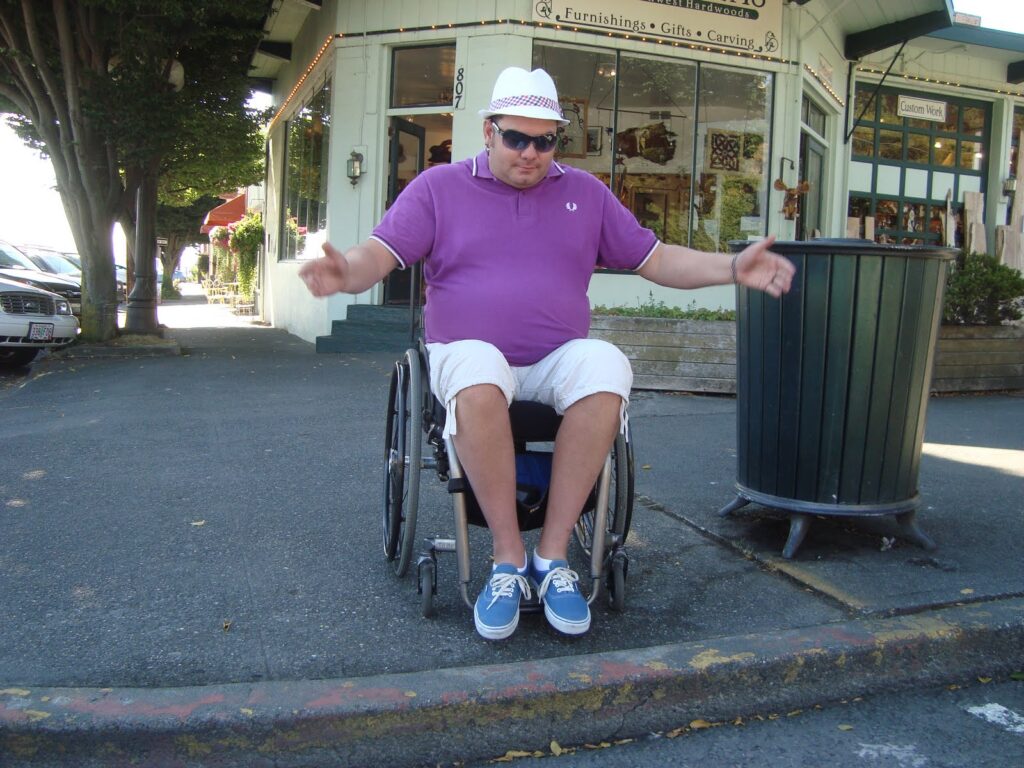
The experience of being disabled is a continuous stream of little reminders that you are inconvenient, and that accommodating you is expensive and annoying. On its own, each one is minor. But they add up. The broken lift that added three hours to your journey because only a third of London tube stations have step-free access. The pub that described itself as wheelchair accessible – apart from the massive step out the front. It IS accessible… but only if you’re already inside. Open the box with the crowbar contained within.
It never stops. The disabled parking space that only allows you to park for four hours – because you can’t possibly be disabled AND working a full-time job. Except you MUST be disabled and working, because the government has decided that in order to balance the books and avoid some difficult politics, you no longer qualify for the money that allowed you to pay for your wheelchair, or the vehicle necessary to transport it. The government are going to help (ie force) you back to work instead. How? Not by funding the existing programme designed for that purpose, which has also been cut to the bone, forcing hundreds of previously employed disabled people out of work.
Making it legal to kill citizens requires a lot of trust. Disabled citizens have lots of really excellent reasons to be wary of extending that trust. The examples given here are – for the sake of levity – fairly minor. They are problems experienced mostly by people who are able to be relatively independent. Another common assumption is that if you have ‘real’ need, of course you will be taken care of. The fact is that disabled people with real need die all the time because of cruel, arbitrary decisions empowered by government policy.
There’s the case of Errol Graham, who weighed only four and a half stone when his body was found by some bailiffs when they broke down the door to his flat. Despite clear rules stating that vulnerable claimants must receive multiple safeguarding assessments before their benefits are stopped, the Department of Work and Pensions – DWP – cut him off, and he starved to death. It was determined that the DWP failed to seek supporting medical evidence from his doctor before sanctioning him.
A recent BBC investigation found that, since 2012, at least 82 people have died following a DWP decision that adversely affected them. In the overwhelming majority of cases, the DWP made significant errors or broke their own safeguarding rules. An inquest into the death of Phillipa Day found that the DWP had made 28 errors in her case, resulting in her being denied a home assessment – despite being a vulnerable adult fully entitled to that accommodation under the department’s rules. She was found dead by suicide, next to the letter informing her that her claim had been denied. Notes taken by call handlers show that she reported that she was ‘starving’ and in extreme distress, but her case was never escalated, and no safeguarding measures were taken, despite her being a type 1 diabetic with high-risk mental health diagnoses.
When disabled people raise concern about the risks to vulnerable people, proponents of the bill are very quick to dismiss them by listing proposed safeguards to be implemented by the institutions responsible for administering the assisted dying pathway. That is not a compelling argument. There is already an entity empowered to make life and death decisions in the lives of disabled people. It has very clear rules about safeguarding and protecting vulnerable adults, that it routinely and callously ignores. No matter how many Prevention of Future Deaths reports pile up that directly implicate the DWP in the deaths of vulnerable claimants, the government and civil servants are allowed to mark their own homework – and they say they are doing fine.
Evidence submitted to the Select Committee highlights some specific concerns about the impact of such a bill on disabled and other marginalised communities. There are the obvious direct concerns: that people may be shuffled off this mortal coil before their time by unscrupulous family members or carers who tire of the responsibility and hardship of caring for them. What is more insidious than the spectre of a careless carer are factors it is much harder to identify and safeguard against. You can train doctors and social workers to spot the signs that a family member may be exercising undue influence, but it is much harder to train them to spot the cumulative pressure of a society that regards you as disposable.
Evidence given by Professor Katherine Sleeman, Director of the National Institute for Health and Care Research’s Policy Research Unit in Palliative and End of Life Care, highlights that a growing number of people seeking or considering physician assisted death in Canada and Oregon cite the financial cost of their care as a reason for seeking this pathway. Being sick or disabled is expensive, even in countries with universal healthcare, and the majority of disabled people live substantially below the poverty line. How does a physician identify this pressure – and what on earth are they supposed to do about it when they do?
She also highlights that in the Canadian system, one that is substantively similar to the UK in terms of how healthcare and welfare are administered, the mere presence of the Medical Assistance in Dying – MAiD – pathway has diverted funds away from comprehensive palliative care provision. This makes it extremely challenging to explore non-lethal end of life options with patients who are suffering, and potentially acts as a funnel towards the patient ‘choosing’ an assisted death because other options to alleviate their pain and suffering simply aren’t available. Anyone familiar with the way the NHS is forced to ration care will not be hard pressed to imagine a similar situation unfolding here.
The Canadian system has been the subject of much criticism from disability rights campaigners, and was the subject of a damning report by a UN Special Rapporteur. When it was implemented, MAiD looked very similar to the UK legislation. It was limited only to those with less than six months to live, who were experiencing extreme suffering, with all the attendant safeguards. Less than ten years after it passed, the legislation has been broadened to include people who are not terminally ill but who have a ‘grievous and irremediable’ medical condition. It is currently in the process of being extended even further to include people whose only or primary medical diagnosis is a mental health condition. In 2023, MAiD accounted for 4.7% of all deaths in Canada.
There are multiple lawsuits and legal challenges currently in the Canadian courts, the most striking of which is being bought by plaintiffs who report having MAiD suggested to them unprompted – by medical professionals and social workers – as a solution to medical or material conditions that could be alleviated by access to proper medical care and a stronger social safety net.
Any disabled person who has been through a DWP assessment will have absolutely no problem imagining an assessor raising assisted dying as an alternative to the state covering the couple of hundred pounds a month needed to pay for someone to take you to the toilet.
I’ve tried to keep my personal perspective out of this article (how did I do?), but I will never forget opening the envelope containing the notes taken by the nurse who conducted my PIP assessment and the complete, soul-destroying horror of realising she had… lied. She hadn’t been a bit loose with the truth, she hadn’t massaged the facts, this wasn’t a sexed-up dossier. She had lied.
Almost every line said the opposite of what I had told her. She said I did not use any mobility aids, when I had explicitly told her that I was using a wheelchair, and my walking stick was visible in frame on Zoom throughout the assessment. She recorded that I seemed well presented, clean and in good spirits, when I was wearing the same pyjamas I’d been in for the past two days, my hair was unbrushed, and I was supported on multiple pillows so I could sit up for the interview. I started crying five minutes into the assessment, and didn’t stop until long after it was over. Is that what counts as ‘in good spirits’ for a DWP assessor? It went on and on for page after page. It was unmistakably my notes, but at every point where I had told her something that would have ‘scored’ points, she wrote the opposite.
I had been expecting it to be tricky. I have supported family members with their benefits applications, I have friends who had already been through the process. I knew it was going to be hard, that I’d have to word things extremely carefully because the assessor would give me no benefit of the doubt. I hadn’t expected that she would simply falsify the whole thing.
I should have complained. I had support, I know lawyers. I know how the system works. But it devastated me at such a fundamental level that I couldn’t bear to continue. It took me five years to apply following my diagnosis, and it was two more before I tried again. The second time, I got halfway through the form, and for the first time in a decade I was severely, dangerously suicidal. Even with support, there was no way I could safely put myself through it.
That betrayal – by a system that is supposed to be there to support you when you need help the most – is profound and terrifying. That’s at the core of how disabled citizens and their supporters regard this bill. How can you trust the state to safeguard you when it has repeatedly shown that it will actively do the opposite?
The bill is currently stalled, mired in an unprecedented number of bad faith amendments – 900 at time of writing – tabled by a coterie of Peers who hope to filibuster the bill by swamping the committee stage, causing it to miss the legislative deadline in the spring. In doing so they risk also drowning out the real concerns people have about this bill, ones that deserve serious scrutiny and consideration, and real amendments made to protect us against slipping into something similar to MAiD.
Once legislation passes, it will never again receive the same level of scrutiny and interest as it did in the lead up. It doesn’t just need to be robust enough to resist potentially harmful amendments by the current government, but also the worst tendencies of any future governments. There has been very little outcry from the general public over the treatment of disabled people by the DWP – each death treated as a one-off, a tragic mistake. The victim should have reached out for the magical help that everyone who has never needed it believes must be there for those who are really in need – and if they didn’t, they probably didn’t really need it. Has anyone checked with their neighbours to make sure they weren’t seen carrying any heavy shopping recently? That’s probably it. Mistakes are inevitable and hey, it’s very important to catch all the scroungers! Will that public come out to fight the good fight if we start sliding down the slippery slope?
Disabled people want the right to die with dignity, and without unnecessary suffering, at a time of our choosing – but we want the right to live to those standards, too. The report on MAiD by the UN special rapporteur warned that the very existence of the non-terminal pathway for ‘grievous and irremediable’ conditions devalued the lives of the people living with them. Don’t like it? Have you considered simply dying?
This was an opportunity to have a nuanced and important discussion about what would actually be needed to safeguard disabled people if assisted dying were made legal. Is a condition ‘grievous and irremediable’ if it could be remedied by a proper social safety net that prioritises the right of disabled people to live fulfilled lives? Or failing that, the right of disabled people not to live in abject poverty, constantly in fear that the routine, callous incompetence of the DWP – or whim of a Chancellor with a budget to balance – will render you penniless, plunge you into debt, leave you starving to death alone in your flat, until some bailiffs arrive to turf you out onto the street? What does it mean to make a ‘free, informed’ choice to die, if that is how you are forced to live?