


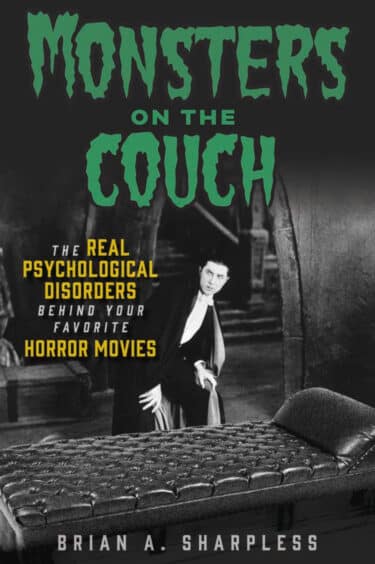
Brian Sharpless is both a practising psychotherapist and a very literate horror fan, so his ‘Monsters on the Couch’ makes for a perceptive hybrid of two infrequently paired subjects.
Skeptics are familiar with the idea that horror themes, as well as being entertaining, give us clues about the human experience. ‘Monsters on the Couch’ goes through lycanthropy, blood-drinking, zombies, demonic attack and possession, alien abduction, misidentification syndromes, cannibalism and necrophilia in order to discuss serial murder, fetishism, fugue and dissociative states, sleep disorders and hallucinations – among many, many other things.
Part one of the books looks at classic movie monsters and Sharpless points out that folkloric versions of such creatures have been recorded since the earliest times. Part two features more modern movie themes that have explicit connections to real psychological disorders. Part three looks at monstrous acts: studying transgression helps to define the acceptable.
There are plenty of real-life examples of supposed supernatural attacks and an analysis of ’sudden unexpected nocturnal death syndrome’ (SUNDS), which interested me greatly. The sudden deaths of many south-east Asian refugees hit the 70s and 80s news, and the victim population had a supernatural explanation to hand. Sharpless draws together strands of medicine, anthropology and psychology to get to the likely cause, examining such things as placebos and nocebos along the way.
We are introduced to the idea that adaptive behaviours such as disgust help to form horror themes; also that horror itself may have a function. Sharpless concludes his book observing that “Horror confronts us with the things that we would rather avoid”. Such confrontation can have a therapeutic use, such as in gradual exposure to a phobic stimulus to lower sensitivity. Thus horror fiction allows us to contemplate subjects from societal breakdown, the randomness of life, the darkness of our own urges and even death, in tolerable doses.
It may be that there is comfort in exposure to fear. For example, we review the personality traits that make people prone to conspiracy thinking: “It is so hard for humans to tolerate uncertainty that we can sometime create our own illusory certainties and then find evidence to confirm them”.
While you would expect ‘Monsters on the Couch’ to be insightful, the bonus is that it is also very entertaining. Have a skeptical Halloween with this one!