



The British physician Ebenezer Sibly (1751–1799) is a kind of transitional fossil in the history of ideas. His masterpiece, A Key to Physic and the Occult Sciences, published in 1792, was quite up-to-date not only with the scientific facts of the time – he describes blood circulation and even mentions the newly discovered oxygen gas – but also with cutting-edge scientific speculation, explaining, for example, magnetic forces in terms of atoms and the exchange of microscopic particles between iron and a magnet.
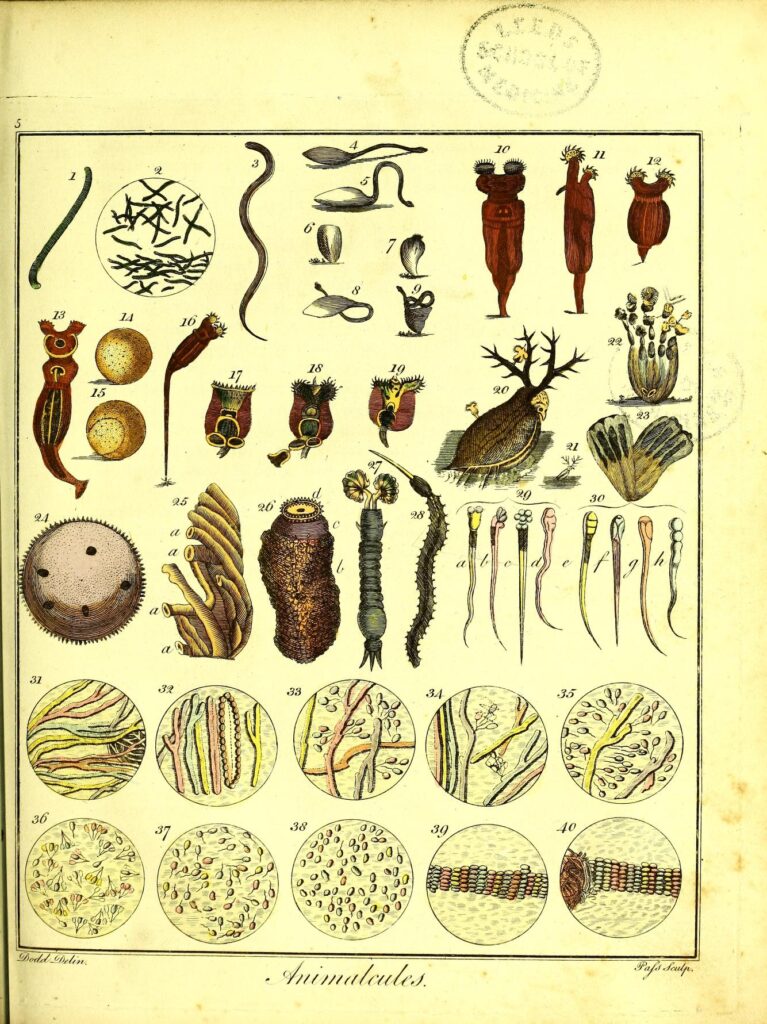
Speaking of microscopic things, the book is richly illustrated with colourful pages that include carefully drawn and detailed images of microbes and sperm. Other pages, however, show horoscopes and a kabbalistic map of the Kingdom of Heaven. For him, gravity and magnetism are manifestations of the anima mundi, a universal soul emanating from God, which underlies the phenomena of astrology and magic, among many other things.
For Sibly, the existence of the circulatory system proves that, as the Hermetic magicians of antiquity taught, the human body is a microcosm, a miniature universe: the heart is the miniature sun, and the bladder, the ocean, into which the rivers of the microcosm flow. Dr. Sibly was up-to-date with science, but for him, the most advanced science of his time merely confirmed, reaffirmed – and, to a certain extent, illuminated and explained – what astrologers, alchemists, and magicians had been saying.
By the end of the 18th century, Sibly’s mysticism was already anachronistic. Isaac Newton’s obituary, presented to the French Royal Academy of Sciences in 1727 – nearly three decades before Sibly’s birth – mercifully omitted his youthful interest in astrology, which by then had become an embarrassing topic for “men of science”. Later, the first edition of the Encyclopaedia Britannica, from 1771, devoted less than a page to “astrology” but 67 pages to “astronomy”.
But across the widening chasm that opened between science and superstition, Sibly’s strategy prospered. At the same time that science washed its hands of occult speculation, occultists, magicians, esotericists, astrologers, and outright irrationalists began to claim scientific support for their eccentricities. Even Joseph de Maistre (1753–1821), the great mystical and reactionary irrationalist, for whom skepticism and rationalism were universal acids that would dissolve civilisation and reduce men to cannibalism and savagery, was certain that one day all of science would be transformed and reach the conclusion that “the ancient traditions are all true”.
From then on, the trope “science supports me / agrees with me / is beginning to agree with me / one day it will prove me right all along” was warmly embraced by all the great proponents of occultism or esotericism. Sometimes in a passive-aggressive tone: Helena Blavatsky (1831-1891), creator of the most successful and influential esoteric doctrine of the Modern Era, Theosophy, said that science was only taking its first steps in areas that her Secret Masters had already explored and mapped. However, she did not hesitate to appropriate scientific ideas and concepts, as she did with the – now discarded – hypothesis of a sunken continent in the Indian Ocean, Lemuria, which Blavatsky adopted as the cradle of human evolution.

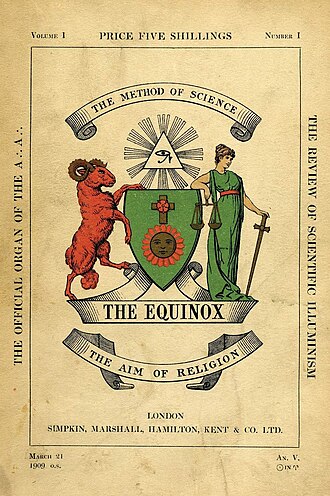
Shortly after Blavatsky’s misappropriation of geology and the Theory of Evolution, Aleister Crowley (1875–1947), “The Great Beast 666”, chose the motto “The Method of Science, The Aim of Religion” for one of his projects. Fast forward to the second half of the 20th century, and we find the likes of Gary Zukav, Amit Goswami, Deepak Chopra, and Fritjof Capra swearing that quantum physics has rediscovered truths long established by ascetic yogis and Tibetan monks – truths that supposedly include the power of positive thinking and may even support the validity of astrology.
Zukav wrote that physics graduate programs would someday have to include meditation classes. Chopra claims that, through quantum effects, positive thinking can alter DNA. Goswami invented, among other things, “quantum astrology”.
Historian Olav Hammer refers to this process as “disembedding”, which means removing scientific facts, concepts, hypotheses, and jargon from their proper contexts and, worse still, from the proper scientific ethos of critical evaluation, organised skepticism, and empirical testing. Analogies drawn in science popularisation works are also “disembedded” and treated not as metaphors or approximations, but as statements of fact.
The products resulting from these disembeddings are called “scientism” by scholars who study esoteric and New Age movements. Of course, in other contexts the same word also means excessive, undue or exaggerated confidence in the power of natural science to describe and explain everything in the world completely and sufficiently. The high prevalence of scientism – in the sense adopted by New Age studies – makes it difficult to adequately distinguish between modern forms of mysticism and mere pseudoscience.
The reason for all this, as it shouldn’t be difficult to imagine, is the vast cultural capital of science, accumulated since Galileo. Because science works, its name commands respect. As playwright and Nobel Prize winner George Bernard Shaw (1856-1950) once quipped, if you wanted people in the 20th century to believe things that profoundly offend common sense, the easiest way would be to call them “scientific.” The same holds true now in the 21st century, even though “traditional” and “original” are gaining ground.
In a better world, people would be skeptical enough, and have access to adequate education, to see the vacuity – or fraud – behind the abuses of the “science” label. Unfortunately, we’re not there yet.
This story was originally published by Revista Questão de Ciência in Brazil. It is translated and reprinted here with permission.