




Ufologist Cynthia Hind said it would be “the biggest story of the 20th Century.” Yet the world’s newspapers at the time failed to mention the landing of a UFO and encounter with alien beings alleged to have occurred on 16th September 1994, at Ariel School in Zimbabwe.
Contrast this with another UFO landing case from Voronezh, Russia, a few years earlier on 27th September 1989, where dozens of children in a similarly little-known location apparently saw a landed UFO, from which an awkward looking three-eyed robot emerged and zapped a boy, making him disappear. Even with this science fiction-sounding detail, this story was widely reported as genuine, making the front-page of two dozen newspapers around the world. The Ariel School encounter made no such headlines. It didn’t even feature in “It’s a weird, weird world” – the regular column dedicated to bizarre stories in The Herald, Zimbabwe’s largest newspaper.
This may have been because its most fantastic claim – that aliens with big black eyes communicated a telepathic warning about technology and pollution to the children – took time to emerge. It only appeared months later, after many interviews, when some of the children were questioned by Dr John Mack from Harvard University.
To this day, the case remains a favourite among UFO enthusiasts, who see these compelling interviews with the children as proof of the reality of alien visitation. Online, a new generation of visualisations has arrived: mostly AI slop renderings of archetypal silver flying saucers and the now ubiquitous “skinny bob” version of the alien “grey.” None, however, include depictions of a plump man that looked like a hippy, a man with long black hair, a man with a band around his head, or of a black and green striped UFO – all of which are details reported at the time but which are now studiously ignored, presumably because they don’t sound alien enough.
While the central claim – that aliens actually visited Earth in a UFO – is essentially impossible to falsify given there is only eyewitness testimony from a fraction of those present (around 60 out of 250 children, and much of it contradictory), the Ariel School story contains three separate, more concrete claims. To this day, these other claims still determine how the story is retold, but by looking at the available media of the time they are easier to examine and address:
- Claim 1. Two days prior an alien spacecraft was seen arriving in the skies over Southern Africa.
- Claim 2. The Ariel children had no prior exposure to UFO pop culture or alien lore.
- Claim 3. Related to this is the claim that the message warning about technology and environmentalism they received could only have come from aliens.
Claim 1: The earlier sighting
The mystery of Ariel School begins two days earlier, with the atmospheric re-entry of a Russian rocket-body that occurred on Wednesday 14th September, 1994. Witnessed by thousands “from Zaire to Johannesburg,” some reported a soundless object flying in an arc, others claimed to see a craft with windows, while still others believed a large alien mothership was accompanied by several smaller craft (the debris).
Investigators had heard about the Russian launch of Kosmos 2290, but couldn’t explain why a rocket part that typically stays in orbit would come back down after 18 days – so instead, thought it was an alien spacecraft.
However, this kind of thing had occurred before. On 10th March 1983, a very similar event involving the same second stage part of a Russian rocket that was also used to place a spy satellite into orbit (Kosmos 1444) burned up in the skies over Arkansas and Mississippi. In orbit for eight days, it was seen re-entering at a similar time of just after 8pm. Witnesses stopped their cars on the highway to gaze at the spectacle, and a similar degree of misperception occurred. One witness described it as coming down slowly and then accelerating away at high speed. Prompt reporting of the North American Aerospace Defense Command’s identification of the object as man-made drew a line under further speculation about an alien invasion, and a UFO flap was averted.
However, the news in Zimbabwe didn’t operate so efficiently. The UK’s The Daily Telegraph (on the morning of 16th September 1994 – before the Ariel School event had even occurred), and ITN’s space correspondent and founder of the venerated Kettering Group, Geoffrey Perry, confirmed: “UFO was rocket”. Yet, it took a full three weeks for The Herald to publish a vaguely worded follow-up report that what was seen in the skies over Southern Africa was the same kind of school bus-sized rocket body re-entering the atmosphere – and not an alien mothership. This was far too late. A UFO flap had already begun. The mystery event at Ariel School had taken place, and breathless television interviews with the children had followed.
Claims 2 & 3: Innocence of UFO culture, warnings about technology, and pollution
A persistent myth regarding this event is that the children attending Ariel School, located in the suburbs of Harare, existed in a bubble untainted by pop culture influences. Again, Cynthia Hind, the first ufologist to go to Ariel School, offered her opinion:
Now the people in Africa don’t have television. They might have a radio, but I can tell you the media don’t deal with UFOs there.
Which seems an odd thing to say, given that “the media” had just spent several days wondering if a rocket re-entry was the arrival of an alien spacecraft.
After the children drew pictures of the UFO and aliens they’d seen, Hind also claimed:
They drew in their drawings many things that I don’t think they could know about.
These just seem like silly fibs, but what’s sillier is that in thirty years no one seems to have bothered to check if there’s any evidence to counter this claim, seemingly accepting that the media available to the kids is somehow lost to time.
Cynthia Hind, who lived in Zimbabwe, had also undercut her own assertion that the media didn’t deal with UFOs when on 20th April, 1994, The Herald published an article she had penned, with the headline: “UFO – It’s no longer a question of ‘are we being visited?’”. In it, she expressed her certainty of alien visitation and outlined the main elements of the alien “abduction syndrome.” She also mentioned that the film UFOs: Miracle of the Unknown had recently aired on television.
This hour and a half movie contains authoritative-sounding assertions of the reality of flying saucers, includes Erich von Däniken’s ancient alien claims, George Adamski’s alleged alien contact, and a telepathically-received warning that humans should stop their development of nuclear weapons, as well as numerous photos of silvery flying saucers – such as the classic hoax image created by Billy Meier, later used in the famous “I Want to Believe” poster seen in The X-Files.
The expensive fee-paying Ariel School with tennis courts and a swimming pool was attended by the children of families with means. Television was a part of their lives, and programming schedules of the day are evidence that even without access to relatively new satellite television, the two terrestrial Zimbabwe Broadcasting Channels (ZBC 1 and 2 – which often only ran from mid-afternoon to “close” around midnight; remember when TV closed for the evening?), aired content indistinguishable from that available to children living in say, Manchester, England.
“TV” consisted of shows imported from Canada, the UK, US, Japan, and Australia: Jeeves and Wooster, Allo Allo, Teenage Mutant Turtles, The Benny Hill Show, MacGyver, The A Team, Miami Vice, Neighbours, and The Fresh Prince of Bell Air – as well as the globally dominant The Oprah Winfrey Show. There was also plenty of Science Fiction: Star Trek, The Empire Strikes Back, Ewoks (cartoon), Voltron, The Twilight Zone and Gerry and Silvia Anderson’s UFO (the opening sequence of which included a silvery UFO landed among some trees, firing off a green laser).
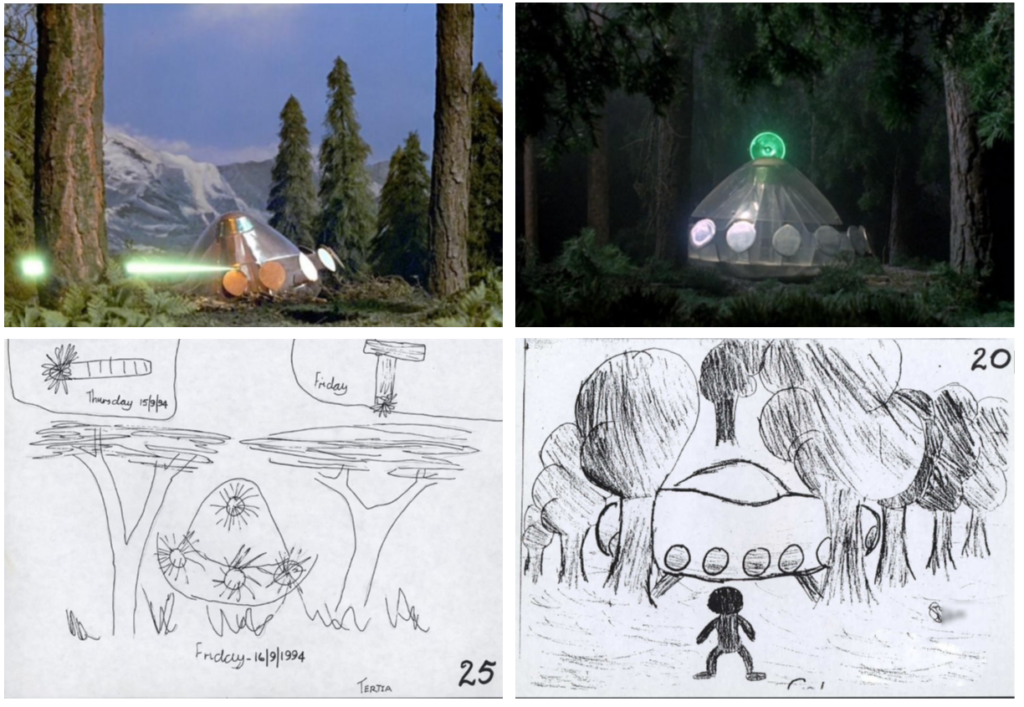
Broadcast in the months prior to the Ariel school event, there were several programs that, in one way or another, dealt with the popular theme of aliens and what they would make of human life should they arrive here.
Shows such as ALF the “Alien Life Form” – a hairy being who crash lands in California and is taken in by a loving family (his homeworld having been destroyed by nuclear war). The Boy from Andromeda was a children’s sci-fi film from New Zealand, in which a large-headed grey alien in a tight-fitting silvery suit arrives on Earth from his dying planet. “We put too much trust in computers; now the computers are against us,” he says – foreshadowing one Ariel pupil’s claim that the aliens told her telepathically that “we mustn’t get too technologed (sic).”
There was also The Cat from Outer Space– a light-hearted Disney movie where a dome-shaped flying saucer with landing gear arrives. Its occupant is an alien in the form of a domestic cat which communicates telepathically and exercises telekinetic powers. Hard Time on Planet Earth featured an alien military commander (Martin Kove), sent to Earth as punishment to spend time in a weakened human form, where he learns about human culture from watching TV, and uses his residual alien powers to help people.
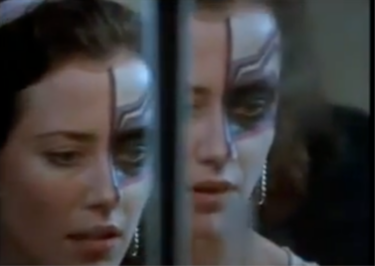
In Starcrossed (1985), a humanoid alien woman escapes her homeworld pursued by “men in black” type characters; she also learns about human culture from watching TV, falls in love with an earthling (James Spader), communicates with him telepathically, and has telekinetic powers. In one scene she’s shown with half her face painted grey with large dark eye make-up, just like a grey alien.
Also popular was Halfway Across the Galaxy and Turn Left – an Australian children’s sci-fi series following aliens on the run from their home planet who have to disguise themselves as a human family. It includes a motif of children joining hands and communicating telepathically with an orbiting spaceship to manifest physical objects (two Ariel girls claim to have held hands before seeing an alien being materialise right in front of them). Delta Space Mission was a Romanian cartoon movie (aired the same afternoon as the Ariel sighting) involving a female alien with blue/green skin, large almond-shaped eyes, and various depictions of spacecraft.
What seems obvious from just this sample of UFO-related shows is that the means of alien travel, how they communicated by thought alone, their struggles to empathise and learn about human nature, and what message they brought, were all thoroughly understood, and regularly featured on available TV at the time. It’s also clear that some of the children, when asked to draw the UFO they had seen, drew their favourite UFO from TV. And, when asked to imagine how the aliens feel, provided responses like one girl who said “I think that in space there is no love and down here there is.”

While ufologists claim their drawings are identical, some drawings resemble the silver, domed craft with green-tinted windows from The Cat from Outer Space; others, the silvery object with circles around its rim from Gerry Anderson’s UFO; while others resemble the orb-like spaceships in Delta Space Mission. There was even the classic oval saucer with tripod landing gear that was an image so deeply embedded in our culture that it also appeared in a playful advertisement for a clothing store named United Factory Outlet (U.F.O.) on the front page of The Herald newspaper.
If ecology and environmentalism wasn’t already a subtext linking these shows, there were also several programs that dealt with the topic explicitly. A Nuclear Free Pacific (1988), a film about nuclear proliferation, aired the day after the event at Ariel School – it opens with images of a bomb exploding. Earth Journal with Dr Richard Leakey was a series about agricultural heritage, recycling, and conservation. Each episode ended with “Earth Tips”: ways that viewers can help the environment.
Then there was Captain Planet, (sing it with me) “he’s our hero, gonna take pollution down to zero… he’s our powers magnified and he’s fighting on the planet’s side”. The cartoon here offered similar instruction to budding “Planeteeers.” Compare that to the claim from one boy at Ariel, who told John Mack that the aliens were trying to tell us “something that’s going to happen,” a warning about “pollution or something.”
The “Intruders” influence
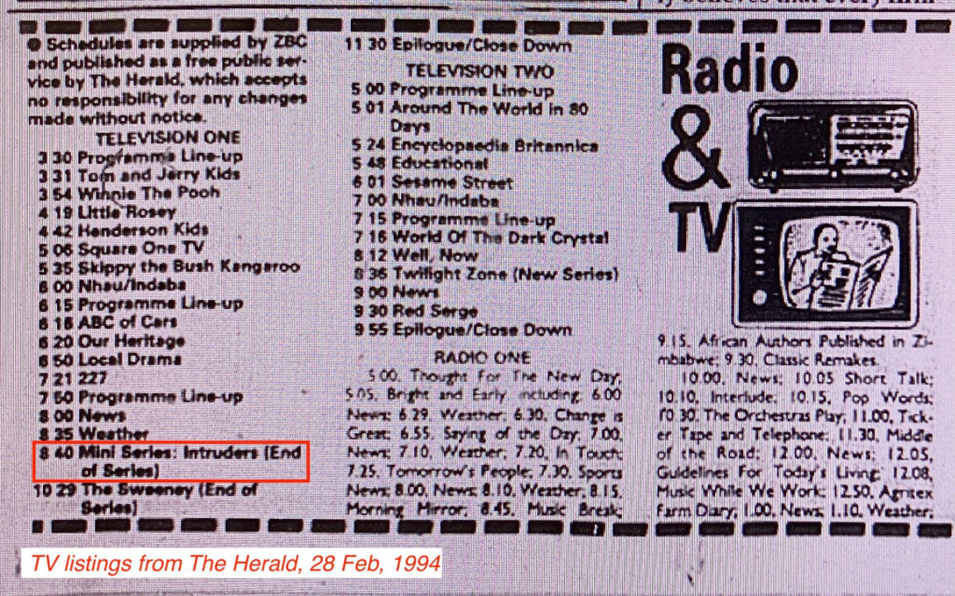
Most significant to the core claims that telepathic aliens with big heads and large black eyes emerged ‘out of nowhere’ at this one strange event at the Ariel School is the broadcast of the CBS miniseries Intruders. Shown at 8:40pm on 28th February, 1994 – just six months before the disturbance at Ariel School – this intensely emotional dramatisation of real-life claims of alien abduction included harrowing visualisations of women being captured by beings who slip through the walls of their homes, only to have alien implants inserted and removed, while being experimented on under eerie blue lights by grotesque alien surgeons. Practical special effects include models of terrifying “greys” with awkward bulbous heads and large glistening black eyes, who communicate telepathically with their captives.
Long after the event at Ariel School, we see evidence that the details of this show had reached the children. One girl, interviewed in 1996, tells Dutch investigator Tineke de Nooij: “I dreamed that the same one [alie] I saw without hair, he came into my bedroom and he took me from my bed”. Another girl describes how she’d heard how “I heard this lady on TV [and] she said this lady got kidnapped and she had babies that were aliens.” These are all specific plot details from the CBS show.
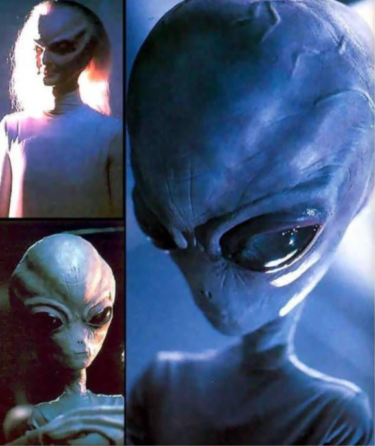
It just so happens that Intruders was based on real claims of alien abduction. The principal character, a psychologist (played by Richard Crenna) was based upon Dr John Mack – the same John Mack who would later interview the children at Ariel School and coincidentally “discover” that they, too, had encountered aliens with large black eyes who telepathically communicated a warning about ecological catastrophe.
Parents of the Ariel pupils may have watched the series and known about its connection with Dr Mack. They may also have seen him discussing his book on alien abduction on Oprah Winfrey’s show in April that year, two months after Intruders aired on local television in Zimbabwe. At least one newspaper article in The Herald, 5th July, 1994, was published that described Mack’s work, and its controversies. This might explain why out of a claimed 62 witnesses, only 12 children sat for the intense interviews with Mack when he arrived at their school in November that year (and out of those twelve the public has only seen snippets of nine of the children’s remarks).
What the children saw and heard is still the subject for speculation (and I’ve done my fair share). There were enough witness interviews, albeit conflicting in their detail, to be reasonably sure that there was a physical, non-imaginary stimulus for the disturbance at the school. How that stimulus was interpreted and relayed by the children remains woefully unexplored especially among ufologists, who consider a landed UFO and aliens with shape-shifting abilities as the only possible explanation for the wide variation in testimony, and who choose to ignore the media context of the moment.
While it may not have become “the biggest story of the 20th century” it seems on-track to become the most frequently mistold of the 21st. It all began with some poor journalism that conflated the rocket re-entry event with the disturbance at the school, and was made worse by attempts to minimise the effect of the children’s exposure to pop UFO culture or their awareness of environmental catastrophising.
Note: television schedules were reviewed on microfilm at the British Library. While I have images of each page it’s currently not possible to obtain high-resolution scans of the whole pages, only photos of the monitors. That feature has not yet been restored to users since the recent cyberattack.