




Edward Warren Miney married Lorraine Rita Warren in 1945. This much we can be sure of. Much of the rest of the pair’s early life is less clear, unless we take their word for it – and there’s good reason why we shouldn’t. Ed claims that his lifelong fascination with the supernatural was a result of having been born and raised in a haunted house. Lorraine insisted that, from the age of seven, she was capable of seeing people’s auras and speaking to the dead. There is no contemporary corroboration of either of those claims.
Nevertheless, that shared love of the supernatural led to them founding the New England Society for Psychic Research (NESPR) in 1952, the oldest ghost-hunting group in America. They were barely 26, yet Ed was already describing himself as a self-taught demonologist, and Lorraine a ‘light trance medium’ who could go into a semi-trance-like state to communicate with the dead, while retaining all memory of what she had said and done. From these simple origins, many highly questionable legends would be born.
In 1970, the NESPR was contacted by a 28-year-old student nurse named Donna from Hartford, Connecticut, who feared her Raggedy Ann doll, ‘Annabelle’, was haunted. According to Donna – or at least according to what the Warrens claim Donna said – Annabelle could move by herself, and had violently tendencies. Donna had a roommate called Angie, who had a fiancé called Lou (just ‘Lou’ – those looking for further identifying information that could be used to corroborate the tale will be disappointed). Annabelle, we’re told, disliked Lou, and one night Lou woke to see the doll at the end of his bed, climbing slowly up his body until it made its way to his neck, at which point it strangled him until he blacked out.
Or so Lou told Angie, who told Donna, who told the Warrens, who sold the story to the newspapers. The morning after the attack, Lou checked his neck for marks, and there were none – which the Warrens claimed was evidence that the attack was definitely supernatural.
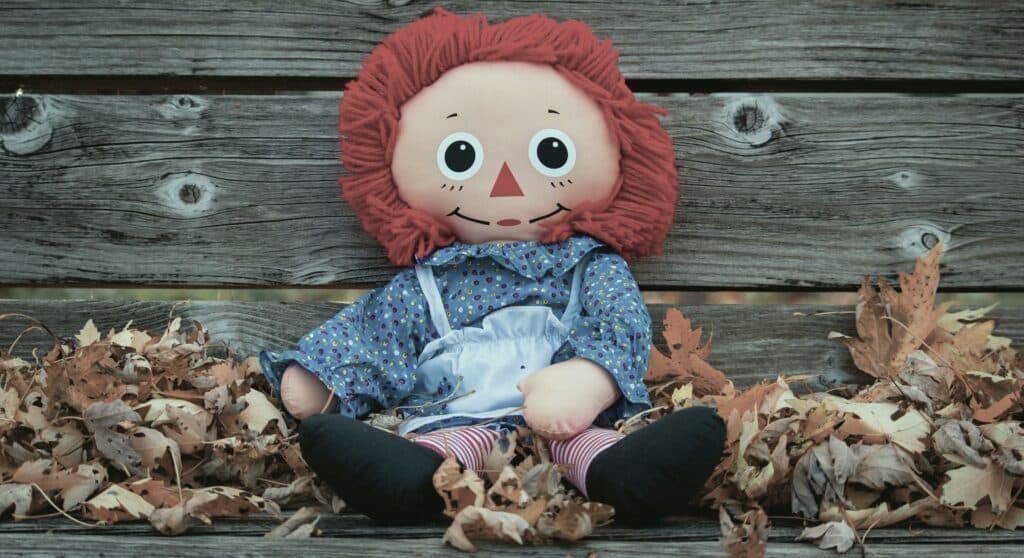
Ever-willing to lend a helping hand when it comes to indulging someone’s paranoia in a way that could be turned into lucrative publicity, Ed and Lorraine took Annabelle from Donna, concluding that it was indeed possessed by an actual demon. Staying in the Warrens’ possession for decades, Annabelle continued to show her malicious streak. Years later, one young man (no name, no identifiable information) visited the Warrens’ Occult Museum and made fun of Annabelle, pulling silly faces at the demonic doll – on the way home, he lost control of his motorbike, hitting a tree and dying on impact. At least, according to the Warrens.
There may be other context, which the Warrens avoided disclosing, in the Annabelle doll affair: in 1963, The Twilight Zone aired an episode titled ‘Living Doll’, in which a child’s toy became possessed by an evil spirit, causing it to take revenge on a little girl… and her mother, Annabelle. Had the Warrens drawn inspiration from fiction for their demonic tales? If they had, they neglected to mention it in the 1980 book The Demonologist, an exclusive telling of the Warrens’ stories.
The Harrisville Haunting
In 1971, Roger and Carolyn Perron and their young family moved into their new 200-acre home in Harrisville, Rhode Island. Shortly after the move, the children claimed to see spirits inhabiting the house, whom they claim caused items to go missing. Clearly, there was only one possible explanation: witch ghosts. Specifically, the ghost of Bathsheba Sherman, who had lived there in the early 19th century with her four children, three of whom died mysteriously before the age of seven. Bathsheba’s tragedy seemed suspicious to her superstitious community, and they labelled her a satanist who had sacrificed her own children with a knitting needle, though there wasn’t enough evidence to convict her in court.
A friend of Carolyn Perron contacted Ed and Lorraine Warren, who turned up to the house to investigate, with Lorraine confidently asserting that the haunting was a dark presence named Bathsheba, who had indeed sacrificed her children to Lucifer before hanging herself and cursing anyone who would move into the property. Had Lorraine’s psychic powers connected her with a ghost? Or had she merely researched the house in advance, finding the name of a past inhabitant whose tragic story was at least enough of a local scandal as to end up in an unsuccessful criminal case, and a matter of public record?
Speaking to the Providence Journal in 2013, to coincide with the release of The Conjuring – the Hollywood movie based on the Warrens’ account of what took place in that house, on which Lorraine served as a consultant – Lorraine explained that her biggest concern about the Harrisville haunting wasn’t so much the dead witch and the spooky events, but the family’s lack of religious faith. “At that particular time, the people did not have religion,” she said. “It was very dangerous.”
She also explained that, while in one of her light trances in the house, she saw “the most grotesque thing [she had] ever seen in [her] life,” which she managed to dispel by shouting at it to “go away in the name of God” – which was further evidence of her psychic gifts, because nobody else present could see anything there at all.
Amityville
From then on, if something spooky happened in the New England region, the Warrens were there to validate it. In 1975, George and Kathy Lutz moved into a new house on the south shore of Long Island, New York, in a suburban neighbourhood called Amityville. Less than a year earlier, the house had been the scene of a multiple murder, with Ronnie DeFeo killing a young family in their sleep – something the family had been aware of when they bought the house.
Within days of moving in, the Lutz family claim to have noticed odd phenomena. There were “odours that came and went”, and the house would make sounds in the middle of the night. Doors were ripped from their hinges. Sometimes, rooms were unexpectedly cold. If that wasn’t enough to justify media attention, Lutz claimed there were a few occasions when he saw his wife physically transformed into an old woman, with the face, hair and wrinkles of a 90-year-old.
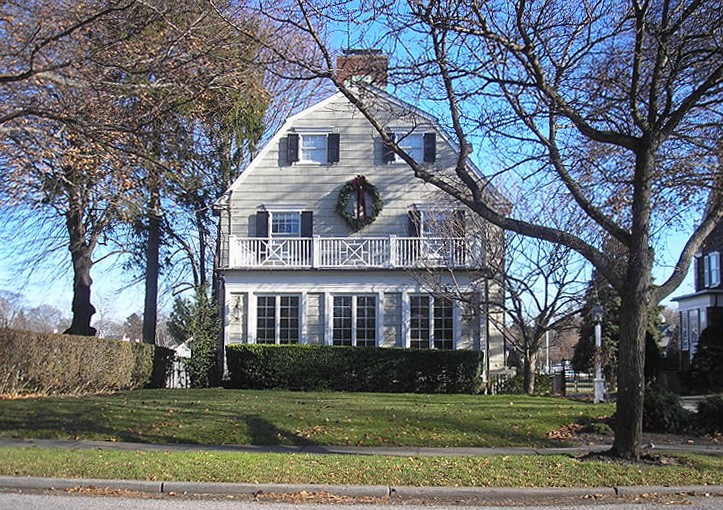
One night, according to Lutz, he heard his children’s beds “slamming up and down on the floor” above him, but he couldn’t get up to help, because he felt pinned down by an unseen force. When he looked across the room, he claimed, his wife was levitating and moving across the bed.
The family left the house the next morning, just 28 days after they moved in. A day later, a removal man arrived to move their furniture out of the house, but he saw nothing at all paranormal.
A month later, Ed and Lorraine turned up to investigate… along with a film crew from the TV station Channel 5 New York. Unsurprisingly, they concluded it really was the work of malevolent spirits, despite other investigators concluding that the whole story was a hoax, and despite a litany of evidence that disproved the account given by the Lutzes. None of which prevented the Lutz family from selling the book and movie rights to their story, and touring TV talk shows with their tale. For their part, the Warrens span their fleeting involvement with the story into The Conjuring 2, released in 2016.
The Enfield poltergeist
Their supernatural tourism and exploitation wasn’t limited to New England – they even made it over to regular England, too. In 1977, they arrived at an unassuming semi-detached council house in Enfield, North London, amid reports of poltergeist activity.
According to the young sisters of the family, Janet and Margaret Hodgson, the house was plagued by disembodied voices, loud noises, thrown toys, and overturned chairs – and if all of that sounded like the work of attention-starved children, how are we to explain the photographic proof of Janet levitating above her bed?
The Warrens were persuaded that this was definitely a case of “demonic possession”. More skeptical investigators on the scene pointed out that the photos looked an awful lot like a young child jumping off her bed. The same investigators pointed out that the Warrens came to their demonic conclusion rather hastily, soon after highlighting how the story could be a lucrative source of income, were it told correctly. When the other investigators were reluctant to play ball, the Warrens left Enfield, though an exaggerated version of their involvement in the case was adapted into The Conjuring 2.
10,000 cases
In 1981, when Arne Cheyenne Johnson was accused of killing his landlord, Ed and Lorraine popped into the case to claim the killing was a result of Johnson being possessed by a demon. The judge threw out his attempt to plead Not Guilty by Reason of Demonic Possession… but that didn’t stop the Warrens’ version of events becoming the plot of the 1983 book The Devil in Connecticut, and the 2021 film The Conjuring: The Devil Made Me Do It.
1983 was also the year that the couple investigated a “werewolf demon” possessing a man called Bill Ramsey – who, unlike traditional werewolves, didn’t transform into a giant man-wolf, but merely became more aggressive and sometimes bit people, before he was successfully exorcised by the Warrens. However, the lack of photo or video evidence has called this claim into question.
In more than four decades of work, Ed and Lorraine claimed to have investigated more than 10,000 cases – though, of course, there is a lack of corroborating evidence for that claim, too. There is no real evidence for any of their conclusions in the alleged paranormal cases they inserted themselves into throughout their careers, yet it was hard to find someone with a spooky story that the Warrens’ wouldn’t validate as genuinely demonic – especially if they could use it for publicity.
Ed died in 2006, and Lorraine in 2019, but their place in paranormal history and myth-making has been well and truly cemented, not least thanks to the work of a string of Hollywood spook stories that claim to be based on the real-life cases Ed and Lorraine investigated – but, crucially, primarily relying on their own self-serving accounts.
When the first of those films, The Conjuring, was released in 2013, USA Today spoke to Steve Novella, who was president of the New England Skeptical Society and who actually met and investigated the Warrens. Novella said at the time: “The Warrens are good at telling ghost stories. You could do a lot of movies based on the stories they have spun. But there’s absolutely no reason to believe there is any legitimacy to them.”
It seems like Hollywood was listening to at least the first half of that, releasing nine films in a cinematic universe following The Conjuring. But for all of the remarkable deeds attributed to Ed and Lorraine, the only thing they actually managed to conjure was a lasting legacy as paranormal pioneers, pieced together from exaggerations, falsehoods, and awkward cameos in other people’s tragedies.