


Note: this article includes candid descriptions of experience with eating disorders and body dysmorphia.
As I watched the eating disorder drama To the Bone on Netflix for the fifth time, I found myself thinking: the story gave me hope. But how much more powerfully would the story have spoken to me if the main character were a man?
Michael Krasnow died at just 28, weighing only 75 pounds. Before his death, he wrote a book called My Life as a Male Anorexic. It wasn’t a bestseller. But it was a rare voice. Raw, unflinching, and male. He didn’t write to be admired. “I want people to know that this disease affects men too”, he said. Michael hoped that more men would feel less ashamed for struggling with an eating disorder.
We hear the same stories so often that we forget to ask who’s missing from the narrative. Eating disorders? That’s a women’s problem, or so we’ve been told. The default image that comes to most of our minds is a teenage girl staring at a mirror, tugging at a dress that won’t zip, and scrutinising her reflection. But that image casts a long shadow that hides faces we never thought to look for.
It is important that we don’t compare sufferings across genders, but there is still space for a shift in perspectives, to make room for men in conversations around mental health and eating disorders. I spoke to Kimberly Tng, Founder and Clinical Psychologist at Ardelle Psychology Singapore, and an AHPRA-registered Psychologist in Australia, who told me it is an overlooked reality that eating disorders affect individuals of all genders, not just women. This misconception, she explained, is rooted in media portrayals and cultural narratives that have long framed eating disorders as a “female issue”, obscuring the experiences of men.
According to Beat, a leading UK eating disorder charity, an estimated 1.25 million people in the UK are affected by eating disorders. Of those diagnosed with anorexia or bulimia, 25% are male. The American Psychological Association highlights that men account for at least one third of all individuals with eating disorders, yet many still struggle to access appropriate care.
While some might be skeptical that men suffer from eating disorders at all, I feared the numbers might barely scratch the surface. So many stories never make it into the data: the ones unreported, misdiagnosed, or dismissed, especially when symptoms don’t fit the stereotype. The National Alliance for Eating Disorders estimates that over 70% of those affected will never receive the treatment they need. According to the National Centre for Eating Disorders (NCFED) in the UK, quantifying the prevalence of eating disorders among men remains challenging due to underreporting and diagnostic bias, especially for bulimia and binge eating. For men, the barriers to seeking help are even more pronounced.
Kim explains that, while the emotional drivers behind disordered eating – such as perfectionism, shame, anxiety, and trauma – are broadly shared across genders, the way these disorders manifest in men are usually socially disguised. While broad averages indicate that women are diagnosed with eating disorders at roughly twice the rate of men, men are significantly less likely to seek help or disclose their struggles, meaning they are underrepresented in published statistics.
The silence surrounding male eating disorders is not benign; it delays recognition and reinforces isolation. According to NHS England’s 2023 youth mental health report, eating-related distress has risen sharply among older adolescents and young adults. Among the male population aged 17-19, 42.3% screened positive for a possible eating problem, with rates remaining high at 43.0% among men aged 20-25. These figures reflect a significant increase in male vulnerability to eating disorders.
While we know that women represent a larger proportion of diagnosed cases, the picture shifts when we look at the younger population. Among adolescents, the gender divide narrows. The new generation is growing up in a digital landscape where social media constantly broadcasts idealised body standards. For ages 10-24, exposure to appearance-driven content and peer comparisons has been linked to increased body dissatisfaction and disordered eating among youth. Hence, this is something we should be aware of for now, but also for the future.
The weight of toxic masculinity
From a young age, boys are taught to ‘man up’, to believe that ‘body insecurities are for girls’ and that ‘talking about emotions makes them soft’. These aren’t just playground taunts – they are cultural imprints, conditioning boys to bury vulnerability and wear their masculinity like armour.
The NCFED notes that reluctance to seek help for eating disorders is intensified by fear, particularly with being “stigmatised as gay”, a concern that deters disclosure and reinforces silence amongst men. They also shared a “double taboo”, where men hesitate to discuss emotional struggles, but also face a self-esteem penalty when they express concern about their appearance, because they feel they will be criticised by others.
The issue runs deep. Men fear being misunderstood, dismissed, or judged. They worry that speaking up will make them seem weak, and so they stay silent. They cope alone with their body dysmorphia, the mental health condition where a person spends a lot of time worrying about supposed flaws in their appearance.
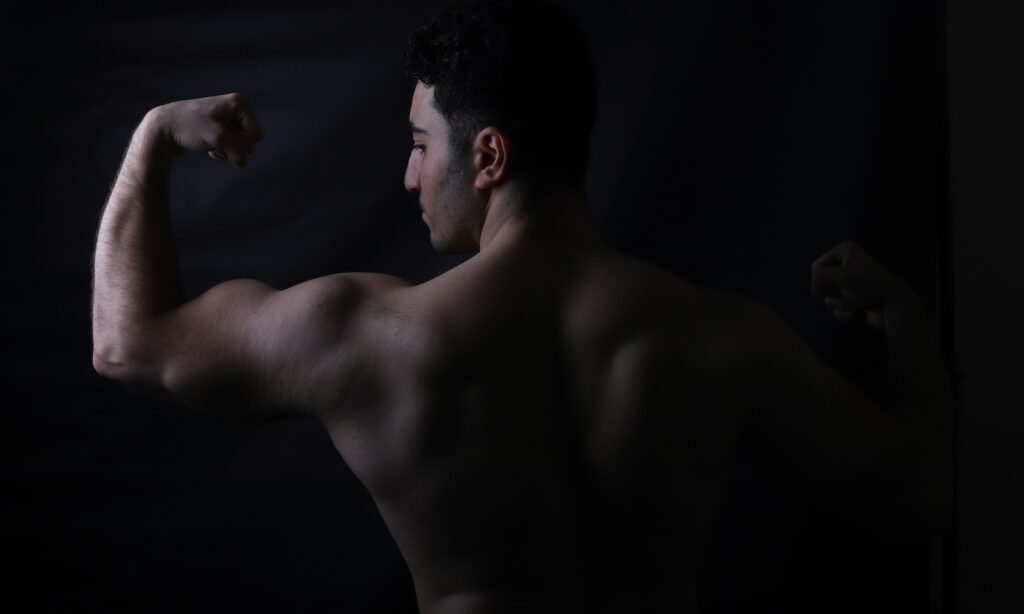
Masculinity is tightly bound by societal norms to physical strength, emotional restraint, and social dominance. These ideals don’t just shape how men behave, but how they suffer. NCFED shares that eating disorders in men are frequently disguised by the pursuit of fitness, with many appearing “toned, muscular and fit” during early stages of illness. This concealment is especially pronounced in cases of Muscle Dysmorphia, also known as the “Adonis Complex”, where men obsessively strive for a hyper-muscular ideal.
The body becomes a project that never feels complete. No matter how much muscle is built or how defined the physique becomes, it is never enough. Beneath the surface lies not pride, but punishment; a relentless drive to earn worth through a perfection that always seems just out of reach. All of it in pursuit of what society tells men they should look like.
Many might assume that someone who is always at the gym must be healthy. However, appearances can be misleading. Behind the front of discipline and fitness, what goes on in the mind may reveal a very different story.
More than the desire to be thin
Public perception often narrows eating disorders to anorexia or bulimia, marked by skeletal frames and obsessive dieting. While they are part of eating disorders, this misconception masks the complexity of a broad spectrum of other conditions.
While weight‑related behaviours may appear on the surface, the reality extends far beyond the pursuit of thinness. It encompasses emotional distress, control, trauma, and identity. In fact, only 6% of people diagnosed with eating disorders are medically underweight. Eating disorders take many forms, and are not always visible.
The battle extends beyond food intake. Excessive exercise is a frequently overlooked form of disordered behaviour. This pattern is often linked to muscle dysmorphia, or reverse anorexia: the relentless drive for a “perfect” physique. Whether it’s sculpted six-pack abs or hyper-defined muscles. The obsessive pursuit of the ideal male body without limits can be a major red flag, and can even become life-threatening. Sufferers may prioritize workouts over rest, social connections, or even recovery from an injury.
Beyond anorexia, bulimia, binge eating, or muscle dysmorphia, some individuals develop an obsessive fixation on eating “clean” or “healthy”, a condition known as orthorexia. The NCFED identifies orthorexia as one of several presentations in males, characterised by rigid dietary control and an intense preoccupation with nutritional purity. Orthorexia belongs to the same pathological spectrum as anorexia and bulimia, particularly when the pursuit of health becomes a vehicle for anxiety, control, or self‑punishment.
When I shared my own experience of restrictive eating, excessive training, and obsession with “healthy” foods with Kim, told me she that compulsive exercise and restrictive eating is a common component of eating disorders, often used to manage guilt around eating. She stressed that whether such behaviour qualifies as an eating disorder depends on the individual’s psychological relationship with food and exercise.
My own experience
I was good at hiding my eating disorder. Amid all the chaos around me, people would often tell me, “You’re so perfect. No drama.” And I let them believe it. To them, I was composed, capable, and in control. However, beneath it all there was pressure, the quiet and unspoken kind that came with being seen as a “role model”. I didn’t want to disappoint anyone, so I kept pretending that everything was fine, and I hid it well.
My own pain slipped quietly into the background, until it felt less like a problem and more like a part of me. After all, what could a 14-year-old boy possibly be struggling with? There’s no responsibility and no work stress. 13 years later, it’s even harder now.
Other than starving, purging or excessive exercising, I had “rituals”. I drank four to five cups of coffee a day on an empty stomach, convinced that caffeine, being a natural diuretic, would flush the salt from my body and reduce the puffiness in my cheeks. I believed it would make me look better in photos. I called it purification, a small act I believed would bring me closer to perfection. This illusion gave me a false sense of mastery over my body, and by extension, some form of assurance.
According to Kim, such rituals are common. Eating disorders can manifest in subtler, less expected behaviours, especially in the form of delusions, habits or symbolic beliefs. These habits are common among those struggling with eating disorders. They become coping mechanisms, often rooted in anxiety and the need to feel in control. While the specific form these “rituals” take can vary widely, they often reflect deeper emotional and cognitive struggles beneath the surface.
Kim suggested we pay attention to subtle signs, like looking out for friends who consistently skip meals or withdraw during mealtimes. She explained that we should approach them with curiosity and care, not confrontation. Her closing message was simple: “There is no body size, or look, for an eating disorder.” These struggles are not always visible and they come in many forms.
To the men who suffer in silence. Your experience is valid, even if it doesn’t fit the stereotype. You are not weak, and you are not alone. You are human, and you are worthy of care.
And if you’ve never lived with an eating disorder, this isn’t a call to guilt. It’s a call to awareness. What matters is how we show up with curiosity, not judgment. Every comment, silence, and gesture makes a difference. You never know who’s struggling quietly beside you, but your empathy could be the difference between isolation and hope.