




At the beginning of 2025, sightings in New Jersey prompted Nick Garrett and Dave Hahn each to write about how, for the general public, drones have become a go-to UAP explanation and a seed of moral panic. Unfortunately, the suspicion of a drone incident can have direct impacts on individuals and society at large. Yet, even with expert eyewitnesses, the possibility of a drone sighting remains stubbornly difficult to either confirm or falsify.
It was an airport security officer who reported the first suspected sighting of drones one dark Wednesday evening at London Gatwick airport in December of 2018. This sparked days of intermittent disruption and repeated sightings – affecting tens of thousands of journeys and gathering widespread media coverage.
While many passengers were inconvenienced, a local couple felt the impact particularly keenly on the Friday evening when Sussex Police – suspecting them of involvement – sent armed officers to storm their house and arrest them. It took a couple more nights for the force to determine the couple owned no drones and had been at work at the time of all the drone sightings. Despite being released without charge after being held for 36 hours, the couple found their names and photos had been picked up by the media furore around the incident, including being spread across the front page of the Daily Mail. Perhaps not what you might expect to follow from even an expert eyewitness spotting unexpected lights in the sky one dark winter night.
On the second day of the Gatwick incident, private and national security forces set up a fleet of drone detection systems using radio transceivers, radar and thermal cameras – all the sorts of systems currently being procured at airports across Europe. Despite the fact they didn’t detect any drones (other than the ones fielded by the local police in their hunt for the rogue drone operator), this didn’t help calm anyone’s nerves when faced with tens of eyewitness reports from airport security, local police and air crews.
Skeptics will be only too familiar with issues of eyewitness reliability, but does aviation expertise help in the specific case of drone spotting?
Expert aviation eyewitnesses
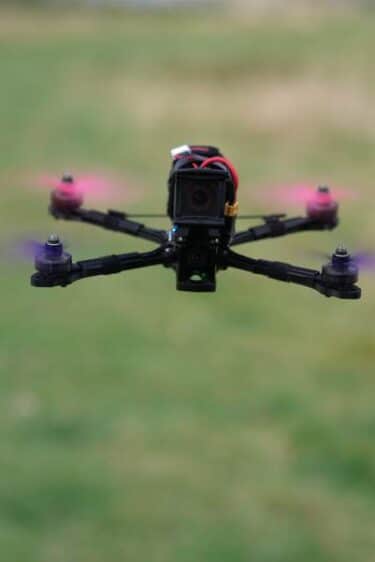
Some months before the Gatwick incident, the Journal of Aviation Technology and Engineering helpfully published a report (Wallace 2018) looking at how easily drones were spotted by ten of the most expert aviation eyewitnesses: well-briefed pilots. The authors asked their participants, ranging from student pilots to airline pilots, to fly past a drone and attempt to identify its location. The drone in question was over half a meter in size – so on the upper end of ‘prosumer’ drones – and had a bright strobing light on it.
The pilots weren’t told exactly where the drone would be, but they were aware to be on the lookout for a drone somewhere along their given route. Even with that briefing, they only successfully spotted the drone in 7.7% of the flypasts – even when they flew as close as a few hundred feet from it.
Should we therefore assume that there’s an order of magnitude more rogue drones than have been reported? Perhaps not. One night in November 2024, a helicopter of the UK’s National Police Air Service (NPAS) was operating in the vicinity of RAF Lakenheath, a military base that hosts United States Air Force (USAF) F15 and F35 strike fighter jets. The police helicopter spotted some flashing red lights orbiting the air base and, identifying them to be drones, reported them to the air traffic controllers.
The NPAS pilots gave chase to the lights – reaching above 5,000 feet in altitude and over 150 miles per hour in airspeed without catching them. Suddenly the lights turned straight for them! With only 400 metres between them and this rogue drone swarm, the police aircraft dived evasively before quickly departing back to the safety of their own home base. In the months afterwards, the UK Airprox Board (UKAB) collated reports, camera footage, radar and radio recordings from NPAS, the USAF controllers, and a third party; a USAF pilot.
Where the NPAS pilots reported a drone swarm hundreds of meters away, the radar recording showed a fighter jet in the same relative direction, but some kilometers away. Matching up the onboard cameras, it does turn out that in a shocking turn of events, the red lights orbiting an air force base were in fact atop one of the air force aircraft based there. While the police were in their epic chase of rogue drones to fantastic heights and speeds, the USAF pilot had been orbiting in an F15 waiting for a helicopter to get out of its way and allow it to land.
These police pilots are about as expert as aviation eyewitnesses can get, so how did they fall foul of such an optical illusion?
Drone detection difficulties
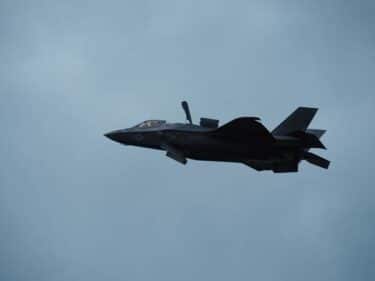
Anything in the sky is necessarily going to appear on a fairly featureless background, without other objects or structures of a known distance to compare against. Clusters of lights don’t have textures or other details visible enough to give a sense of their own size, nor do any aircraft until they’re close enough. Without these cues, even expert brains are unable to deduce a sense of scale of aerial objects – something small that’s flying nearby is indistinguishable from something big that’s flying far away.
The UK’s Civil Aviation Authority highlighted in its CAP1627 drone report that within London airspace there are 10,000 times more traditional aircraft movements than there are reports of drone sightings. Given the relative incidence of these events, it seems worth checking that any suspected drone sighting isn’t actually a full-size aircraft, just a little further away.
Finally though, if you gifted or received a drone for Christmas, making sure it’s flown according to the local drone code and well clear of any high-risk areas are two of the best ways of keeping it out of any drone sighting statistics.