

Like more than a billion people worldwide, I play games on my mobile device – specifically in my case, a Freecell solitaire-based game, in moments when I’m waiting for the kettle to boil or other short pockets of otherwise dead time. And given that it is a free game, I see a lot of ads.
Mobile game ads usually fall into one of several categories. There’re the ads for other games from the same publisher, which are usually fairly unobtrusive. Then there’re ads for legitimate (if not entirely unproblematic) companies like Apple TV and Amazon – the types of things you’ll see advertised on TV. Then there’re the ads for slightly less legitimate companies like Temu – often with deceptive ‘close’ buttons, which actually open a browser and then try to open or download the Temu app.
Then we get into more-scammy territory. Games like Royal Match or Township, or where you have to shoot hordes of advancing soldiers, or stop a widow from freezing by moving some sliders – games where the gameplay in the ad is largely unrelated to the majority of the actual game, and where progression halts at a certain point unless you make a micropayment. Or there are ads for games like Solitaire Cash, which claim that by playing games of Solitaire you could take home real money – that one got reported to the ASA pretty quickly.
And then there are the outright scam products – fake devices or supplements or other things that have absolutely no place being advertised to a mass market. Each are advertised via basic animations, still images with text claims, or often through videos – as talking heads, testimonials, or even comedy skits. Take an ad I got recently, which featured footage of some overweight women in their underwear transforming into slender women in dresses.
This woman instantly lost 15 lbs after quitting her diet. Here’s how she did it.
Meet Jennifer. She’s a vibrant 52 year old mother of two from Texas. for months Jennifer struggled with stubborn belly fat that appeared out of nowhere. But as the weight kept piling on, despite her best efforts, she realised she was being becoming the mom who avoided family photos. She was becoming the weird woman who wore baggy clothes everywhere because her favourite dresses no longer fit.
As you approach menopause your GLP-1 hormone levels could crash by up to 60%, forcing your body into Permanent fat storing mode. No diet or exercise can fix this hormone deficiency.
I recommended Ozempatch, the only natural patch that boosts GLP-1 levels while you sleep.
Within two weeks she dropped 8 pounds, without starving herself. Without brutal workouts, by week 6, she’d lost 18 lbs and was confident and glowing again.
Over 10,000 women have transformed their bodies by fixing their hormones with Ozempatch. So if you’re carrying a bit of extra weight that just won’t budge no matter what you do, it might just be your GLP one hormones crashing. Try Ozempatch this summer and reclaim your body just like Jennifer did.
The ad, which lasts around a minute, makes heavy use of AI-generated videos and most of the script is delivered by a white haired man in a white coat, whose name tag tells us is James Barkley MD. The product itself, OzemPatch, is made by a company called RejuvaCare, and claims to have a 4.5-star rating on Trustpilot based on over 700 reviews. The ad ends with the text, “The Fat Loss Secret Ingredients Women Are Raving About” – by which they mean cardamom, clove, white peony root, cinnamon, pepper seed, liquorice, tangerine pool, langan, and asparagus. All of which presumably gets squished into a patch that gets smooshed against your skin to produce miraculous results.
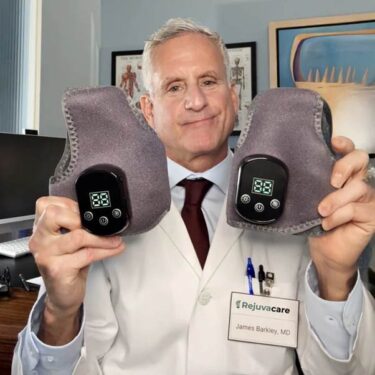
At least, I assume that’s its method of action because if you were to visit their website in the weeks after I spotted the ad, you’d have found Dr Barkley and Rejuvacare selling an electronic foot massager that claims to relieve foot pain and improve circulation to the feet. Dr Barkley appears prominently in their marketing with the product, but there’s no sign of OzemPatch – odd, given how revolutionary a topically-applied alternative to Ozempic would be. You’d expect more demand for weight-loss patches than foot massagers.
If you were to google Dr Barkley, you’d find there is little information online. He appears in an article on a website called BarChart, advertising the RejuvaKnee product he developed – which is like his foot massager, but for knees. The exact same story appears on the website of The Globe And Mail in Canada – a real and respectable newspaper. However, the story appears with the disclaimer:
This section contains press releases and other materials from third parties (including paid content). The Globe and Mail has not reviewed this content. Please see disclaimer.
And then there’s a result on TikTok for ‘Dr James Barkley Knee Relief’, which returns a range of videos showing people receiving knee physiotherapy, or icing their knees, or even having surgery – none of which involve our white-haired man in a white coat. That might seem odd, except under the Title section on TikTok, there’s an expanding box with the message:
Discover effective methods to relieve knee pain with Dr. James Barkley, a trusted knee specialist. Unlock healing techniques for long-lasting results! Dr. James Barkley knee specialist, knee pain relief exercises, chondromalacia patella treatment. This information is AI generated and may return results that are not relevant. It does not represent TikTok’s views or advice.
TikTok’s AI seems pretty ‘convinced’ that Dr James Barkley is a trusted knee specialist. But is he? With a little deeper digging, I was able to find Dr Barkley’s Facebook page, on which he appears standing in front of a lecture theatre of presumably medical students… all of whom have hideously melted faces, incredibly shiny plastic legs, and erratically shaped water bottles, while Dr Barkley has three fingers on one of his hands.
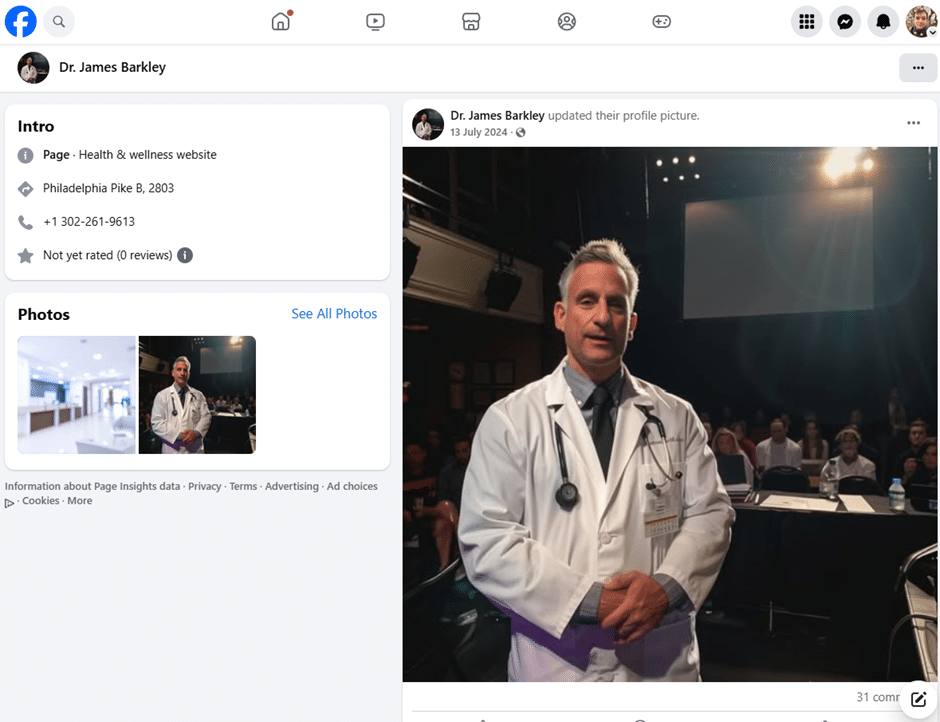
The image is obviously an AI fake. But the man in the video is clearly not AI generated – so who could he be? To answer the question, I saved a few frames of the video in which his face was clearly visible from a number of angles, and ran it through Pimeyes – a tool that uses images to identify people on the web. Our Dr Barkley had also been featured on an inbound marketing website, and a site called grandee.app, which is a collaboration platform that matches video creatives with brands to market.
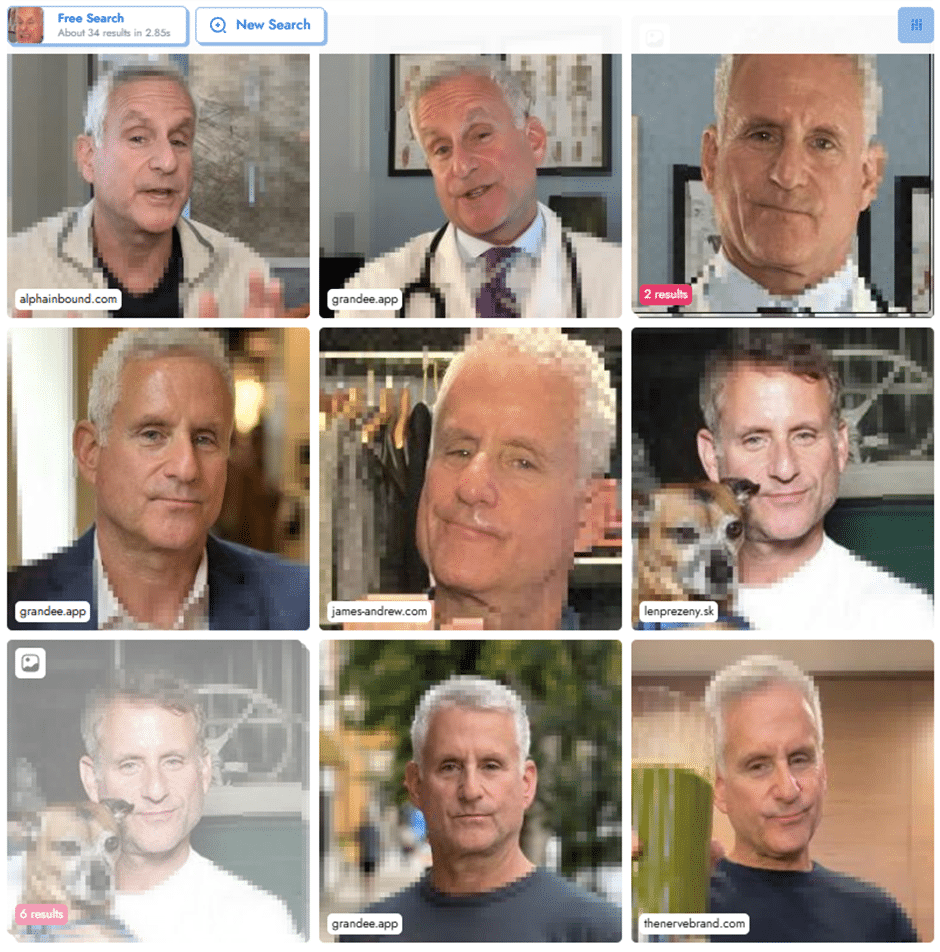
Dr James Barkley is not an actor. Dr James Barkley does not exist. The handsome white-haired gentleman in the white coat is named Steve, and he is an actor – I was able to track down his acting resumé on Backstage (via his successful amateur-swimming career with the Chicago Smelts swim team – including his appearance at the 1994 Gay Games).

His Backstage listing includes video examples of his work – such as his patient testimonial for the Red Wolf Prostate Supplement in which he explains that, as a 62-year-old man called Paul, he no longer has to get up to pee as often in the middle of the night thanks to this wonderful new supplement he’s taking.
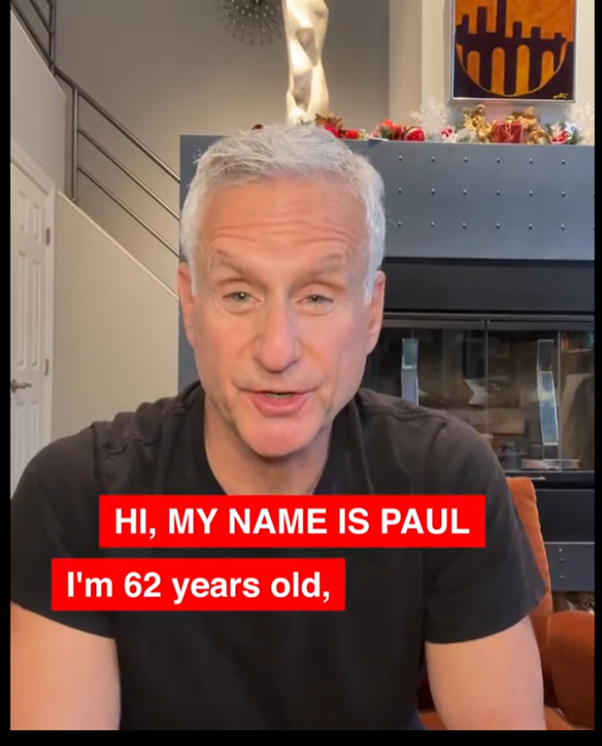
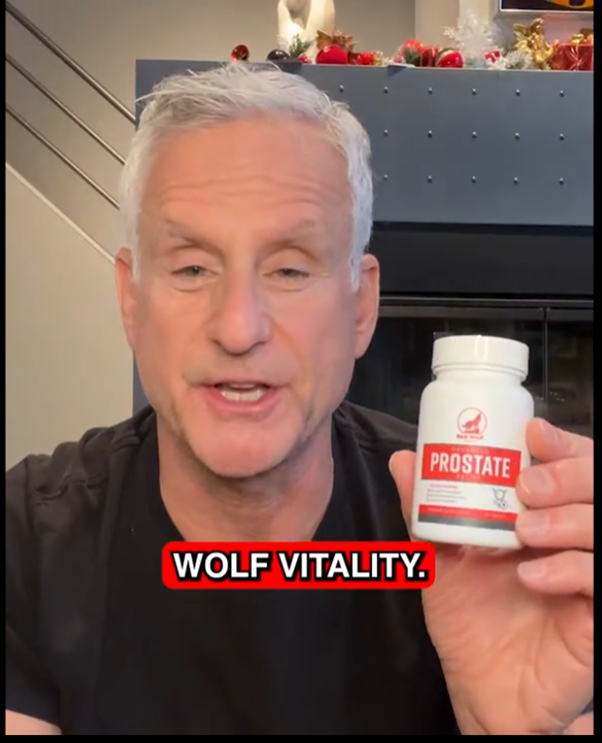
Other credits have Steve/Paul/James as a customer of Red Boost supplements, Hims erectile dysfunction medication, NuWave Corp air fryers, Lion Heart Marriage Coaching, Hootie Personal Safety Alarm for Women, Kara MD Pure IV, Cleanux Nasal Decongestant, HealthMale Nutritional Supplements, and something called “Govt $5200”. Whoever this actor is, it sounds like he has a lot of health complaints that have been miraculously cured thanks to the vast array of supplements he is happy to tell customers he relies on.
Each of these videos is listed on Steve’s resumé as UGC – ‘User-Generated Content’. Except, of course, they are not user generated – Steve is a paid actor pretending to be a patient, a customer, and even a doctor, in order to mislead viewers about his medical experiences to promote a range of products. These are presented as honest testimonials, but they are anything but – and, in my opinion, no marketing for any of those companies can be relied upon as being honest, given they are paying for fake testimonials. If you hear an ad read for Hims on your new favourite podcast any time soon, you’d be well placed to contact the host to let them know about these misleading ‘UGC’ testimonials from paid actors.
Over on Steve’s professional Instagram profile, more of these testimonials appear – including work for RhinoRope where he explained that being a dad in his 50s means it’s hard to find time to exercise, but his new skipping rope burns calories and builds muscles fast. He even shows off his impressive muscles – which, arguably, might be less to do with the expensive skipping rope and more the result of a competitive swimming career of over 30 years (he even won bronze at the 2022 US Masters Swimming Spring Nationals in San Antonio, Texas).
Elsewhere on his Instagram, that white coat makes another appearance – though this time his name badge reads “Graham Bennett” and he’s promoting a new device to help get oxygen to the nerves in your feet. In fact, in the video he specifically says:
You’re probably thinking, who’s this guy talking to me about neuropathy? Hi, My name is Dr Graham Bennett, helping people relieve pain through non-invasive natural solutions. I got fed up of seeing my patients rely on risky surgeries or addictive pain pills to manage their foot pain. SI I teamed up with my friends at a small healthcare company called Naxir. together we were able to come up with a simple yet effective at home solution that’s able to provide consistent relief from neuropathy pain
Steve seems quite proud of that white coat, as versatile and multi-purpose as it is, able to fit a range of personas, identities, and false medical qualifications. He even lists it on Backstage as part of his self-recording service:
I shoot with an iPhone 16, ring lights, tripods, wireless mic, wired mic, podcast mic and green screen. I also can meet any wardrobe request you have. I Own a complete doctor’s wardrobe including a stethoscope.
I reached out to Steve via email to ask him whether he held the medical qualifications he professed in the ads, and if not, whose idea was it for him to impersonate a doctor in his ‘user generated content’. I received no reply.
So, what’s the point in all of this? Well, firstly it is: don’t buy Ozempatch from Rejuvacare – but you can’t anyway, because the places listing the product a few months ago no longer do, and the Rejuvacare website is retooled around a different product now. This was just another example of SEO-juicing affiliate marketing – the latest extension of which is fake “User-Generated Content” filmed by paid actors and influencers, whose videos are dishonest to the point of outright fabrication.
And, obviously, don’t trust anything advertised by Dr James Barkley or Dr Graham Bennett, because neither of those men exist – they’re both alter egos of a Chicagoan actor who should have stuck to the swimming pool.
Ultimately, something is fundamentally broken in the way products are advertised online, and the way those adverts are regulated. Ads like these fall under the remit of the Advertising Standards Authority, whose job it is to regulate them. But regulation is not straightforward, because these mobile ads are constantly awash with these kind of misleading claims and scam products, yet when any action is ever taken, it’s taken against the company selling the product, which is told the ad must not run again – which it wouldn’t, because the fake company has changed its website and moved on to a different scam product. They have nothing to fear from a regulatory wrist slap.
If a newspaper were to publish an ad for a scam product, the product manufacturer would be held responsible for the ad’s claims, but the newspaper would also be at fault for publishing it without vetting – if the newspaper continued to do so, they’d find themselves in hot water, reputationally and regulatorily. Similarly, if Channel 4 were regularly selling TV-advertising screen time to scam weight-loss supplements, Channel 4 would be feeling the force of the regulator just as much as those scam supplements.
But when it comes to who is responsible for scam ads in mobile games, there is a third party that has responsibility without any accountability: the ad delivery network, which is the infrastructure that serves ads within games. These act as a broker between advertisers and publishers – in this case, they find advertisers to fill ad slots within mobile games, and take a cut of the publisher’s profit as a fee.
When regulators take action, they can rule against the advertiser, and they may be able to tell the game not to publish that ad again. This is useless, since the scam company behind the product has already stripped their site and brand down for parts and replaced them with a different promotion of a different scam product under a different name – one that goes on to create other misleading ads, until that scam runs its course.
A fatalist would argue this is like playing whack-a-mole, where the regulator is always one step behind the scammer. But that comparison completely overlooks the role of the ad network. Those moles aren’t finding their way to your garden by themselves, they are being released there by mole handlers, who make money for every mole they release, regardless of what a mess they make of your vegetable patch. And we can catch every mole and flatten every molehill, but all that effort is futile if those metaphorical mole handlers aren’t stopped. According to one complaint handler at the ASA, holding these platforms to account is outside their remit.
In this age of Big Tech, there has been an ever-advancing project to centralise resources and reach, while decentralising accountability. But we cannot allow tech companies to tell us they’re helpless to stop the misinformation they’re spreading, which they profit from spreading.
If we want to stop scam ads filling our phone screens every time we pause for the kettle to boil, we have to make sure that the people serving us those ads feel some of that heat.