



This article originally appeared in The Skeptic, Volume 7, Issue 1, from 1993.
Current historical evidence gives no indication of regular playing-cards being used for card games in Europe before 1377, and no mention of Tarot cards before 1440. In fact, Tarot cards were designed for play, and not for telling fortunes. There are many variations of the Tarot game, and hence variations of the Tarot pack.
The practice of telling fortunes by means of ordinary playing cards was not heard of in Europe until the eighteenth century. Exceptions were the use of playing cards drawn at random used as indices into a book containing prophecies (dice would have done just as well), and a special fortune-telling pack which was devised in England at the end of seventeenth century.
In the 1780s, when the practice of fortune-telling with regular playing-cards had been well established for at least two decades, the use of the Tarot pack for cartomancy began. It was confined to France for the next century before spreading to other countries.
The Tarot Pack >>>
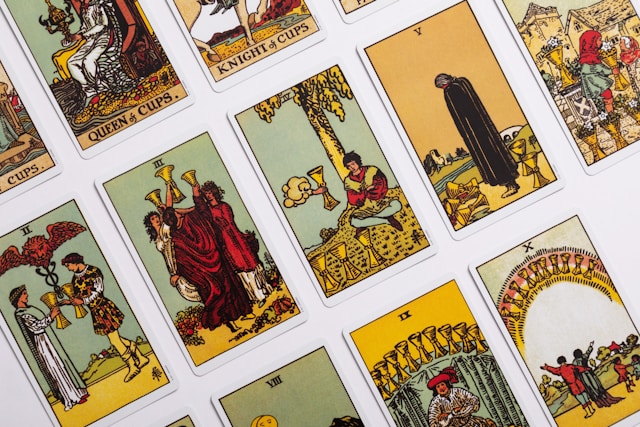
There are many variations of packs used for playing the game of Tarot, some with as few as 42 cards and others with as many as 97. All of them have sprung from the 78 card pack which contains 56 suit cards (1-10, king, queen, knight and jack) and 22 picture cards not associated with any suit. Of these twenty-two cards one is called ‘The Fool’ and is un-numbered with the remaining twenty one numbered with Roman numerals from I to XXI. These cards are called tarocchi in Italian (where the game originated somewhere between 1420 and 1440) which became tarau in French and was anglicised to tarot. During the fifteenth century these cards were also referred to as carte da trionfi, that is cards with triumphs (the triumphs, or trumps, being the 22 picture cards) – strictly speaking tarocchi cards are the trump cards only, excluding the suit cards. A sixteenth century treatise on card games explains that sometimes one plays with extra cards called tarocchi and sometimes without them.
The beginning of the occultist tradition
The entire occultist Tarot tradition stems from the work of Antoine Court de Gebelin (1719-1784), a Protestant pastor, Freemason and savant. Between 1773 and 1782 he published by private subscription the first nine volumes of a huge work entitled Le Monde Primitif. All of this work is now forgotten, except for his essay on the Tarot pack published in the eighth volume in 1781.
At the time de Gebelin was writing, the Tarot pack, and the games played with it, had been known in France for two and a half centuries. However, card-playing traditions in France were highly localised, and the game was at that time quite unknown in Paris (de Gebelin’s home).
De Gebelin discovered in these, to him, very exotic cards, symbols of the ancient Egyptian religion. He concluded that the pack had been invented by ancient Egyptian priests, and that it contained a symbolic representation of their doctrine, and was in fact a seventy eight page book.
At that time Egyptian hieroglyphics had not yet been deciphered by Champollion; nevertheless de Gebelin concluded that the word ‘Tarot’ means ‘the royal road’, being derived from ancient Egyptian ‘tar’ meaning ‘way’ and ‘ro’, ‘ros’ or ‘rog’ meaning ‘royal’. Neither word can be found in any classical Egyptian dictionary.
The clever disguise of the Egyptian priests’ teaching had ensured its preservation through the ages, and card players had been innocent dupes in its perpetuation. He added also that the twenty two triumphs (picture cards) correspond to the twenty two letters of the Hebrew alphabet.
De Gebelin appended to his own essay one by another (anonymous) author which contributed more to the Tarot pack’s subsequent mythology. He calls the pack the ‘book of Thoth’ and gives a different, equally spurious, etymology to the word ‘Tarot’. His major contribution is to introduce the association of Tarot cards with fortune-telling. He ascribes this practice to the ancient Egyptians, without offering any evidence, and describes a method of divination using the cards which purports to be a method used in ancient Egypt. Further, he associates the Gypsies with the Tarot pack and its dissemination throughout Europe. The Gypsies did not originate from Egypt, but when they arrived in Europe they had given themselves out to be a group of persecuted Egyptian Christians, and they were generally accepted as such until their Indian origin was established by a philological study of their language.
These absurd conjectures would have been as quickly forgotten as the rest of de Gebelin’s works had it not been for a professional fortune-teller calling himself ‘Etteilla’ (his real name was Alliette). Etteilla practised his trade in Paris from 1770 until 1791. Fortune-telling, particularly by means of playing-cards, began to achieve a vogue in Paris during the period preceding the Revolution and continued during the Revolutionary and Napoleonic eras. Etteilla published various works (in 1770, 1773 and 1782) describing his method of fortune-telling using a 32-card piquet pack. It was he who (inspired by de Gebelin) invented in 1783 a method of cartomancy involving the use of the Tarot pack and published extensively on it between 1783 and his death in 1791.
From 1783 onwards Etteilla offered for sale a ‘corrected’ Tarot pack, the first in a long line of Tarot packs designed specifically for cartomancy. And in 1788 a society for Tarot cartomancy was formed (Société Littéraire des associés libres des interprètes du livre du Thot). Etteilla’s work laid the foundation of a tradition which survived well into the second half of the nineteenth century.
Various practitioners carried on after Etteilla’s death, all of whom could not resist publishing their own interpretation of the cartomantic Tarot pack. And so it was that the tradition started by Etteilla took on an independent life. The designers of these various cartomantic Tarot packs did not go back for their inspiration to the traditional Tarot cards which Etteilla had ‘corrected’. Instead they based their interpretations on the cartomantic significance of the cards or on their own imaginations to give a Biblical, Egyptian or mediaeval flavour to their cards. Those who bought the cards were probably not aware of the traditional use of the Tarot pack for play, nor of the romancing poured out by Etteilla in his publications. Without Etteilla it is possible that no one would have decided that the Tarot pack was a suitable tool to use for divining the future.
New Impetus for the use of the Tarot pack
The association of the traditional Tarot pack with the occult received a new impetus with the publication in 1855 of Le Dogme de la haute magie by Alphonse-Louis Constant using the name of Eliphas Lévi. In 1856 he published Rituel de la Haute Magie; from these two books (and the stream of related books he followed up with) the whole of the modern occultist movement has its roots.
Lévi’s business was magic. His thesis was that the classic works of occult literature state, in symbolic language, the existence of a universal agent he called ‘magnetised electricity’, which ‘profane science’ has investigated under four of its manifestations – heat, light, electricity and magnetism – but which has other manifestations, in the form of magical phenomena. This agent is elsewhere called by Lévi ‘the Great Magical Agent’ and ‘the Astral Light’. It ‘has a direct action on the nerves’, and can conversely be directed by the will. This is the explanation of all the classical magical phenomena: by operating on the Astral Light, the adept can call up apparitions of the dead, render himself invisible by making others unable to see him, predict the future, convert base metals to gold, revive the recently dead, cure illnesses, control the will of others, etc.
Why did Eliphas Lévi achieve a success far beyond any of his predecessors? Perhaps because his options were easiest. One wasn’t required to become a Freemason or join any other of the various secret orders. One did not have to participate in esoteric religious rites. Magic was not presented by Lévi to his readers as a mystery which he could only partially disclose and they would be able to penetrate only with difficulty – for the most part he claims to have discovered all and to be revealing all. He didn’t require that those accepting his teachings changed their lifestyles or abandon their religious belief. Lévi’s magic was ‘all in the head’. The emphasis was on the theory, not on the practice; the theory sounded grandiose, but amounted to little that would commit one to any definite belief or course of action.
Lévi’s magical symbolism and doctrines are borrowed from the standard sources of European occultism since the Renaissance; the Cabala, alchemy, the Hermetic books and astrology. At the same time he passed by existing scientific and historical knowledge, since he was completely unconcerned with rational considerations; no attempt at all was made to square the current state of knowledge of science and history with those elements forming the basis of his doctrines.
To this mish-mash, Lévi added one new ingredient – the Tarot. He took over from de Gebelin and Etteilla the theses that the Tarot pack was of immense antiquity and embodied a symbolic representation of a body of profound and ancient wisdom. He dated the Tarot as belonging to long before Moses, from the time of Enoch. And since the ‘Egyptian Tarot’ designed by Etteilla had been debased by being taken over by professional cartomancers it was necessary to return to the traditional Tarot pack. Since he was unaware of the history of the Tarot pack (modern techniques of historical research are now applied to playing-cards as to other printed ephemera but results of this work have been published only from the 1960s onwards) his idea of the ‘traditional Tarot pack’ was the Tarot de Marseille.
The Occult Tarot Pack >>>
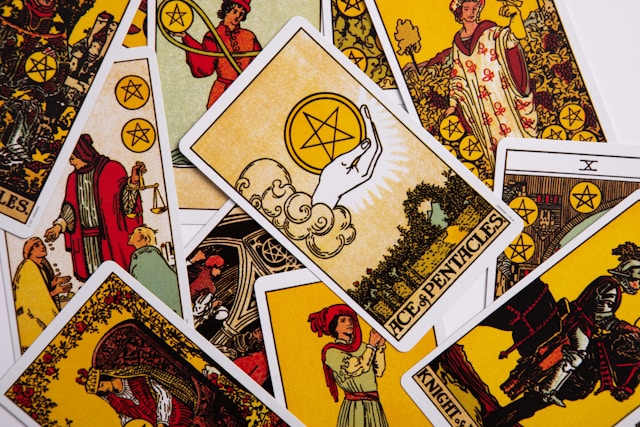
A Tarot pack designed for fortune-telling has four suits consisting of Swords, Batons, Cups and Coins. These suits are the traditional ones still in use in Italy today for playing local games and are the oldest European suit system (the Hearts , Clubs, Diamonds and Spades with which the French, English and Americans are so familiar were probably not thought up until the 1470s). In the occultist tradition the Batons will be called Wands, and Coins will become Pentangles. The suit cards are collectively called the ‘Minor Arcana’.
The term ‘Major Arcana’ is given to the remaining 22 cards. One card is un-numbered and shows the Fool. The subjects most usually depicted on the remaining twenty one numbered picture cards are as follows:
- I: the Bagatto (Mountebank) (aka Magician)
- II: the Popess (aka High Priestess)
- III: the Empress
- IV: the Emperor
- V: the Pope (aka High Priest/Hierophant)
- VI: Love (or the Lovers)
- VII: the Chariot
- VIII: Justice
- IX: the Hermit
- X: the Wheel of Fortune
- XI: Fortitude
- Xll: the Hanged Man
- XIII: Death
- XIV: Temperance
- XV: the Devil
- XVI: the Tower
- XVII: the Star
- XVIII: the Moon
- XIX: the Sun
- XX: Judgment
- XXI: the World
Artistic licence is often employed and the designs used in modern occult packs may be of different subjects altogether. Variations of the game of tarot flourished in various northern Italian cities during the fifteenth and sixteenth centuries, among them Milan. As a result of the French occupation of Milan the game spread to France and Switzerland and was extremely popular in France during the sixteenth and seventeenth centuries. The principal standardised set of designs is those originating from Milan but called Tarot de Marseille since that town became one of the major manufacturers of the pack. From the late fifteenth century the triumphs were numbered. The French manufacturers added the inscriptions at the bottom sometime during the eighteenth century.
Lévi was not primarily concerned, like Etteilla, to promote the use of the Tarot pack for fortune-telling or to set himself up as a cartomancer. They could be put to this use, but it was a secondary one:
An imprisoned person with no other book than the Tarot, if he knew how to use it, could in a few years acquire universal knowledge, and would be able to speak on all subjects with unequalled learning and inexhaustible eloquence.
For Lévi, the Tarot was a source of magical doctrine and symbolism, like the works of the Cabalists and the Hermetic writings: more, it was the key to these, the ‘universal key of magical works’. This key, lost for centuries, Lévi himself had recovered, and thus had been able ‘to understand the enigmas of every sphinx and to penetrate all sanctuaries’. Lévi referred to the Tarot throughout all of his writings – the Renaissance theorists of magic would have been amazed to see a mere, and familiar, pack of cards elevated to this rank, but to Lévi (another Parisian) as to de Gebelin this pack was not a familiar one.
Lévi’s work struck a note with the public and initiated a boom in occultist writings. The result was a wide dissemination of his neo-occultist teachings and of his school.
The occult Tarot in Britain
The transmission to Britain of French neo-occultism and, with it, the Tarot mystique, took place during the period 1886-1911. In other Western countries, with the possible exception of Italy, the phenomenon belongs strictly to the twentieth century. The introduction of Tarot occultism into Britain is largely bound up with the Hermetic Order of the Golden Dawn. This order was set up by Dr Wynn Westcott (1848-1925), a doctor and coroner and a magician in his leisure time using a manuscript written in alchemical cyphers and some German letters ostensibly from the Orden der goldenen Dämmerung as authority for doing so. All the documents were latter proved to be forgeries perpetrated by Westcott or someone else.
The brand of magic to which it subscribed was that of Eliphas Lévi and his followers – the familiar blend of Hermeticism, the Cabala and the newly created Tarot mystique. The Order purported to be in the direct line of succession from the original Rosicrucian brotherhood, and Rosicrucian symbolism was prominent. It established temples in London, Bradford and Weston-super-Mare and, later, Edinburgh, Paris and Chicago. The Tarot symbols played a large part in the teaching, rituals and practices of the Golden Dawn.
A.E. Waite, a prominent member of the Golden Dawn, translated sections of the work of Lévi and published it in London in 1886 under the title The Mysteries of Magic. The first original publication in Britain concerning Tarot occultism and cartomancy was by S .L. Mathers (1854-1918) who had no career outside magic and appears to have supported himself principally by sponging from others. Mathers refers to de Gebelin, Etteilla, Eliphas Lévi and others and borrows ideas from all of them; his original contribution was to establish the occultist nomenclature of the Tarot cards in English.
An Explanation of the Symbols Shown? >>>
One extremely plausible explanation for the composition of the triumphs is that the name refers to the characters depicted taking part in a triumphal procession. Such processions were a favourite entertainment in the courts of Renaissance Italy; the floats would bear figures derived from classical mythology or representing abstractions such as Love and Death. The poem I Trionfi (the Triumphs) by Petrach (1304-1374) took the idea a stage further. Each successive personified abstraction triumphs over the last; love triumphs over gods and men, chastity over love, death over chastity, fame over death, time over fame and eternity over time. It is possible that similar ideas give rise to the characters traditionally depicted in the Major Arcana and their relationship with each other.
He referred to the Batons suit as ‘Sceptres’ (later ‘Wands’ would overtake this in popularity) and the Coins suit ‘Pentangles’. The use of the term Pentangles is interesting since there was, at that time, no pack existing with a suit consisting of five-pointed stars. Lévi had been fond of the word pantacle meaning an occult symbolic design or emblem and since he followed Etteilla in regarding the Coins as representing magical talismans, he sometimes applied the word pantacles to the cards of that suit. In his translations from Lévi, Waite simply left pantacles unaltered as ‘pantacles’. Lévi had not meant by pantacle a five-pointed star (he used ‘pentagramme’ when he did) but Mathers seems to have misunderstood the word ‘pantacles’ in Waite’s translation of Lévi and used ‘Pentangles’ instead. Thus it was that the five-pointed star found its way into cartomantic Tarot packs.
![A black and white portrait photograph of a standing man, showing him from the knees up. He is looking directly at the camera and dressed in a white shirt with formal dark frock coat, and on his head is wearing a dark cylindrical cap. The cap has a winged badge on it, and there are many medals and decorations on the shirt and coat. A wide ornamental chain or ribbon hangs around the man's neck. In his right hand he is holding a short thin staff or cane, and a sword hangs at his left hip by his left hand. Some handwritten text and symbols on the left hand of the photograph are as follows: An XII ☉ in ♑ [cross] Baphomet X° O.T.O. R.S.S. Ireland Iona and All the Britains.](https://www.skeptic.org.uk/wp-content/uploads/2026/06/250pxAleister_Crowley_as_Baphomet_X°_O.T.O.jpg)
Image via Wikimedia Commons
Mathers took over leadership of the Golden Dawn upon the death of Dr William Robert Woodman (the third founder of the Order along with Mathers and Westcott), and moved to Paris. In 1900 the society fragmented due to the wranglings which resulted from Aleister Crowley (1875-1947) being refused admission to the inner orders by the London temple but being granted it by Mathers at his Paris temple. Further wranglings and scandals led to mass resignations and further fragmentation of the Order. It all became rather sordid and silly; when two leading women quarrelled with each other they conducted a magical battle with each other, the chief weapon in which appears to be the manifestation of demonic cats.
During these upheavals Arthur Edward Waite continued his career as a writer on occult subjects, and came to be the principal British exponent of the Tarot mystique. In 1910 he wrote The Key to the Tarot to accompany a pack in art nouveau style designed to his instructions by Pamela Coleman-Smith. This pack has suits of Wands and Pentangles; pentagrams appear on the latter suit sign – he had perpetuated the mistake which his erratic translation of Lévi had been unintentionally responsible for. Many of the cards incorporate quite unwarranted occultist features into their design. For example, the Wheel of Fortune loses completely its original symbolism, which had already been obscured in the Tarot de Marseille; instead of four men, one at the nadir of his fortunes, one ascending, one at the zenith, and one descending, as the Wheel revolves, we now have a sphinx perched at the top of a wheel not obviously in motion, with the serpent Typhon on the left and the dog Anubis at the right, and at the four corners of the card are the symbols of the four Evangelists.
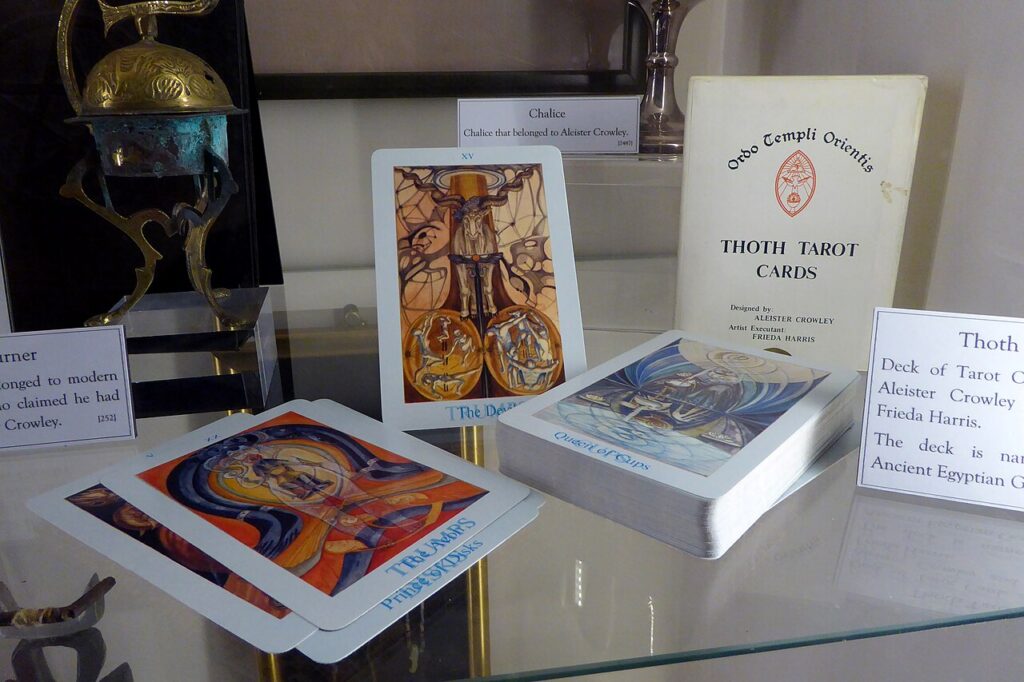
In 1944 Aleister Crowley published (under the name of Master Therion) a book entitled The Book of Thoth. This book contained plates of very florid Tarot designs made to his instructions. This book, in common with most of the others discussing the occultist Tarot pack, attempts to throw light on the question of which Hebrew letter should be attributed to each of the Major Arcana and in which position the Fool should be ranked in among the other members of the Major Arcana. It is worthy of note that each author disputes the findings of all others; there is no consensus.
We will end our look at modern Tarot writers with Mr Crowley, who you will be glad to know achieved his ambition of attaining the highest rank in his Order. Since there was no one of suitable rank who could initiate into this exalted grade, he initiated himself; the ceremony which made him a Magus involved the baptism, crucifixion and subsequent eating of a frog.
Many other writers have contributed to the subject of the occultist Tarot since. In fact, in the popular consciousness, it now appears that the Tarot pack belonged to the occultists from the beginning. Walk into any bookshop for remaindered books today and you are almost bound to find a book explaining the ‘Mysteries of the Tarot’ and how Tarot cards may be used for their true purpose of divination. You will be told how the origins of the Tarot have been traced back to the Egypt of the Pharaohs. No proof will be offered of these assertions, none of the careful methods of current historical research will be deemed necessary to be applied. There will be no searches of proclamations banning their use (taking care to return to the original documents and retranslating them), no careful perusal of contemporary written and oral traditions for mention of them, no careful sifting of inventories forming part of wills or taxes, no careful dating of artwork illustrating their use, no perusal of the records of the manufacturers, no look at the revenue raised by tax-stamps. And yet playing-card historians are doing all of these things and increasing our knowledge yearly. Eliphas Lévihas truly left us a most dreadful legacy – that of ignoring any facts inconvenient to the theory you wish to put your trust in. It is hardly surprising that the cartomantic Tarot pack is popular with ‘New Age’ thinkers.
This article could not attempt to give more than an outline at the theories of the occultist Tarot writers in the space available. Nevertheless, it should have become apparent that occultist theories of the Tarot are simply inconsistent with the ascertainable facts about the history of the cards.
Notes
Anyone wishing for an excellent introduction to this fascinating topic is urged to read The Game of Tarot by Michael Dummett (Duckworth, 1980, ISBN 0-7156-1014-7) upon which this article draws heavily.