




This article originally appeared in The Skeptic, Volume 6, Issue 5, from 1992.
A story worthy of the pen of American writer Edgar Allan Poe was enacted in real life just over one hundred years ago. The story of the world’s greatest mind-reader, Washington lrving Bishop, has the same ingredients of terror and horror that earlier had existed only in the fertile imagination of the author of The Raven and Tales of Mystery and Imagination.
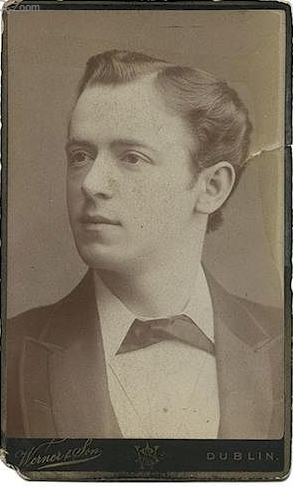
His family and close friends called him lrving, but I will refer to him as Bishop. Bishop was born on Lower Broadway, New York City, on 4 March, 1856. His father, Nathaniel Coney Bishop, was always described by Bishop as an eminent lawyer, when he was, in fact, a travelling salesman with too great an affection for strong drink.
Bishop’s mother, Eleanor Fletcher Bishop, was one of America’s earliest spirit mediums. Bishop inherited from Eleanor a most unfortunate and rare illness. They both suffered from hysteria-catalepsy. This meant that at any time they could collapse and fall into a deep trance. This trance would be so deep that no signs of life could be found – the breathing too shallow and the pulse too faint to detect.
Bishop had a genuine fear of dissection while he was in one of his trances. Because of this, he always carried a paper with the following message written upon it:
To whom it may concern: If I am found apparently dead, do nothing to me for 48 hours. I occasionally fall into a state which resembles death, but which is merely a trance. Get me to bed, keep my body warm; and have patience. Under no conditions let a surgeon’s knife touch me, do not apply electricity to my body, and do not place my body on ice.
Bishop suffered a very severe cataleptic fit on one occasion and was pronounced dead by several doctors. In spite of this, he recovered after 48 hours. No wonder Bishop has been called ‘The man who died twice’.
Bishop was educated at St. John’s College in Fordham, New York, and started work at the age of 16 as a clerk in Hudnut’s Drug Store. He later had a job at the New York Customs House. He became very interested in magic and soon became proficient at sleight of hand with cards, coins and other small objects. This, coupled with his inside knowledge of the shady side of spiritualism, qualified him admirably to get a job working with the famous stage medium, Anna Eva Fay.
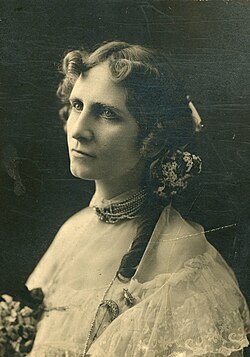
Anna was a baffling sensation wherever she appeared. She was a vivacious performer who had more than her fair share of self-confidence. She was a slender woman with grey eyes and curly blonde hair, always superbly dressed and invariably wore half a dozen glittering diamond rings. Anna’s act was explained and illustrated in 1883 by John Truesdell in his book The Bottom Facts Concerning the Science of Spiritualism. Her speciality was the Cotton Bandage Tie. A committee from the audience would tie Anna’s Wrists behind her back. She then sat on a stool and her tethered wrists were secured to a ring in a post behind her. Her neck was tied to another ring higher up the post to prevent her bending forward. Finally, her ankles were tied together with a length of rope which was then trailed out to the audience for someone to hold.
Anna’s husband, Henry Fay, placed a selection of musical instruments on her lap, asked for the gas-light to be turned down and a curtain was drawn in front of her. Then, bells rang, a guitar was played and a tambourine was tossed over the curtain. The curtain was whisked away and Anna was found securely tied exactly as before.
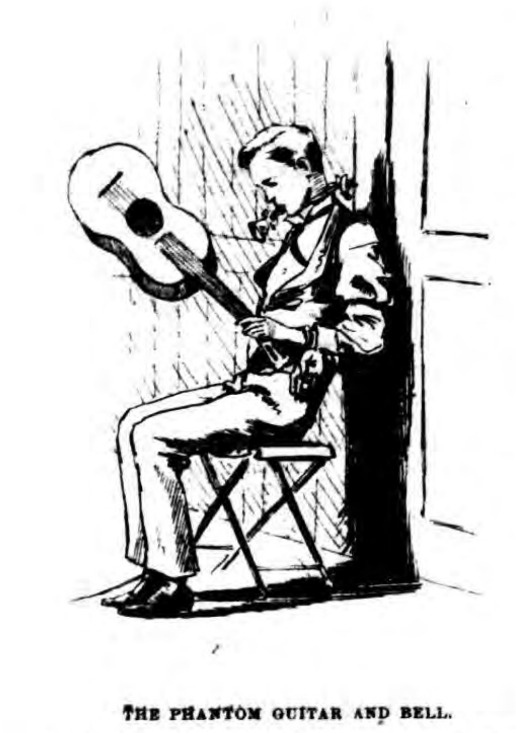
Image: Daily Graphic, New York, 12 April 1876, page 342
Truesdell explained how these effects were accomplished: Anna was always tied the same way so that she could manoeuvre both wrists to one side of her body to play the instruments. In some of the tests, Anna allowed a spectator to sit behind the curtain and to put one hand on her head and the other on her knee. Bishop worked with Anna for two years but then they quarrelled over money and Bishop left the show. Shortly afterwards, Bishop gave private performances of the Cotton Bandage Tie, but he made his shows an expose of spiritualism, showing how the effects were accomplished.
In 1876, he wrote a devastating expose of Anna’s act and sat for eight illustrations for an article which appeared in the New York Daily Graphic. For shows in private houses, the bandages were tied to two iron staples which had been hammered into a door jamb.
As well as having an inside knowledge of spiritualism, Bishop knew about a new development in mind-reading. In the early 1870s, he had seen performances in New York of the pioneer of contact mind-reading, John Randall Brown. John Randall Brown was born on 28 October, 1851 in St. Louis, Missouri, and his efforts definitely predate Bishop’s work in this field, although some have suggested the opposite to be true. Brown’s most impressive stunt was to have a member of the audience hide a pin anywhere in the theatre. Then, wearing a blindfold, he would grasp the wrist of the hider of the pin. The two of them would then move around about a minute or so until the pin was found.
The effect was genuine (no confederates were involved) but not psychic. Brown depended on the very slight but detectable unconscious movements of the spectator. All that was necessary was that the spectator should actively will the performer to succeed. The basic idea of unconscious muscular pressure had been proved experimentally by one of the greatest scientists of all time – Michael Faraday – in England in 1853 in connection with the spiritualistic craze of table-turning.
Bishop’s own first theatre performance was at Chickering Hall, New York on Thursday 18 May, 1876. Bishop was described as ‘a young man, slightly but symmetrically built, of lithe carriage, and with a face denoting intelligence and quickness of thought’. Bishop, clean-shaven at this stage of his career, was only 5 feet 5 inches tall. He could be the most charming man in the world. I quote: ‘his wit was boundless and like lightning in its swiftness.’ In short, he was more than a match for skeptical spectators. He showed all of Anna Eva Fay’s tricks under the glare of the calcium lights. The New York Times of 10 June said that after Bishop’s shows the ‘spiritualists might as well give up.’
I have a programme of Bishop’s for December 1877 in which he appears as ‘The Renowned AntiSpiritist and MindReader’. So, by then, he was using Brown’s contact mind-reading.
Now, there was something contradictory about Bishop going around exposing spirit mediums, while his mother, Eleanor, was still giving seances. He solved the problem by sailing to Great Britain. Bishop’s first performance in Britain was on 16 January, 1879 at the Edinburgh Music Hall. Here, and later in Glasgow, Bishop played to packed theatres, and eminent Victorians were beginning to take notice. For example, Sir William Thomson –the distinguished scientist who later became Lord Kelvin – gave Bishop a testimonial to the excellence of his performance.
While he was in Scotland, he published in Edinburgh in 1880 a 78-page booklet for sale at his performances entitled Second Sight Explained. It was actually ghost-written (!) for him by a journalist on the Glasgow Evening News called Frederick Wicks. It exposed the verbal code used for two-person second-sight acts, such as the one made popular by Robert-Houdin.
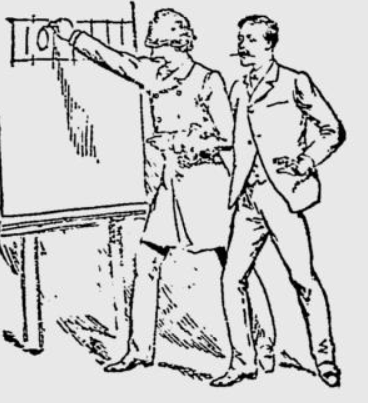
Alas the illustration of Bishop searching for hidden objects is unavailable to this website now.
The illustration comes from a series of drawings from The Graphic and shows the blindfolded Bishop searching for hidden objects. Note also the blackboard test. He used contact mind-reading to find the serial number of a banknote that was being thought of by a spectator. Bishop had a profound effect on a number of prominent scientists – who ought to have known better. For example, he performed a number of shows in Lancashire. He was in Manchester in October 1882 and Liverpool in January 1883. At this time he was having trouble with his catalepsy and was described in Liverpool as a ‘full dress-coated skeleton’, but he still held the large audiences in the palm of his hand.
Two young ladies, Miss Ralphs and Miss Edwards, saw a Bishop performance in Liverpool and afterwards experimented in thought transference. They later convinced Oliver Lodge that telepathy was real. As a result of this, he became a leading spiritualist along with Arthur Conan Doyle. They were both later knighted on the same day in 1902.
The Member of Parliament of the day for Northampton and editor of the weekly crusading paper, Truth, Henry Labouchere, had a more healthy skepticism, though. He bet his £1000 against Bishop’s £100 that Bishop would not be able to reveal the serial number of a banknote that he himself had sealed in an envelope. Bishop arranged a special performance on 12 June, 1883 at St. James’s Great Hall in London.
Before the event, they disagreed over who should be the spectator who knew the serial number. Bishop did not believe that Labouchere would actively will him to find the number because of the bet, and Labouchere wanted to make sure that there was no confederacy, as he would be the only one who knew the number. On the day of the test, Labouchere failed to turn up, but Bishop went ahead with the performance and found the number on someone else’s note. A fire balloon was released outside the theatre to signal the success.
After the Labouchere challenge performance, Bishop had thousands of copies of a booklet called The Truth, whose cover and layout closely resembled Labouchere’s paper Truth. One of the articles in the spurious paper said:
In London [a] dastard plot, which for ever cover John Nevil Maskelyne and Henry Laboucbere with infamy, was being hatched… The plot was as simple as its villainy; to bring the well-known and highly respected gentleman, Mr William Ladyman… to ruin… It was to bribe Mr Ladyman… to declare that he had been guilty of fraud. Now then, let John Nevil Maskelyne, whom I unqualifiedly stigmatise as a man devoid of honourable instincts, bring forth this proof… By the best advice procurable at the highest bar, I am assured that with the proofs of infamy in my possession I can hold John Nevil Maskelyne criminally liable and make justice punish him.
Maskelyne sued Bishop for libel and the case was heard on 15 January, 1885. Bishop was the one not to turn up this time, but this did not stop the jury agreeing on damages of £10,000 in favour of Maskelyne. This was truly a massive fortune in 1885. However, Bishop was never made to pay, since he had left Britain in 1884 for the continent and, of course, he was never to return.
After his tour of the Continent and Russia, Bishop returned to the United States. Here, he found that people had still not forgotten his libel against Maskelyne and was finding bookings difficult to come by. So, he came up with the finest publicity stunt of his career – that of driving a horse and carriage at full pace, though wearing a blindfold and searching for a hidden object, through the streets of New York. The publicity stunt worked and Bishop packed the theatres once again.
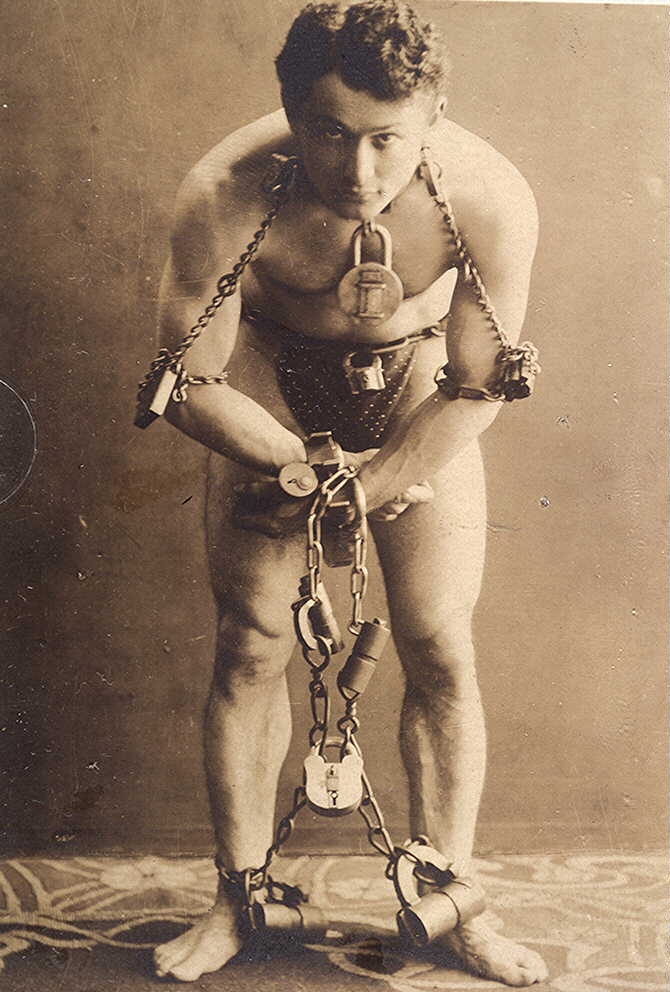
At about this time, an ambitious 15 year-old by the name of Ehrich Weiss was taken into Martinka’s Magic Shop in New York by his friend Joseph Rinn. While they were there, in walked Washington Irving Bishop. So, two of the greatest wonder-workers of all time met briefly – Bishop, coming to the end of his career, although he did not know it at the time, and Ehrich Weiss, just starting out on what was to be a most dazzling career as Houdini.
Bishop gave his last performance at Lambs Club, New York, on Sunday 12 May, 1889. During this, he fell into the very deepest cataleptic trance and had to be put to bed at the club. He was pronounced dead on the following day at 12.10 p.m. and an autopsy was carried out only four hours later. The reason for this hasty action probably stems from Bishop’s frequent claim that his ability to read minds was due to his unusual brain structure. Further, he was always urging doctors to investigate his brain after his death. They did just that, but found that his brain was perfectly normal.
Bishop’s wife and mother found out about the post mortem in horrific circumstances. When they visited the undertakers to view the body, his wife noticed that his hair had been combed forward, not his usual style. When she tried to comb it back his normal way, she disturbed a large incision that had been made and the top of his skull came away. If that was not bad enough, she noticed that Bishop’s brain was not in the skull!
Bishop’s wife and mother both claimed that he was not dead during the autopsy, but was in one of his cataleptic trances. Eleanor had her own experience of such fits and knew that he would be keenly aware of all that went on as they sawed through his skull to examine his brain. In what was a unique case, the doctors involved were charged with Bishop’s murder, but eventually the charges were dropped. After the funeral service, the hearse took Bishop’s body to the family plot at Greenwood Cemetery. Bishop was buried in the same grave as his little half-sister, Sarah, who died in 1849 at the tender age of six years. To the side of him lay his father’s first wife, Sarah C Bishop, who died in 1852, and next to her was Bishop’s father’s coffin.
In my studies of the history of mind-reading, and in all my travels at home and in the USA, I have come across no story as absorbing as that of ‘the man who died twice’. I feel sure that Edgar Allan Poe would have been drawn to the story. He would certainly have written it far better than I can but, unfortunately, he was found dying in the streets of Baltimore on 7 October, 1849, some six-and-a-half years before Bishop was born.