




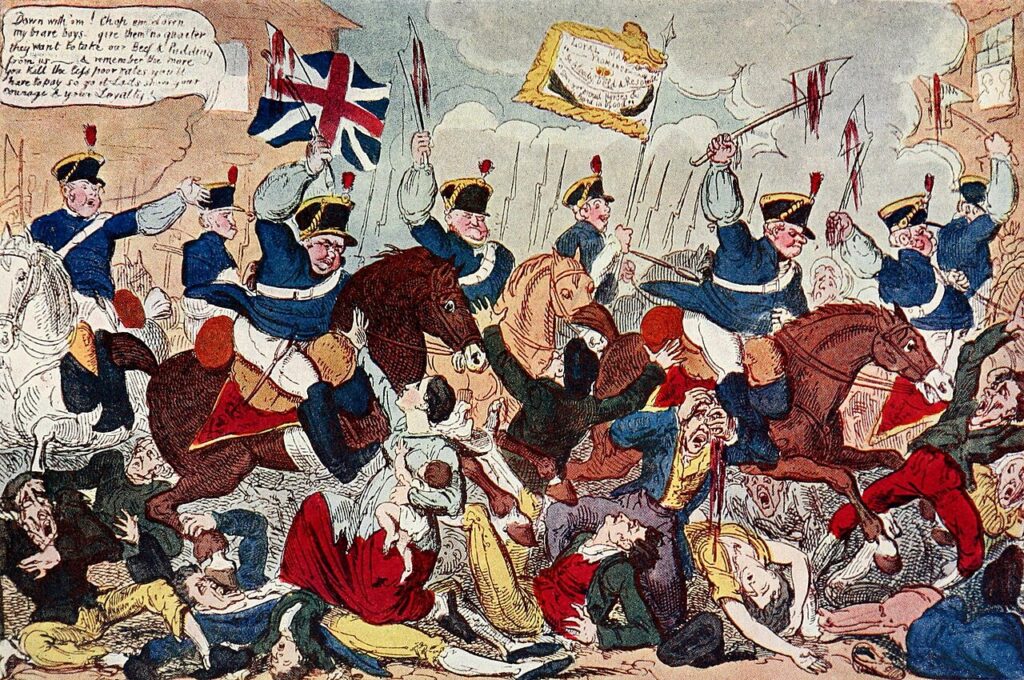
If I ask you to free-associate on the regency era, you may think of Jane Austen novels, racy TV show Bridgerton with its empire waists and elegant balls, or even Hugh Laurie in Blackadder the Third. The more politically-minded might perhaps think about the Napoleonic Wars, or even the 1819 Peterloo Massacre of demonstrators gathered in Manchester to call for electoral reform in the UK. It was this event that launched freethinking radical publisher Richard Carlile (1790-1843) into public view and catalysed the course of his life thereafter.
Carlile, as has been briefly noted in The Skeptic before, was a significant figure in the history of skepticism who is largely forgotten today. He spent nine years of his life in jail on matters of principle around the freedom of belief and freedom of expression. While people from across the political spectrum today would consider these basic human rights, he also campaigned for causes that remain controversial, from anti-monarchism to sexual freedom.
Carlile was brought up a strict Anglican, but when hard financial times led him to question traditional values, he began to supplement his income by distributing radical papers, Cobbett’s Weekly Political Register and The Black Dwarf. By 1817 he partnered with William Sherwin – who was just 18 years old – to publish his own newspaper, Sherwin’s Political Register. When Carlile was invited to speak at the St Peter’s Field protest in Manchester, calling for electoral reform, he became a first-hand witness to the horrific events that unfolded, leaving 18 people dead and many hundreds injured. He escaped the authorities – this time – and he published an account of the events in Sherwin’s Political Register, advertised with the words “Horrid Massacres at Manchester”.
Carlile’s bookshop and publishing house was quickly raided and shut down, but this just led to him immediately founding a new publication, the even more radical Republican. This activity, alongside his publication of Thomas Paine’s long-banned The Age of Reason, culminated in prosecutions that kept him locked up until 1825 and led to a further 150 of his distributors and associates finding themselves jailed.
The forbidden fruit tastes the sweetest
Of particular interest to skeptics is his (unsuccessful) defence against blasphemous libel for his republication of The Age of Reason. In a letter to The Society for the Suppression of Vice, he insisted repeatedly that discussion of the basis and content of religion must be allowed:
On what ground must the established and dissenting codes of religion of which you boast…. be raised, when a small volume of enquiry into its origin shakes its very centre, and threatens a total annihilation?
During his defence, he added that in a free country the courts should not be responsible for adjudicating between opinions on religion:
[T]here is no Court of justice competent to try a question of honest difference of opinion on religious matters.
While he still refrained in this defence from any overt embrace of atheism – not least because he was, after all, hoping to be acquitted – his prosecutions and the publications he and his supporters made detailing them massively expanded the reach of his arguments, as the kerfuffle caused by the case drew public attention and drove sales of The Republican.
Once in prison, Carlile went on to declare himself an atheist in that very newspaper, and he has been widely credited as the first living person to openly declare himself as such in print, with repeated statements in different issues of The Republican:
It is not till since my imprisonment that I have avowed myself Atheist… There is no such a God in existence as any man has preached
While this uncompromising approach led to many other social reformers distancing themselves from him, the seeds had been sown and a very much wider public had now had the opportunity to read skeptical accounts of religion. Ultimately, this attempt by the authorities to silence the replication of a deist tract had inadvertently led to the first mass exposure of the British public to full-blown atheism.
Men of science, men of society
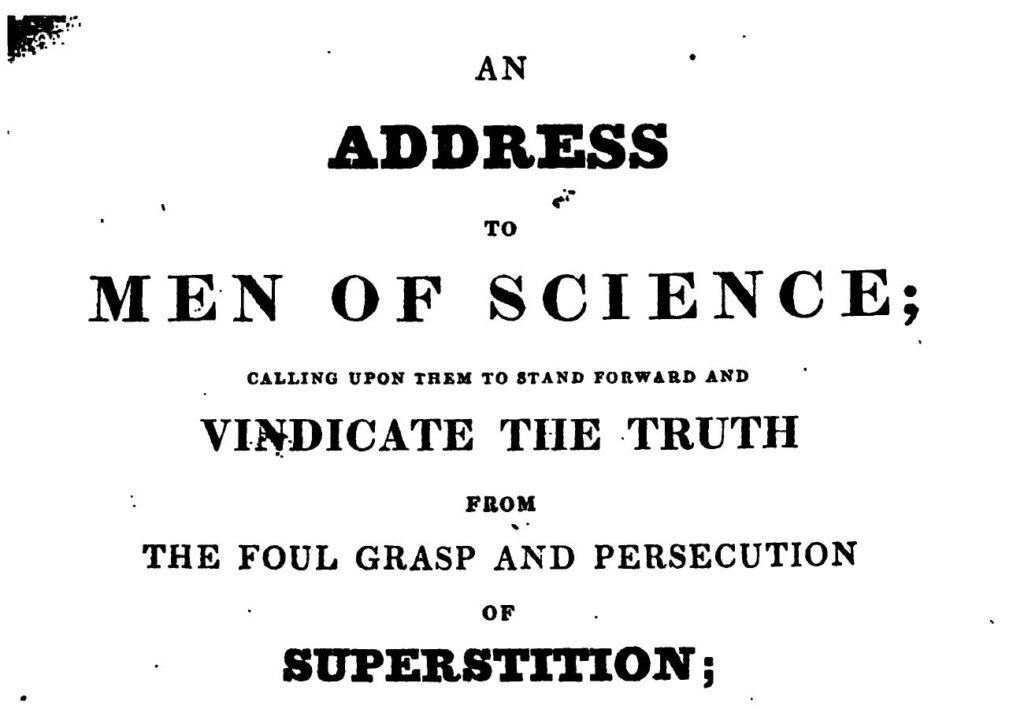
While in prison Carlile wrote An Address to Men of Science (1821). While Carlile had no formal education and was not a scientist himself, he was well read and drew on scientific advancement that was increasingly popularised through cheap printed summaries of scientific proceedings. As such, he was very aware of the logical endpoint of many recent discoveries, even while the scientists themselves often softened or distanced themselves from the materialist conclusions that could fairly be drawn from their own work.
Carlile attacked scientists for such behaviour, in particular relating to the treatment of surgeon Willian Lawrence, whose materialist beliefs were in opposition to the vitalist beliefs of the day, a debate summarised by Michael Rectenweld (2016):
This foray inaugurated the early nineteenth-century vitalism-materialism debate, which focused on the question of life: was life a substance or vital influence imparted on matter from without (vitalism), or was it autotelic by virtue of an auspicious set of material conditions, including organization (materialism)?
Vitalism was of course more fitting with the prevailing Christian thought of the time and so Lawrence’s work was found to be blasphemous, and effectively banned or censored. His book therefore lost its copyright and so was open to Carlile to republish, making the work more widely available.
In Men of Science, Carlile did not stop at anatomy:
My present address is chiefly confined to those Philosophers, who study and practice the sciences of Chemistry and Astronomy. I shall endeavour to point out to them that they are bound by duty, by common sense, and by common honesty, to make known to mankind, or, more particularly their fellow countrymen, whatever discoveries they may make to prove that the others are following a system of error… they have not hitherto done this… because the institutions of the country were connected with them; or, because they feared to offend those persons who might be deriving an ill-gotten profit from them.
He calls out scientists for their vested interests and for being fearful, though such nervousness was quite understandable, given the significant threats to WIlliam Lawrence’s career and even liberty that his materialist publications risked.
Carlile is not just a strong advocate of a materialist explanation; he extends it to a logical conclusion:
…we should consider ourselves but as atoms of organized matter, whose pleasure or whose pain, whose existence in a state of organization, or whose non-existence in that state, is a matter of no importance in the laws and operations of Nature… We are of no more importance in the scale of Nature than those myriads of animalcules whose natural life is but for the space of an hour, or but a moment.
For Carlile, it is the responsibility of scientists to spread their knowledge, expand scientific education for children, highlight natural explanations for the world, and counteract the power of dogmatic and religious controls on society:
It is the duty of the Man of Science to make war upon all error and imposture, or why does he study? Why does he analyse the habits, the customs, the manners, and the ideas of mankind, but to separate truth from falsehood, but to give force to the former, and to extinguish the latter?
…Science must be no longer studied altogether as an amusement or a pastime, which has been too much the case hitherto; it must be brought forward to combat the superstitions, the vices, and the too long established depravities among mankind
Carlile was not, however, immune to the fashionable pseudosciences of the day, not least with his passion for phrenology. He was at least in good company on that error, as many luminaries, like the co-discoverer of evolution, Alfred Russel Wallace and psychiatric reformer William Browne, were proponents of the decidedly dodgy practice of measuring skulls to supposedly reveal mental faculties.
“Sex is a part of nature. I go along with nature.” – Marilyn Monroe
Carlile didn’t restrict himself to science and religion. His advocacy of contraception and female sexual pleasure was truly astonishing for the day, not to mention embarrassing for his associates.
In 1828, Carlile published Every Woman’s Book, which detailed the use of contraceptive sponges, sheaths and the withdrawal method. Carlile’s mentor Francis Place had referenced contraception obliquely in a more scholarly book on overpopulation in 1822, and then anonymously a year later with more explicit instructions on how to use contraception, with the stated aim of reducing the number of children and so reducing poverty. This was obviously an important reason for the use of contraception, and Place is rightly noted as the founder of the birth control movement.
However, Carlile took things a daring step further. Every Woman’s Book was the first mass-market publication with a named author in English that advocated for the use of contraceptives for pleasure, rather than on the basis of avoiding overpopulation.
Carlile was not alone in his work, with women featuring significantly in his life. His wife Jane Carlile shared his politics and also served time for an article published in The Republican. His own correspondence suggests that she was influential in his writing Every Woman’s Book, and particularly the discussion and detail of contraceptive methods.
He was also an advocate of the necessity and normality of sexual pleasure for both men and women, and that since men and women had the same needs they were equal. He noted in Every Woman’s Book “the honourable principle of mutual equality, mutual desire, and mutual pleasure.”
He also suggested that the law should not interfere in people’s sex lives, except with the most modern of caveats:
While violence in this case ought to be punished in the most deterring manner, all other legislation upon the subject, beyond the maintenance of offspring, may be fairly deprecated.
He is not of course entirely modern in his thinking, believing that consumption – tuberculosis – in women was caused by a lack of sex, and that masturbation causes disease, but it is nonetheless a remarkable work for the time.
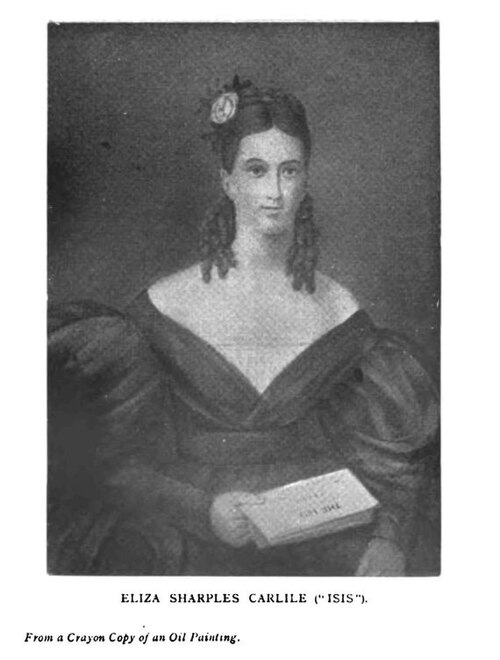
Estranged from his wife Jane in later years, in the early 1830s Carlile entered into a relationship with fellow radical Eliza Sharples, who gave impassioned speeches while he was (again) imprisoned, a living embodiment of the principles they both espoused. While Sharples has sometimes been dismissed as a mere mouthpiece for Carlile’s views while he was in jail, Gail Turley Houston points out that “when Carlile’s agent informed Carlile about Sharples’s request to visit him in jail, it was not so that Carlile could instruct her, but, rather, so that she could “explain her views” to him”.
Furthermore, when she gave radical speeches on the Blackfriars Rotunda while unmarried and pregnant:
…her very body argued for the right of a woman to own her body, make sexual choices for herself, obtain knowledge, and participate unapologetically and fully in the public sphere without fear of reprisal for enacting her reproductive rights and rights of personhood. While Carlile cautioned her to keep the pregnancy quiet, she begged him to make it public; demanding that her male lover accept equal emotional responsibility for the relationship, she expected him to live up to her feminist political commitments.
Richard Carlile died in 1843, and Eliza Sharples nine years later. While his fellow reformers distanced themselves from the thoroughly scandalous Carlile, Sharples was even more thoroughly forgotten, having been denied the opportunity to even speak at public events on women’s rights by other social reformers of the day.